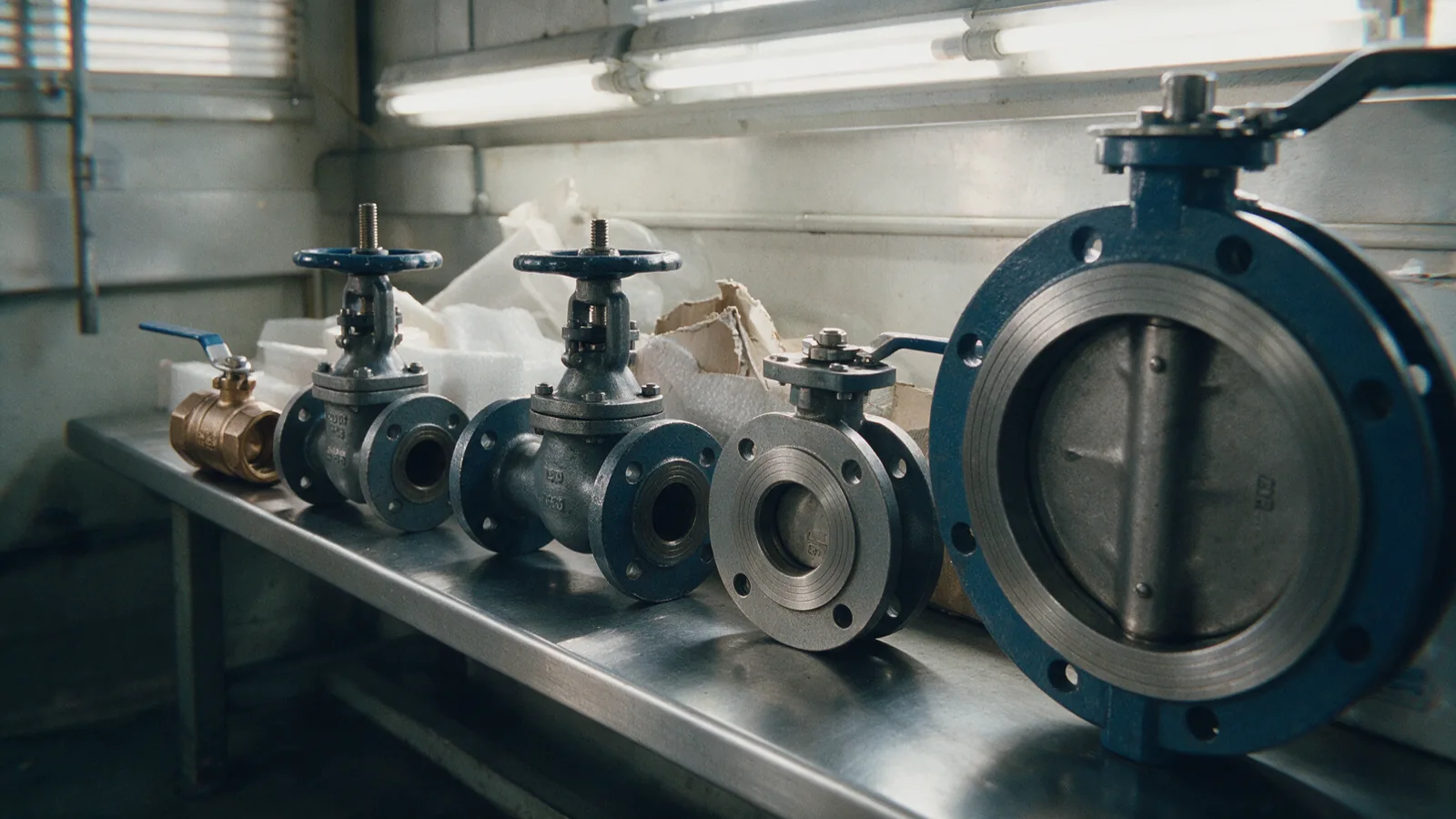
The selection sequence: service condition → type → class → material → ends → documentation
A valve is chosen in a fixed order, and each decision narrows the next. The service condition comes first; everything after it is a consequence. Type follows duty. Pressure class follows the design pressure at the design temperature, read from the rating table in ASME B16.34. Material follows the medium. Ends follow the flange standard the line already uses. Documentation proves the first five were met. Reverse the order and every later step becomes a compromise found at commissioning.
- Service condition
Medium, design pressure, design temperature, line size, duty. Written down, not remembered.
- Valve type
Isolation, throttling, backflow prevention or protection. The duty picks the family.
- Pressure class
The ASME B16.34 class whose curve clears design pressure at design temperature, with margin.
- Body and trim material
Compatible with the medium at temperature: corrosion, erosion, embrittlement, hardness limits.
- End connections
Flange class and facing to ASME B16.5, face-to-face to the matching dimension standard, gasket to B16.20.
- Test and documentation
Shell and seat tests, leakage class, inspection certificate type. Agreed before the order, not after.
Step 1: write the service condition down. Medium, design pressure, temperature, size, duty
Five fields, and all five are needed before anyone can quote. Medium names the fluid and what it carries: chilled water with glycol, seawater, saturated steam, sour gas with wet H₂S. Design pressure is the relief set point, not the normal operating figure. Design temperature is the hottest or coldest case the body will see; for steam it is fixed by pressure. Size is nominal bore and the existing connection. Duty is what the valve does: open or shut, modulate, prevent reverse flow, or protect.
How far five fields take the selection
Before a product is named, the service condition has fixed the valve family, the class, the material and the documents to cite. The matrix below shows six duties common in the Gulf.
| Service condition | Duty → type | Class (ASME B16.34) | Body / trim | Governing documents |
|---|---|---|---|---|
| Chilled water, 16 bar g, 6 °C, DN 200 | Isolation → butterfly or gate | 150 (PN 16) | Ductile iron, EPDM seat; 316 disc if glycol-free | ASME B16.34 · B16.5 · ISO 5208 |
| Potable water, 10 bar g, 25 °C, DN 50 | Isolation → ball | 150 | DZR brass or lined carbon steel; approved elastomers | ASME B16.34 · ISO 5208 · WRAS / NSF 61 |
| Seawater, 16 bar g, 35 °C, DN 300 | Isolation → butterfly (lined) or ball | 150 | Super duplex or 6Mo trim; rubber-lined body | ASME B16.34 · ISO 5208 · ASTM G48 |
| Saturated steam, 10 bar g (184 °C), DN 100 | Isolation → gate or globe | 300 | Cast carbon steel A216 WCB; 13Cr trim | ASME B16.34 · B16.5 · API 598 · API 600 |
| Hydrocarbon gas, 51 bar g, 60 °C, NPS 6 | Isolation → trunnion ball | 600 | Forged A105 / A350 LF2; NACE-limited hardness if sour | API 6D · API 598 · API 607 / 6FA · ISO 15848-1 · NACE MR0175 |
| Condensate return, 3 bar g, 120 °C, DN 40 | Backflow prevention → swing or dual-plate check | 150 | Bronze or carbon steel; stainless disc | ASME B16.34 · API 598 |
Step 2: valve type by duty. Isolation, throttling, backflow prevention, protection
Duty picks the family before size or price. Isolation wants a full-bore, tight-shut valve: gate for large bores, ball for quarter-turn speed, butterfly where weight and face-to-face length dominate. The trade-offs are set out in gate, ball or butterfly? and the comparison page. Throttling wants a characterised plug and a body that tolerates the pressure drop. A gate valve throttled half-open erodes its own seat. Backflow prevention is a check valve, sized for the minimum flow that holds the disc open, not the line size. Protection means pressure-reducing and safety valves, covered in steam, pressure and protection. A valve asked to do two of these jobs does neither well.
Step 3: pressure class under ASME B16.34. How a class becomes an allowable pressure at temperature
A pressure class is not a pressure. Class 150, 300, 600, 900, 1500 and 2500 are labels for curves. For each body material group the standard tabulates the allowable working pressure at a series of temperatures, and that pressure falls as temperature rises. Take material group 1.1, forged A105 and cast A216 WCB carbon steel: a Class 150 valve is rated at about 19.8 bar g at 38 °C but only about 13.8 bar g at 200 °C, while Class 300 holds about 48.6 bar g at 200 °C. Find the design temperature on the curve, read the allowable pressure, and take the lowest class that clears the design pressure with margin. The ASME B16.34 ratings guide works through the tables class by class.
A class number is not a pressure. It is the name of a curve. Read the allowable pressure at the design temperature, compare it against the relief setting, and take the lowest class that clears it with margin. Choosing a class because its number resembles the line pressure is folklore, not the table.
Reference values. Confirm against the current edition of the standard and the manufacturer's rating table.
Step 4: body and trim material by medium. Carbon steel, stainless, bronze, ductile iron, and when each fails
Material follows the medium, and every material has a documented failure mode. Carbon steel (A216 WCB, A105) is the default for steam, hydrocarbons and clean water above ambient. It rusts in oxygenated water and loses toughness below about −29 °C, where A352 LCB or A350 LF2 take over. Austenitic stainless (CF8M / 316) resists general corrosion but pits in chlorides, which is why seawater trim moves to super duplex or 6Mo alloys proven under ASTM G48. What a super duplex line item must name is set out in super duplex valve materials for seawater. Bronze and DZR brass suit small-bore water and low-pressure steam but dezincify in aggressive water. Ductile iron is economical for chilled and condenser water at Class 150 / PN 16 but is excluded from many hydrocarbon and steam specifications. Sour service adds a hardness ceiling from NACE MR0175 / ISO 15156 for trim, bolting and welds.
| Medium | Usual starting point |
|---|---|
| Chilled water | Carbon steel or ductile iron body; bronze or stainless trim |
| Potable water | DZR brass, or an approved lining, with certified elastomers |
| Seawater | Super duplex or 6Mo alloy, proven under ASTM G48 |
| Steam | Carbon steel (A216 WCB); chrome-moly alloy steel at high temperature |
| Hydrocarbon | Carbon or low-alloy steel; hardness per NACE MR0175 when sour |
Step 5: end connections and face-to-face under ASME B16.5 and B16.20 gaskets
The valve has to bolt to the line that already exists. ASME B16.5 fixes flange dimensions, facing, bolting and ratings for NPS ½ through 24; above that, B16.47 applies. European lines use EN 1092-1 PN flanges whose bolt circles do not match ASME patterns. A Class 150 valve does not fit a PN 16 flange without adaptation. Face-to-face length comes from the dimension standard for the valve family (ASME B16.10, or API 6D for pipeline valves), and a valve with the wrong face-to-face cannot be installed without re-piping. Gasket type follows ASME B16.20 for spiral-wound and ring-joint gaskets; the gasket material must suit the medium at temperature.
Step 6: test and certification scope. API 598, ISO 5208 leakage rates, fire-safe and fugitive-emission tests
Testing is where the specification becomes evidence. API 598 defines the shell, backseat and seat closure tests a valve passes before it ships, and the allowable leakage. ISO 5208 grades seat leakage in rate classes from bubble-tight Rate A upward. Naming the class removes an argument at the test bench. Two further qualifications sit outside the pressure rating. Fire-safe type testing under API 607 (quarter-turn, soft-seated) or API 6FA (the API 6D family) proves a valve still seals after its soft seat has burned away. The difference is covered in fire-safe valves: API 607 vs API 6FA. Fugitive emission classification under ISO 15848-1 grades stem sealing by tightness class and endurance cycles; how the fugitive-emission classes read on an order has its own guide. None of this is implied by the class stamp; each has to be asked for.
Reference values. Confirm against the current edition of the standard and the manufacturer's rating table.
Worked example: chilled-water versus steam-line isolation valves
Two isolation valves, same size, opposite answers. The chilled-water line runs at 16 bar g and 6 °C, DN 200, isolating a chiller. Nothing corrodes at 6 °C. The risk is a seat that passes when shut, drifting the return temperature and costing pump power. A Class 150 (PN 16) ductile-iron butterfly valve with an EPDM seat clears the rating with margin and shuts tight at low cost. The steam line runs at 10 bar g saturated, DN 100. Temperature is not a choice: 10 bar g saturated is 184 °C. A Class 150 carbon-steel body, rated at roughly 14 bar g there, is marginal against the relief setting, so Class 300 is the answer. That means a cast-steel gate valve to API 600 with 13Cr trim, tested to API 598, with an EN 10204 3.1 certificate. Same duty word, different valve in every column.
Rate the body against the relief setting at the design temperature, never against the operating line. A valve that is merely adequate at normal conditions is replaced after the first upset.
Governing standards and the “confirm against the current edition” rule
The documents that govern selection are published and revised on their own cycles: ASME B16.34 for ratings, wall thickness and shell testing; ASME B16.5 and B16.20 for flanges and gaskets; API 600 for steel gate valve design, API 598 for inspection and test, API 6D for pipeline valves and API 607 / 6FA for fire type tests, all listed by the American Petroleum Institute; ISO 5208 and ISO 15848-1 from ISO; NACE MR0175 for sour service; EN 10204 for inspection documents. Every figure here is reference data from those documents. The glossary says what each document fixes and where it is silent.
Reference values. Confirm against the current edition of the standard and the manufacturer's rating table.
The two buyer mistakes: too cheap, and over-engineered
Selection fails in two directions. Too cheap is the valve chosen on unit price: the rating is marginal, the seat material is wrong for the glycol or the chloride, the test certificate is generic. The purchase saves a few percent, then the line is shut down once a year to replace it. Over-engineered is the opposite reflex: Class 600 stainless for a Class 150 chilled-water duty. It is safe, and it is paid for three times, in price, in weight on the pipe supports, and in lead time. The service condition, written down at step 1, stops both. It makes the right class and material a calculation, not a preference.
Documentation to request with the quotation
Ask for the paperwork when the quotation is requested. Documents that were never ordered cannot be produced later. The baseline list for a specified valve:
- Manufacturer's pressure-temperature rating table for the exact body material and class quoted.
- Material test certificate to EN 10204: type 3.1 for pressure-retaining parts on steam, hydrocarbon and sour duties; 2.2 is the usual floor for building services.
- Shell and seat test report to API 598 or ISO 5208, with the leakage class stated.
- Fire type-test and fugitive-emission certificates where the specification calls for them, naming the standard and the qualified size range.
- General arrangement drawing with face-to-face, flange facing and bolting, and the nameplate data.
What a buyer should demand, and what each document proves, is covered in sourcing and documentation. The European standard a pressure test line may name, and what its publishers' records do and do not settle, is set out in EN 12266-1 valve pressure testing.
Related product lines and category pages
The method resolves to the industrial valves category: ball, gate, globe, check, butterfly and knife-gate valves. Where the duty is protection or flow balance, it resolves to pressure-reducing, safety and steam valves and HVAC and district-cooling valves. The product lines we supply span those categories, and technical support and testing is how an enquiry becomes a checked specification. Availability, lead time and price for any item are To confirm per enquiry.
Articles in this cluster: selection, ASME B16.34 ratings, gate vs ball vs butterfly, fire-safe valves, super duplex, fugitive emissions, actuator mounting, seat leakage classes, EN 12266-1 pressure testing
This guide is the spine of the valve-selection cluster. Each article below takes one step deeper:
Which valve does this service actually need?
Selection by medium, pressure and temperature, case by case.
Step 3ASME B16.34 pressure-temperature ratings explained
Class 150 to 2500, by material group.
Step 2Gate, ball or butterfly?
Isolation valves compared for size, cost and duty.
Step 6Fire-safe valves: API 607 vs API 6FA
And when a specification needs them.
Step 4Super duplex valve materials for seawater
UNS S32760 (F55) on a purchase order.
Step 6ISO 15848-1 fugitive emission classes
Tightness, endurance and temperature on an order.
Step 5ISO 5211 actuator mounting pads
What the F number fixes, and what it does not.
Step 7Control valve seat leakage classes
What ANSI/FCI 70-2 rates, and why it is not an isolation test.
Step 8EN 12266-1 valve pressure testing
What the European pressure test standard covers, and what sits outside it.
The other three pillars are listed in the guides library: district cooling and HVAC, steam and pressure protection, sourcing and documentation.
Next step: send an enquiry with the service condition pre-framed
An enquiry that arrives as a service condition is answered as a specification; one that arrives as a part number is answered as a price. State the medium, pressure, temperature, size and duty, and the reply can name the class, material, test scope and documents. Price, lead time and availability are confirmed per enquiry.