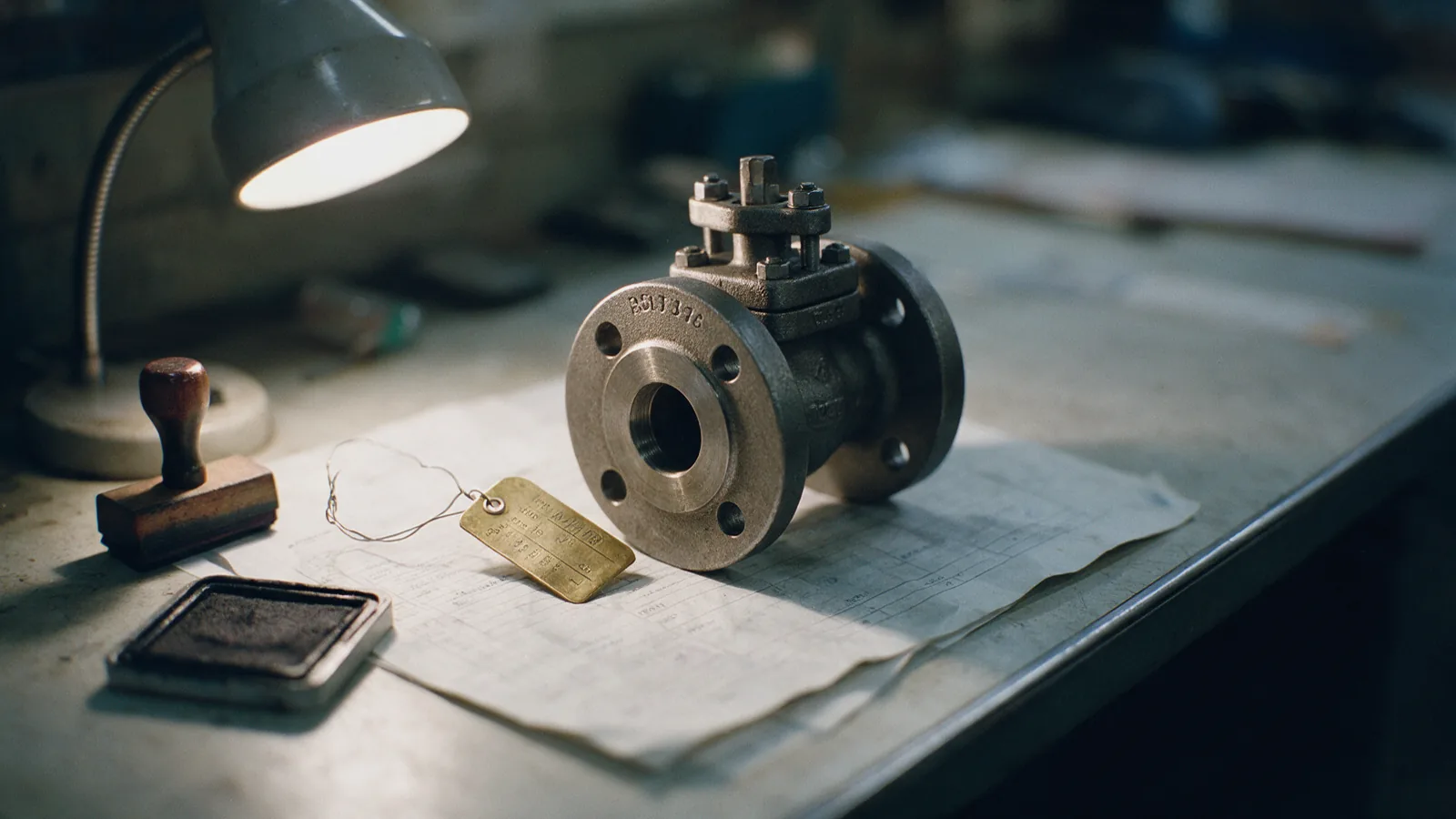
The four buyer questions: why the fourth decides the job
Every valve enquiry turns on the same four questions, ranked in the wrong order. Price and lead time are negotiable. Stock moves daily. Paperwork is decided at the moment of order and can never be recovered. A certificate not ordered with the valve does not exist.
Real only when it prices the same specification: class, trim, tests and documents.
Confirmed per enquiry, against the documentation level ordered. A 3.2 certificate adds an inspection visit.
A claim to verify, not to assume: what is on the shelf, where, and with which certificates.
Decided at order, impossible to backfill. The document ledger below is this question, expanded.
The paperwork ladder: what each document proves, and what it does not
Valve documentation is a ladder, each rung proving one thing. Disputes at goods-inward start when a document is read as proving something it never claimed. The ledger states what each one establishes.
| Document | What it proves | What it does NOT prove |
|---|---|---|
| EN 10204 type 2.2 | The maker declares compliance, with non-specific test results typical of production | Anything about the actual heat in your valve |
| EN 10204 type 3.1 | Specific results for the actual heat, certified by the maker's production-independent inspectors | Independent witnessing. The certifier is still the manufacturer |
| EN 10204 type 3.2 | The 3.1 content, countersigned by the purchaser's representative or a third party | Seat tightness or function: a material document, not a test report |
| API 598 / ISO 5208 test report | This valve passed shell and seat tests at the stated leakage rate | Material chemistry, fire safety, or storage since the test |
| API 607 / API 6FA type test | A representative valve of the design family survived the fire test | That your serial was ever fire-tested. Type tests qualify designs, not units |
| ISO 15848-1 classification | The design achieved an emission tightness class over an endurance cycle count | Emissions of the production valve, unless a production test is specified |
| NACE MR0175 / ISO 15156 compliance | Materials and hardness sit within the standard's sour-service limits | Fitness for your sour severity. The buyer defines the environment |
| API monogram | The product was made under an API-licensed quality system to the named specification | Anything outside the licensed scope. It never replaces the test reports above |
Test reports: API 598, ISO 5208, leakage rates, witnessed versus unwitnessed
API 598 and ISO 5208 govern the pressure tests a valve passes before it ships. A shell test proves the body. Seat tests prove closure at a stated allowable leakage. ISO 5208 sets seat tightness as rate classes, so naming a class turns an argument into a number. An unwitnessed report is the manufacturer's record of its own routine test. A witnessed test puts the purchaser's or a third party's inspector at the bench. Say which you require in the enquiry: a witness cannot be added after the valve is boxed.
Certification marks: API monogram, CE / PED, fire-safe and emission certificates
Marks and type-test certificates qualify designs and quality systems, not individual units. The API monogram licenses a manufacturer to mark products made to a named API specification under an audited system, as far as the licence's scope. CE marking under the EU Pressure Equipment Directive covers pressure equipment placed on the European market. Fire-safe certificates cite API 607 or API 6FA. Fugitive-emission classes cite ISO 15848-1. Sour service cites NACE MR0175 / ISO 15156. Every certificate names a design, a size range and a revision. Check that your valve falls inside all three.
Reference values. Confirm against the current edition of the standard and the manufacturer's rating table.
Traceability: matching the certificate to the valve on the pallet
A certificate is only evidence when it ties to the object. The heat number on the body must match the heat number on the material certificate. The serial on the test report must match the nameplate. Markings must survive painting and packing.
A certificate that cannot be matched to the heat number on the body is a photocopy, not evidence. Check traceability on the pallet, with the paperwork in hand. Not in a folder six months later.
The goods-inward rule
Make the match a receiving step: certificate to heat number, report to serial, marking to specification. Five minutes per crate is the last moment a documentation gap is still the supplier's problem.
Sourcing in the UAE: trading houses, manufacturer offices and specialist suppliers
The UAE valve market is deep but uneven. Know which kind of counterparty is quoting. The three types answer the four questions differently:
Broad catalogue, fast quotes, price-led. Documentation is passed through, not owned. Use the ledger above as the checklist.
Deep on one brand, authoritative on its data and certificates. Structurally unable to say when a different maker fits the duty better.
Carries selected lines and engineering capability. Reads the service condition, names the standard, treats the document pack as part of the product.
One email separates them. Send a service condition: medium, pressure, temperature, size, duty. See whether the reply is a selection with a document list, or a price. Flowsynergy answers under technical support and testing.
Trading brands we supply
Flowsynergy Solutions Limited supplies industrial valves, pipeline fittings and flow-control equipment into Dubai, the UAE and the wider Gulf, from Level 41, Emirates Towers. Our trading brands are KITZ, DFT, Etelec, KVC UK Ltd and Vogt. No appointment status is claimed for any of them.
Full detail is on trading brands, and the categories on industrial valves. Stock and lead time are To confirm per enquiry.
Worked example: the document pack for flanged gate valves on an oil & gas utility line
A contractor buys Class 300 flanged carbon-steel gate valves for an oil & gas utility line. The specification calls for API 600 construction, so the enquiry names the document pack. EN 10204 3.1 certificates for the pressure-retaining castings, matched by heat number to the bodies. API 598 shell and seat test reports per valve. The maker's pressure and temperature rating table for the material group. A fire-safe type-test certificate, because the line ties into a hydrocarbon system. The QA plan asks for one valve in ten witnessed, stated in the enquiry. At delivery, goods-inward matches certificates to heat numbers on the pallet. Nothing in the pack was expensive; all of it was ordered on time.
Governing standards and the “confirm against the current edition” rule
The instruments in this guide are published documents on their own revision cycles: EN 10204 for inspection documents; API 598 and ISO 5208 for pressure testing; API 607 / API 6FA for fire type tests; ISO 15848-1 for fugitive emissions; NACE MR0175 / ISO 15156 for sour service; the API Monogram Program rules for marking. Every description above is reference data. The current edition and the project specification govern. The glossary defines each term.
Reference values. Confirm against the current edition of the standard and the manufacturer's rating table.
Buyer mistakes: the certificate that does not match, and paper the spec never required
The two failure modes mirror each other. The first is accepting paper at face value: a 3.1 certificate whose heat number matches nothing on the pallet, or a fire-safe certificate for a different size range. A five-minute check at receiving catches both. The second is over-ordering the ladder: 3.2 certification with third-party witnessing where the specification asked for 2.2. That costs money and weeks of lead time, and proves nothing the project needed proven. Demand the document level the specification names, and none more.
A pre-order checklist to copy into the enquiry
- Service condition: medium, design pressure and temperature, size, end connection, duty.
- Construction standard (e.g. API 600 / API 6D) and pressure class.
- Material certificate type per EN 10204 (2.2, 3.1 or 3.2) for pressure-retaining parts.
- Test report per API 598 or ISO 5208, with the leakage rate class, witnessed or unwitnessed.
- Type-test certificates required: fire-safe (API 607 / 6FA), fugitive emission (ISO 15848-1), sour service (NACE MR0175).
- Marking and traceability: heat numbers on bodies, tag numbers, nameplate data.
Named brands in the enquiry, and every quotation that returns is comparable: same metal, same tests, same paper.
Related pages and the next step
The supply behind this guide is set out on product lines, industrial valves and technical support and testing. Selection method is the valve selection pillar. Two articles go deeper: valve documentation, MTCs and test certificates and choosing a valve supplier in Dubai. The rest of the library is at insights. When the enquiry is ready, send it through the contact page.