Infrequent, full-bore duty
Steam and hydrocarbon mains, pump suctions and pigged lines. Anywhere the valve opens twice a year and must cost the flow nothing. Metal seats take temperature that retires every soft seat.
A ball valve suits clean liquids in small lines that cycle often: tight shut-off, quarter-turn speed. A butterfly valve wins on large-bore water where cost, weight and space dominate. A gate valve suits infrequent full-bore isolation on steam, hydrocarbon and hot lines. Size, medium, temperature and cycling frequency decide, not habit.
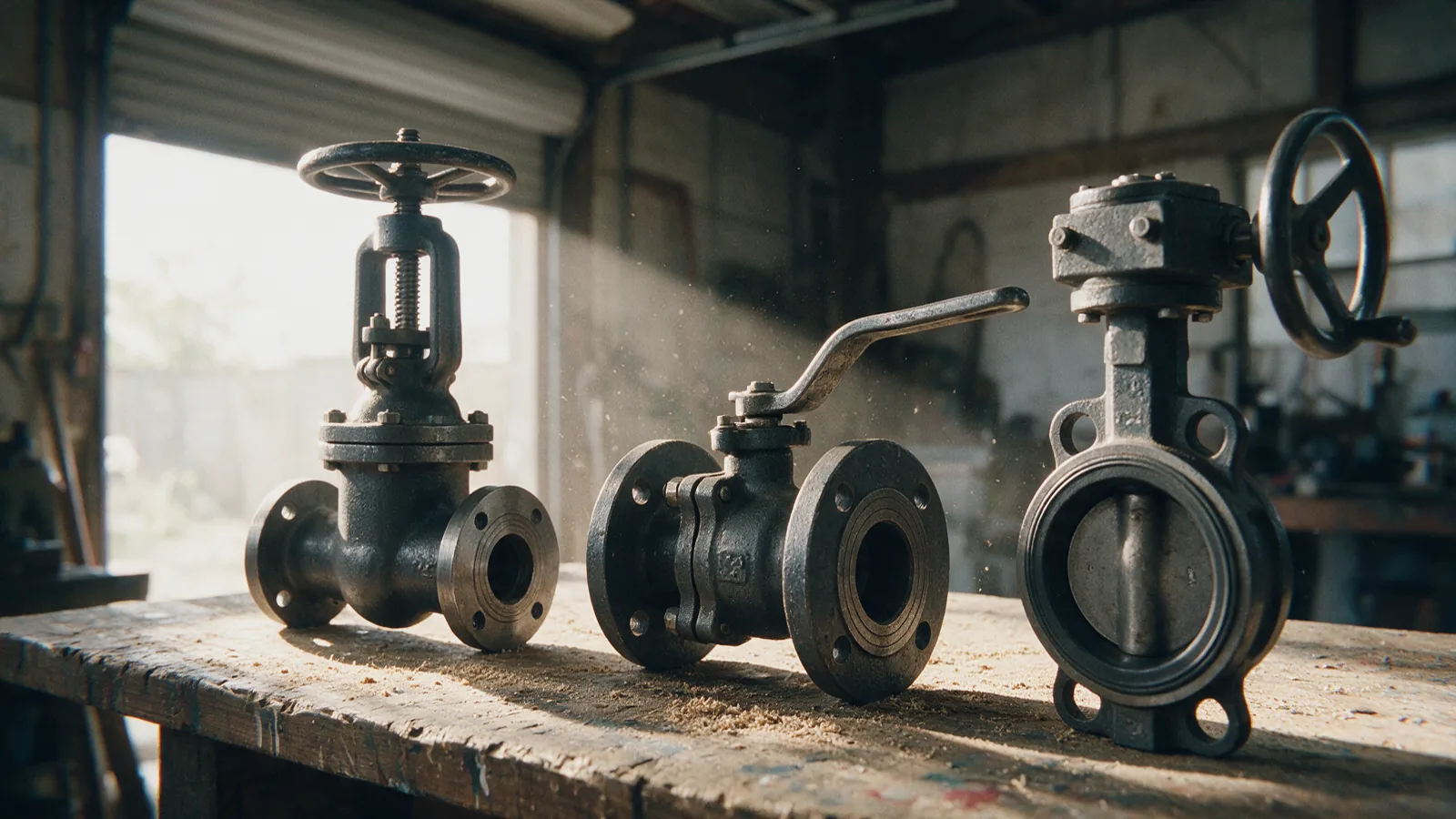
All three valves do the same job: fully open or fully shut. The choice is decided by everything around the job. Ball for clean media in small and medium bores that cycle often and must shut bubble-tight. Butterfly for large-bore water, where its weight, length and price advantage grows with size. Gate for infrequent full-bore isolation on steam, hydrocarbons and hot lines. Size, medium, temperature and cycling frequency decide; habit does not.
The comparison prevents two opposite buying mistakes. Too cheap: a plain wafer butterfly on a dead-end line, or a soft-seated ball on a hot line. It saves money until the duty finds the weakness. Over-engineered: a trunnion ball valve on a chilled-water riser. A lugged butterfly does the same at a fraction of the weight and cost. Still deciding the service condition? Start from the valve selection guide; all six supply types are on the industrial valves page.
A gate valve lowers a wedge across the flow. Sealing is metal on metal, energised by stem thrust and line pressure. Its bore is the pipe's bore, so it costs the flow nothing when open. Every closure drags the wedge across its seats, so wear arrives as slow seepage. A ball valve rotates a bored sphere between two spring-loaded soft seats. Closure is fast, repeatable and bubble-tight until heat, debris or abrasion attacks the polymer.
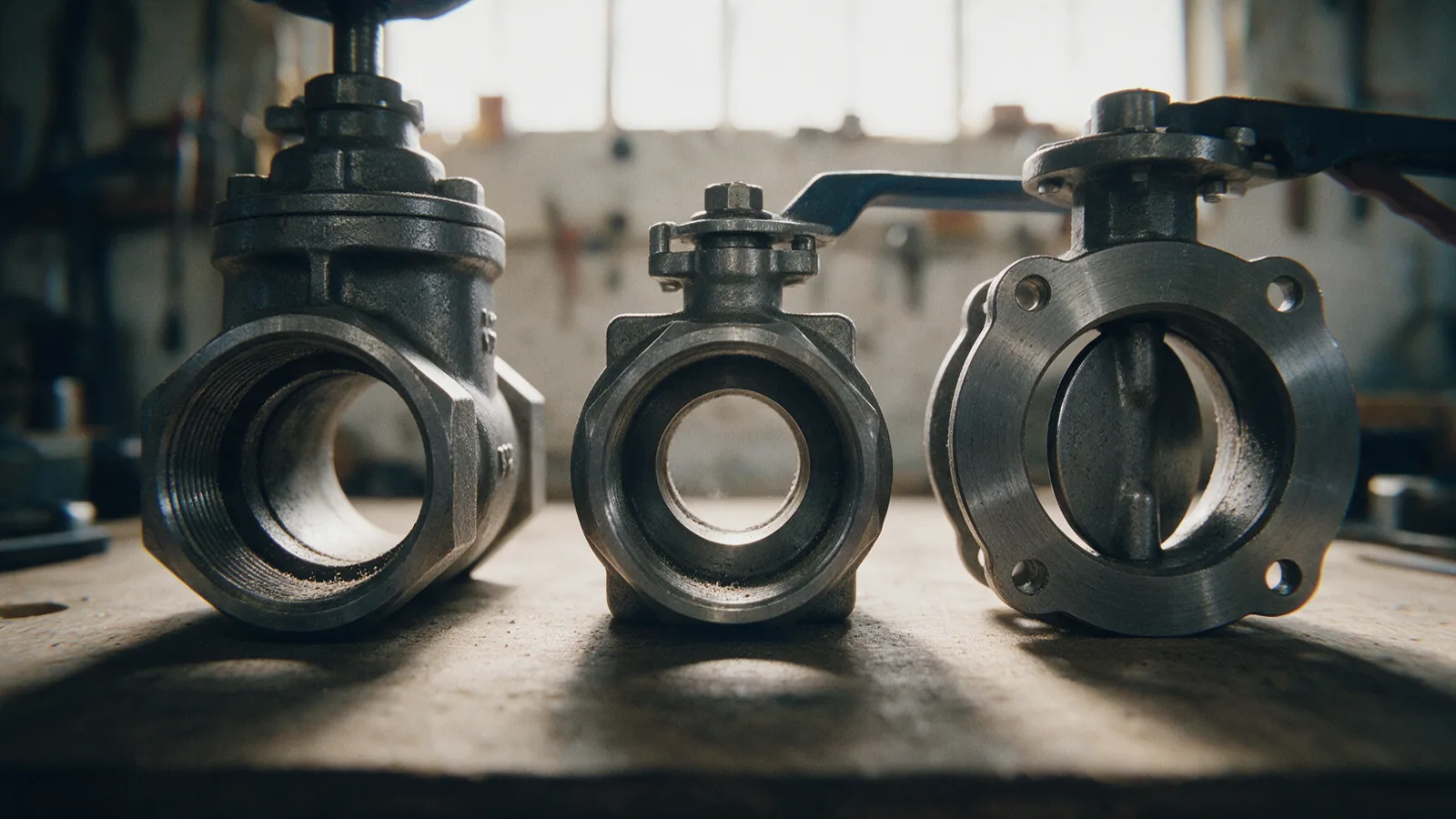
A butterfly valve pivots a disc about its own diameter. In the resilient-seated pattern the disc edge presses into an elastomer liner. That liner is both seat and body lining. It explains the butterfly's profile: tight shut-off and low cost at moderate ratings. The service limit is whatever the liner can bear. The figure below shows the three bores: full passage, ported sphere, disc in the stream.
Ten criteria, three contenders. The lifted cell wins its row. Rows with no lifted cell are decided by the system, not the valve. Read the table as a shortlist tool, not a verdict. Almost every real line has one criterion that outranks the others. A full bore a pig demands, a face-to-face the plant room fixes, a shut-off class, an actuator torque. Find that criterion first, read its row, and treat the other nine as the cost of that choice. Size thresholds are working conventions, not standard limits. Pressure ratings come from the material group in ASME B16.34, not the valve type.
| Criterion | Gate | Ball | Butterfly |
|---|---|---|---|
| Bore and pressure drop | WinnerFull, straight bore: the lowest loss of the three, and pigs and scrapers pass | Full-port bores match the pipe; reduced-port saves cost at a small loss | The disc stands in the stream at every opening: a permanent pressure drop |
| Shut-off tightness | Metal seats; tightness declines as the seat wears | WinnerSoft seats give bubble-tight closure, cycle after cycle | Resilient liner seals tight at its rating; offset designs extend it |
| Speed of operation | Multi-turn and slow, a feature where surge must be avoided | WinnerQuarter-turn in seconds | Quarter-turn, geared down at large sizes |
| Throttling | Never: the disc chatters and wire-draws | Limited, with a characterised ball and the maker's blessing | WinnerCoarse flow control on water, within the maker's opening range |
| Weight, length and cost at large bore | Heavy, tall and costly as sizes climb | Trunnion designs carry weight and price at size | WinnerWafer and lug patterns: lightest, shortest and cheapest above about DN 300 |
| High temperature and steam | WinnerThe steam-main standard: metal seats take the temperature | Soft seats retire around 200 °C; metal-seated designs cost accordingly | Resilient liners rule out steam; high-performance designs are a different class of valve |
| Solids and slurries | Scale jams the seat pocket | Fibrous solids pack the body cavity | Tolerates dirty water; abrasive duty wears the liner. Heavy slurry is a knife-gate's job |
| Actuation | Multi-turn actuator, long stroke, larger budget | WinnerCompact quarter-turn actuator on an ISO 5211 pad | Quarter-turn; torque grows with size and differential |
| Maintenance in line | WinnerRising stem repacks in place; seats can be lapped | Soft seats and seals renewable; some one-piece bodies are replace-not-repair | Liner renewal means the valve comes out of the line |
| Where it wins | Infrequent, full-bore isolation on steam, hydrocarbons and mains | Tight, frequent, fast shut-off on clean media to about DN 150 | Large-bore water, chilled water and seawater isolation |
The table scores criteria; specification happens in situations. Six cells below: a win and a failure for each contender. Read the failure cells against the line being specified. Most isolation-valve problems in service are one of these weaknesses, found the hard way.
Steam and hydrocarbon mains, pump suctions and pigged lines. Anywhere the valve opens twice a year and must cost the flow nothing. Metal seats take temperature that retires every soft seat.
Asked to throttle, the disc chatters and wire-draws its seats. Asked to close fast, its multi-turn stem cannot. Scaling media jam the seat pocket: the classic stuck riser valve.
Clean liquids and gases to about DN 150, frequent cycling, automation on an ISO 5211 pad. Every duty where bubble-tight closure is the specification.
Soft seats retire around 200 °C. Fibrous solids pack the cavity. At large bore, price and weight climb until the honest comparison is with a butterfly.
Chilled water, seawater and utility water above about DN 100: lightest, shortest, cheapest, tight at its rating. Geared or actuated economically at any size.
A plain wafer valve cannot hold a dead-end line. That duty needs a lugged valve rated for it. Resilient liners rule out steam. Abrasive media wear the liner the seat depends on.
Water and chilled water are the butterfly's home ground above about DN 100, with ball valves taking the small bores. The plant-room detail is on the HVAC & district cooling page. Steam belongs to the gate valve at the mains and metal-seated globes at control points. Resilient-seated butterflies do not attend. Hydrocarbons take all three into qualification: fire type-test, fugitive-emission class and, on sour lines, material limits (section 08).
Seawater is decided by chloride pitting before type. Alloy selection outranks the gate-ball-butterfly question. Concentric rubber-lined butterflies do much of the Gulf's intake and cooling duty. Slurry defeats all three: the gate's pocket scales, the ball's cavity packs, the butterfly's liner abrades. That is what the knife-gate on the industrial valves page is for.
Two ratings govern every candidate. The body follows ASME B16.34 or its PN equivalent: a class read against the material group at design temperature. The seat is the differentiator. Polymer ball seats retire around 200 °C; the exact figure is the maker's. Resilient butterfly liners sit lower still. Metal seats take whatever the body takes. They are the gate's default and the ball's and butterfly's higher-cost option.
The method: fix design pressure and temperature, then eliminate the seats that cannot attend. Compare what survives on cost and duty. The commonest way to buy the wrong valve: compare at cold-water conditions, then install on a hot line.
Reference values. Confirm against the current edition of the standard and the manufacturer's rating table.
Below about DN 50, the ball valve is close to unbeatable: compact, cheap, tight and easy to automate. Between DN 50 and DN 150 ball and butterfly overlap, and the medium decides. Clean process favours the ball's shut-off; plain water favours the butterfly's price. Above about DN 300 the butterfly's advantage compounds. A wafer or lug body weighs a fraction of a trunnion ball or gate. It costs accordingly and fits between existing flanges.
The gate valve holds what the quarter-turn valves surrender. High-class steam and hydrocarbon mains at any bore. Lines where a full straight bore is a process requirement. Torque follows the same curve. Quarter-turn actuation stays compact; gate actuation grows with stroke. That is often the deciding line item; the actuators page carries it.
Three qualifications sit on top of type and rating. Fire type-testing exists because ball and butterfly valves carry polymers a fire removes. API 607 covers soft-seated quarter-turn valves, API 6FA pipeline valves. A certificate is valid only for the size range, class and seat material tested. Fugitive emission under ISO 15848-1 classifies the stem sealing. The quarter-turn stem is easier to seal than the gate's long rising stem. Seat leakage is specified in ISO 5208 rates or the API 598 tables. “Tight shut-off” is not a specification; “Rate A” is.
Every designation is defined in the glossary. The certificates that evidence them are listed in section 10.
Each contender has its own design standard. The shared rating, test and qualification documents make the comparison fair.
| Designation | What it fixes | Kind |
|---|---|---|
| API 600 / 602 / 603 | Bolted-bonnet steel gate valves: standard, compact and corrosion-resistant classes. | Design |
| API 608 | Metal ball valves with flanged, threaded and welding ends. | Design |
| API 609 / EN 593 | Butterfly valves: lug, wafer and double-flanged patterns. | Design |
| API 6D | Pipeline valves (ball, gate, check and plug) for transmission duty. | Design |
| ASME B16.34 | Pressure-temperature ratings common to all three types, read against the material group. | Ratings |
| ASME B16.10 / EN 558 | Face-to-face and end-to-end series, so a replacement drops into the existing spool. | Ends |
| API 598 | Inspection and testing: shell and closure tests, durations and allowable leakage. | Test |
| ISO 5208 | Seat-leakage rate classes A through G: the language shut-off tightness is specified in. | Test |
| API 607 / API 6FA | Fire type-testing of soft-seated quarter-turn valves and pipeline valves. | Qualification |
| ISO 15848-1 | Fugitive-emission classification of stem sealing. | Qualification |
| EN 10204 | Inspection document types: 2.2 non-specific, 3.1 mill-certified, 3.2 witnessed. | Document |
The paper is the same whichever contender wins. Five items, asked on the enquiry. The sourcing & documentation guide explains what a compliant version of each contains.
EN 10204 3.1 for body and bonnet or body and disc, tied to the heat numbers on the castings. All three types alike.
Shell and closure test to API 598 or ISO 5208 stating pressure, medium, duration and leakage rate observed. The document that makes “tight shut-off” a number.
API 607 or 6FA for soft-seated ball and high-performance butterfly valves on flammable service. It must cover the exact size range, class and seat material ordered.
The ASME B16.10 or EN 558 series stated on the order. The same size and class exists in more than one length: the difference between a drop-in and a re-pipe.
ISO 15848-1 tightness and endurance class where the specification calls it up, with the packing arrangement named.
One line we supply covers all three contenders from a single catalogue. A mixed isolation package (gate mains, ball small-bore, butterfly risers) stays in one documentation family. The complete set is on the product-lines page; appointment status with any principal is To confirm. Every selection guide is indexed under Insights.
 KITZIndustrial valves
 DFTCheck valves
 EtelecElectrical connection protection
 KVC UK LtdIndustrial valves
 VogtIndustrial valves
Enquiry Dubai
State line size, medium, design pressure and temperature, operating frequency, throttling and end connection. We reply with the type, class, material group and the documents that should come with it.
Send an enquiry