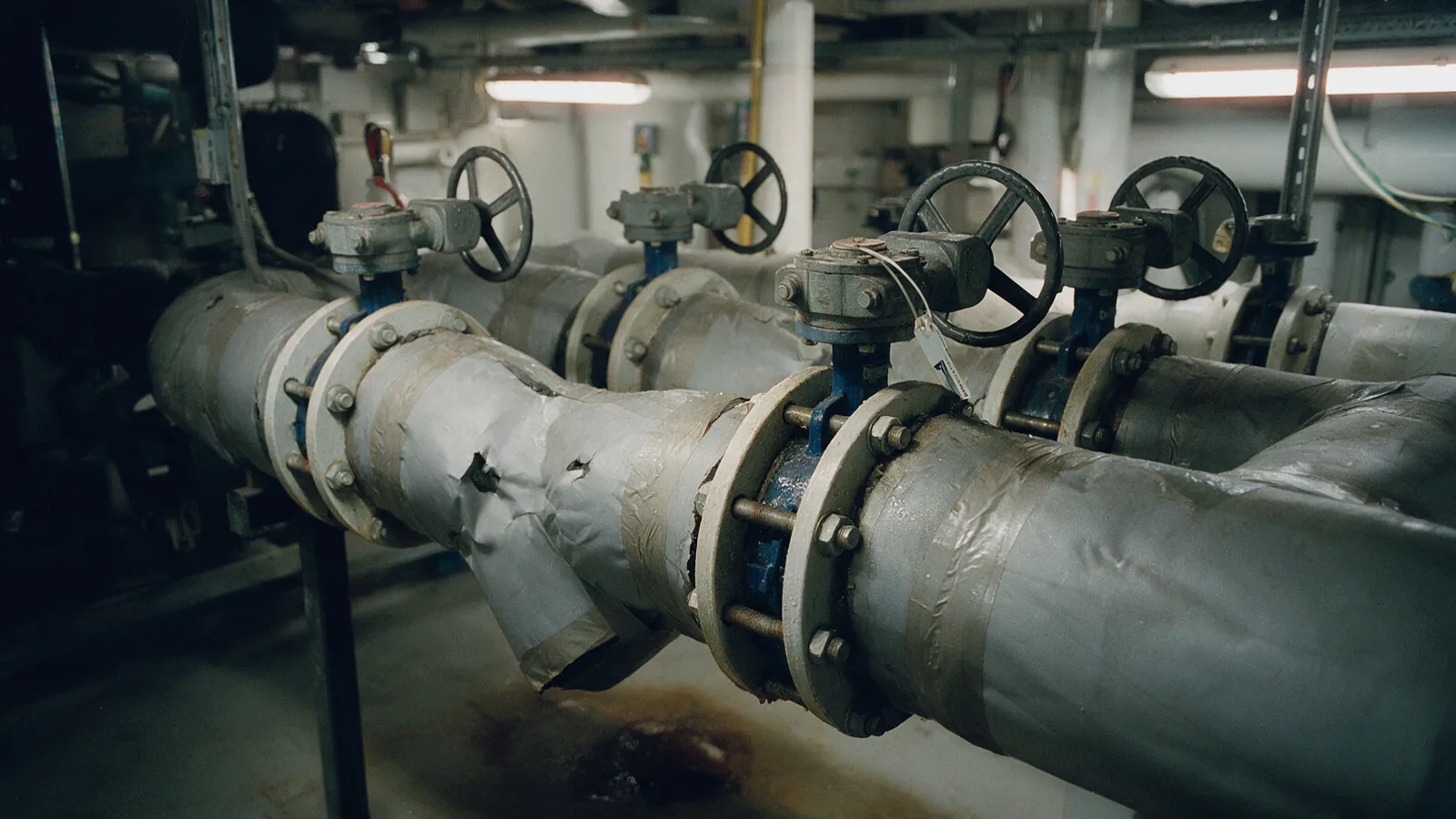
Where each valve sits: terminal, branch, riser, plant room, and what each demands
A chilled-water circuit is not one duty but five, strung in series from coil to plant. Each position asks a different question: limit the flow, prove the balance, isolate the branch, shut the header, stop the reverse. Each selection error has its own signature failure. The ledger below runs the circuit from terminal to plant. It is the cooling companion to valve selection by standard and service condition.
| Position | Duty | Usual valve | What goes wrong |
|---|---|---|---|
| Terminal unit: FCU / AHU coil | Limit and modulate coil flow | PICV; or static balancing valve + two-port control valve | Oversized valve loses authority; the coil never reaches design ΔT |
| Branch / commissioning set | Proportional balance and flow verification | Double-regulating valve with measurement test points | No test points, so the balance can never be proven, only asserted |
| Riser | Balance between floors; isolation for fit-out | Double-regulating valve; differential-pressure control valve on phased fit-outs | ΔP swings after each fit-out un-balance every fixed setting below |
| Plant-room header / chiller | Large-bore isolation for maintenance | Butterfly with gearbox at size; tight shut-off seat | A passing seat blends supply into return and drifts the whole plant's ΔT |
| Pump discharge / ETS interface | Backflow prevention; isolation for service | Non-slam check (dual-plate or nozzle) + isolation valve | A slamming swing check hammers the riser every time a pump trips |
Terminal flow control: PICV versus balancing valve plus control valve
At the terminal the choice is between two philosophies. A pressure-independent control valve combines a differential-pressure regulator, a flow limiter and a control valve in one body. Set the design flow on the dial and the cartridge holds it, whatever the rest of the network does. A static balancing valve with a separate two-port control valve is the older, cheaper pair: it balances at the one condition it was commissioned at, and drifts at every other. The full trade-off is worked through in PICV vs balancing valve, and the chilled-water case in choosing flow control for chilled-water terminals. The more the load varies, the stronger the case for pressure independence.
Mechanical versus electronic PICV: what the actuator actually adds
A PICV does its pressure work mechanically: spring, diaphragm and cartridge need no power. The actuator only strokes the control section. An electronic PICV adds a measured-flow loop and a bus connection, buying visibility and remote re-setting at a price in commissioning skill.
The cartridge already solved the hard problem. Buy electronics for the data and the remote reset, not to fix a balance the cartridge has already fixed.
The position this guide takes: editorial, not a standard
Without a commissioning-grade BMS team, a mechanical PICV with a plain modulating actuator is the honest specification: fewer settings to get wrong, and the flow limit survives a dead actuator.
Risers and branches: double-regulating valves and commissioning sets
Between terminal and plant the job is proportional balance. A double-regulating valve carries a calibrated stem position and test points, so an engineer can measure the flow, set it, lock it and prove it. That discipline is codified in the commissioning guidance of CIBSE. Where fit-out is phased, a differential-pressure control valve across each branch holds the local ΔP steady. A commissioning set puts the DRV and orifice in one assembly, so the test points exist when the balancing contractor arrives.
Plant-room isolation at size: butterfly types, seats, gearbox versus actuator
Chiller and header isolation is a size problem. At DN 200 and above a butterfly valve wins on weight, length and cost. The trade-off against gate and ball is set out in gate vs ball vs butterfly and in isolation valves compared. In chilled water the seat decides it: EPDM suits treated chilled water and common glycols, and the disc should shut bubble-tight to a stated leakage rate under ISO 5208. A header valve that passes flow blends supply into return. From about DN 150 up, specify a gearbox. Motorise only the valves a sequence cycles.
Pump discharge and bypass: non-slam checks and water hammer in tall risers
Every pump discharge needs a check valve. In a tall building that choice is a structural decision. A swing check closes after reverse flow starts, with a slam whose pressure spike travels the full riser. A non-slam design, dual-plate or nozzle, closes on springs as forward flow decays, so the slam never happens. Size the check for the minimum flow that holds it fully open, not for the line: an oversized disc flutters and machines away its own hinge. On the bypass, a differential-pressure valve protects minimum flow through the pumps.
The Gulf condition: high design ΔT, continuous load and fouling
The Gulf runs some of the world's largest district-cooling networks. Dubai's utilities, among them Empower, serve whole districts from central plants. Their economics land directly on valve selection. Tariffs reward high return temperatures, so schemes are specified for high design ΔT. The season is year-round, so valves cycle continuously. Closed loops accumulate dirt a short season never surfaces.
The tariff punishes low return temperature. Every overflowed coil drags it down: the classic low-ΔT syndrome. Flow limitation at the terminal is a billing device, not a comfort device.
No off-season means no annual strip-down. Seats, cartridges and actuators accumulate cycles two to three times faster than a seasonal climate suggests.
Construction debris, corrosion products and biofouling circulate until they lodge in the smallest passage, usually a PICV cartridge or a control-valve pilot.
Hydronic design guidance is published by ASHRAE and CIBSE. The design values themselves, ΔT, water treatment and flushing regime, belong to the project specification.
Strainers and dirt: why a cartridge valve fails in a loop that was never flushed
A PICV is a precision instrument with millimetre passages, installed in a pipe that was recently a construction site. The failure sequence is always the same: the loop is barely flushed, weld scale and sealant reach the cartridges, flows drift, and the PICVs are blamed for a cleaning problem. The defence is unglamorous. Fit the mesh the valve manufacturer specifies ahead of every cartridge device. Flush and treat the water before terminals are opened to flow. Put strainer blowdown on the maintenance schedule.
Worked example: terminal and riser valves for a tower on a district-cooling ETS
Take a 40-storey tower on a district network, energy transfer station in the basement. Terminals: fan-coil units of varying size, so PICVs, each set to its coil's design flow behind a specified strainer. The tower's tariff position is decided here. Risers: phased fit-out, so a DPCV per riser holding branch ΔP steady, with DRVs and test points at each floor for proof of balance. Plant room: butterfly valves with gearboxes on the ETS headers, ISO 5208-rated shut-off so a passing seat cannot blend the loops, and dual-plate non-slam checks on the secondary pumps.
Select terminal valves for the tariff, riser valves for the fit-out, and plant valves for the shutdown. A schedule that repeats one duty eighty times has answered none of the three.
Governing standards and the “confirm against the current edition” rule
Bodies and flanged ends are rated under ASME B16.34 and ASME B16.5 (European lines: the EN 1092-1 PN series). Seat tightness is a leakage rate under ISO 5208. Castings carry inspection documents to EN 10204. Hydronic design and commissioning method sit with ASHRAE and CIBSE guidance, not a product standard. Terms are unpacked in the glossary.
Reference values: confirm against the current edition of the standard and the manufacturer's rating table.
Buyer mistakes: isolation bought a size down, and a PICV on every uncommissioned coil
Two mistakes recur in Gulf chilled-water procurement. The first is isolation bought one size down. A butterfly disc sitting permanently half-open is a throttling device by accident, paying the saving back in pump energy every hour. The second is the opposite reflex: a PICV on every coil in a system with no flushing regime and no one to set the dials. The cartridges silt, the settings stay at factory default, and the most expensive terminal valve performs like the cheapest. The valve schedule and the commissioning plan are one document.
Documentation to request: flow-setting charts, Kv tables, certificates
Ask with the enquiry, because commissioning cannot reconstruct what was never supplied:
- Flow-setting chart for each PICV size: dial position against flow, the document the engineer sets from.
- Kv / flow-coefficient tables and ΔP ranges for balancing and control valves.
- Pressure and temperature rating for each body, and the seat-leakage class under ISO 5208 for isolation valves.
- Material certificates to EN 10204 for pressure-retaining parts, and elastomer compatibility for the glycol concentration in use.
- Strainer mesh recommendation for every cartridge device on the schedule.
What each document proves, and does not, is the subject of sourcing and documentation.
Related product lines and category pages
Specify the duty first. Send the medium, pressure, temperature, size and quantity. View our trading brands or ask our Dubai team to confirm a suitable product.
Related: Industries we supply.
Articles in this cluster, and the next step
Two articles go a level deeper: PICV or balancing valve for chilled-water terminals works the terminal decision case by case, and district-cooling valve selection in the Gulf expands the high-ΔT argument. Other pillars are in the guides library. Send the service condition: design flow, available ΔP, temperature, glycol concentration and size. The reply names the valve, the setting and the documents before anything is priced.