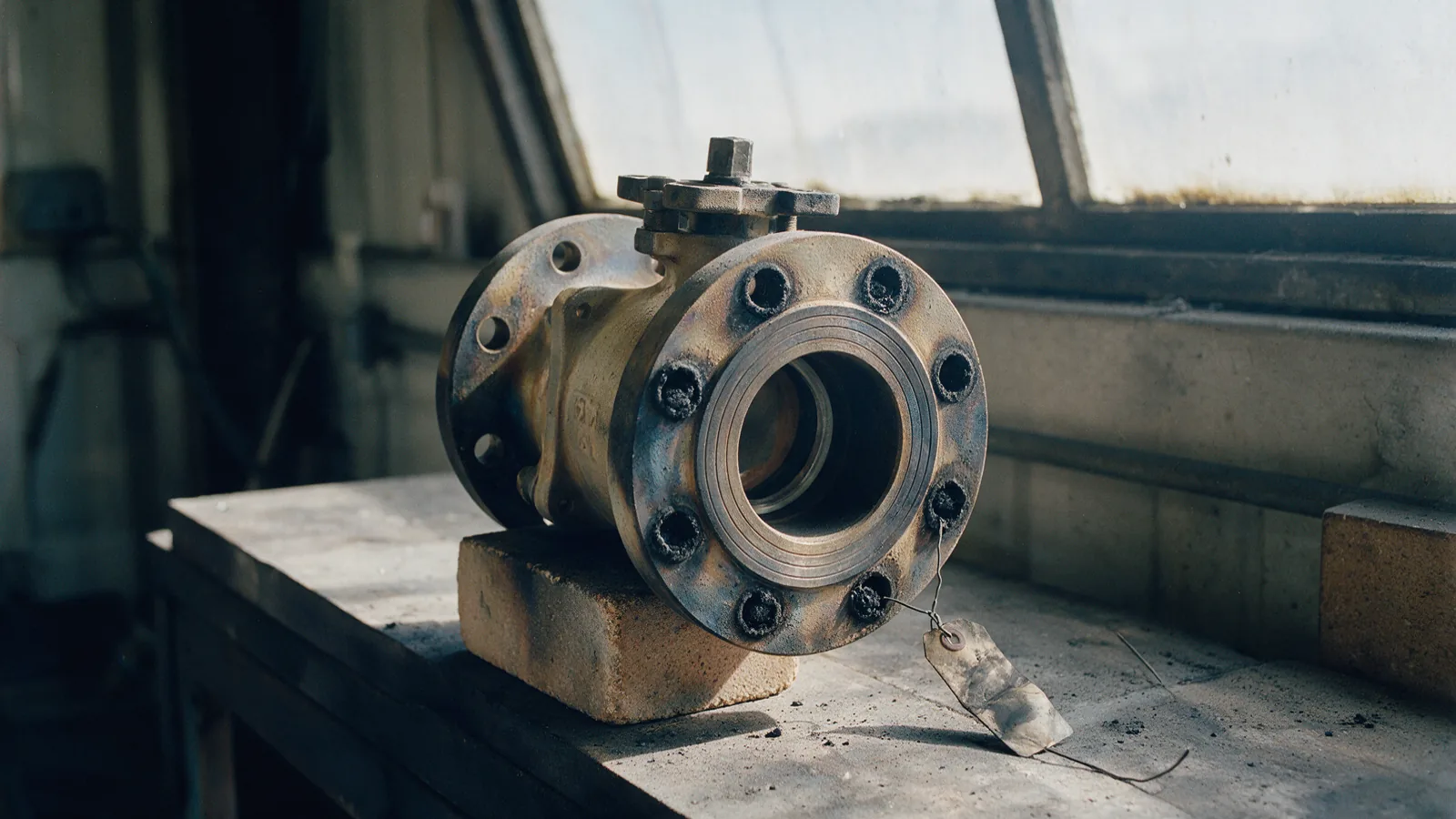
What a fire test proves, and the difference between fire-tested, fire-safe design and fire-proof
Three phrases get used interchangeably on datasheets and they are not the same thing. Fire-tested means a valve of that design, size and class range was physically burned in a laboratory to a named procedure and its leakage measured. Fire-safe design means the drawing includes the usual features: a secondary metal seat behind the soft seat, graphite stem packing, an anti-blowout stem. There is no test behind the claim. Fire-proof means nothing at all; no valve standard uses the term. The valve selection guide treats fire testing as one of several qualification steps, and this article separates the two API procedures a specification is most likely to name.
API 607: scope, the valves it covers, and the burn-cool-operate sequence
API 607 is the fire type-test for quarter-turn valves and other valves with non-metallic seating: in practice, soft-seated ball, plug and butterfly valves. The specimen is pressurised, closed, and exposed to a controlled fire for a defined period. Leakage through the closed seat and past the body joints and stem seal is measured during the burn. The valve is then cooled, measured again, and finally required to operate: it must still close, and it must still hold to a defined allowance. That last step is the point of the whole exercise, because a valve that survives the fire but cannot be shut afterwards has not protected anything. The burn duration, temperature envelope and leakage allowances are all fixed by the edition in force.
Exhibit: API 607 and API 6FA compared by scope
| Aspect | API 607 | API 6FA |
|---|---|---|
| Valve families in scope | Quarter-turn and other soft-seated valves: ball, plug, butterfly | Valves built to the API 6D and 6A families |
| Typical application | Process, utility and plant piping carrying hydrocarbons | Pipeline and wellhead service |
| Seating addressed | Non-metallic primary seat with a secondary metal seat behind it | Both soft and metal-seated pipeline designs |
| Test outline | Burn, measure leakage, cool, re-measure, then operate | Comparable burn-and-operate sequence to the pipeline design basis |
| What is measured | Through-seat leakage plus external leakage past joints and stem | Through-seat and external leakage, to the pipeline allowances |
| Qualification basis | One tested specimen qualifies a stated size and class range of the same design | Same principle, ranged against the pipeline valve family |
| Pressure rating | Set separately by ASME B16.34 | Set separately by ASME B16.34 or the API design standard |
| What it does not prove | Not a corrosion, cycle-life or fugitive-emission qualification | Not a substitute for the routine API 598 shell and seat test |
Reference values. Confirm against the current edition of the standard and the manufacturer's rating table.
API 6FA: scope, its link to API 6D and 6A valves, and how it differs from 607
API 6FA is the fire test written for the pipeline and wellhead valve families rather than for general plant piping. Its subjects are valves designed to API 6D (the pipeline ball, gate, check and plug valves that also fall under the API Monogram programme) and to API 6A for wellhead equipment. The procedure follows the same logic as 607: burn the closed valve, measure what escapes, cool it, and then require it to operate and hold. The difference is not sophistication but context. A specification for a plant utility ball valve normally names 607; a specification for a transmission pipeline valve normally names 6FA, because the design standard it is testing against is different. Naming both on the same line item is usually a copy-paste, not a requirement.
ISO 10497 and where the international test sits alongside the API procedures
ISO 10497 is the international fire type-test for valves and covers similar ground to API 607, which is why many manufacturers certify to both and print both on one certificate. European and internationally specified projects frequently name the ISO document where an American-specified project names the API one. They are close relatives rather than identical twins, and a specification that names one will not automatically accept the other. The acceptance has to be written down. The glossary sets out what each of these documents fixes and where its scope ends.
A fire test does not stop a valve burning. It establishes how much escapes while it burns, and whether the valve can still be shut when the fire is out.
Fire type-testing
When a specification needs a fire type-test: hydrocarbons and fuel gas
The test earns its cost wherever a valve failing in a fire would release something that feeds the fire. That means hydrocarbon process and transfer lines, fuel-oil and diesel systems, fuel-gas risers in tall buildings, tank farms and loading arms, and isolation around fired equipment. It also means emergency shutdown duty, where the valve's entire purpose is to close during an incident. In those cases a soft-seated ball valve without a fire test is a valve whose PTFE seat is expected to survive an event it was never demonstrated against. That is the reason the secondary metal seat exists in the first place.
When it does not, and what over-specifying quietly costs
Chilled water, condenser water, potable water, compressed air and most HVAC duty do not need fire-tested isolation, and specifying it there costs more than the certificate. It narrows the field to designs that carry the qualification, pushes the valve into a heavier construction than the duty asks for, and adds paperwork someone has to check on receipt. On a large district-cooling header the difference between a resilient-seated butterfly valve and a fire-tested ball valve of the same bore is not a line item. It is a different valve family, at several times the cost and mass, doing a job the cheaper one does better. That is over-engineering in its purest form: real safety spent where there is no fire case.
Reading a fire-test certificate: lab, size and class range, qualification family
A fire-test certificate is a document about a tested specimen, extended by rule to a family. Four things decide whether it covers the valve on your order. First, the standard and edition tested to: 607, 6FA or ISO 10497, and which revision. Second, the test laboratory and report number, which should be traceable rather than a manufacturer's own statement. Third, the size and class range the tested specimen qualifies, which is where most certificates stop covering the valve actually supplied. Fourth, the design family: the same seat arrangement, stem sealing and body joint as the tested unit, not a later variant. A certificate for a DN 50 Class 150 ball valve does not cover a DN 300 Class 300 one.
Worked example: a fuel-oil transfer line and a district-cooling header
Two DN 100 lines, two specifications. The fuel-oil transfer line carries a flammable liquid past occupied areas and is isolated by actuated ball valves. Fire testing is not optional here: the specification names API 607 with the edition, requires the certificate to cover the size and class supplied, and requires the routine API 598 shell and seat test in addition. The district-cooling header carries chilled water at moderate pressure with no fire case at all. Its specification names a resilient-seated butterfly valve, a seat compound checked against the glycol, and an ISO 5208 leakage class. It says nothing about fire, because there is nothing to burn. The family reasoning behind both is set out in gate, ball or butterfly.
Governing standards and the confirm-against-the-current-edition rule
Fire type-testing sits beside, not instead of, the other qualification documents. API 607 and API 6FA are the fire tests; ISO 10497 is the international equivalent; ASME B16.34 still governs the pressure rating of the tested valve; API 598 or ISO 5208 still govern routine shell and seat testing; ISO 15848-1 covers fugitive emissions, which is a different question again. Each is revised on its own cycle, so a specification that names a standard without an edition has left an ambiguity for someone to resolve at the worst moment.
Reference values. Confirm against the current edition of the standard and the manufacturer's rating table.
Buyer mistakes: too cheap buys downtime, over-engineered buys cost
The cheap mistake is accepting the words "fire-safe design" as though they were a test result. They are a description of features, and features are not evidence; asked for the report number and the qualified size range, that claim usually evaporates. The expensive mistake is the opposite reflex: writing fire testing into every isolation valve on a project, including the chilled-water and compressed-air lines, because it reads as diligence. It is paid for in price, in mass and in a narrower field of suppliable designs, and it buys nothing on a line with no combustible inventory. Both mistakes come from the same place: treating the certificate as a quality badge rather than as an answer to a specific hazard.
Documentation to request alongside the fire-test certificate
The fire certificate on its own does not make a valve acceptable. Ask for the set:
- The fire type-test report: standard, edition, laboratory, report number, and the size and class range qualified.
- Shell and seat test record to API 598 or ISO 5208 for the actual valve supplied.
- Material test certificate to EN 10204, type 3.1 for pressure-retaining parts on hydrocarbon duty.
- The pressure and temperature rating for the body material and class, read at the design temperature.
- Where the specification asks for it, the ISO 15848-1 fugitive-emission classification, which the fire test does not cover (what the ISO 15848-1 classes mean).
What each of those documents proves is set out in valve documentation a buyer should demand and in sourcing and documentation.
Related product lines and the category pages this guide resolves to
Fire-tested isolation sits inside the industrial valves category, most often as soft-seated ball valves on hydrocarbon duty, with actuation covered under actuators, dampers and fittings. Which of the product lines we supply carry a current fire type-test, and for which sizes and classes, is To confirm per line and size against the manufacturer's certificate, never assumed from a family name. Technical selection support and testing is where that check is made before an order is placed.
Next step: send an enquiry with the service condition pre-framed
Fire testing is a question about the medium first. State the medium and whether it is combustible, the operating and design pressure in bar g, the operating and design temperature in °C, the size and end connection, and the standard and edition your specification names. Send that to us and the reply can confirm the valve family, the class, and exactly which certificates can be produced for the size and class in question.