- Home
- Valves
Industrial valves
Flowsynergy supplies ball, gate, globe, check, butterfly and knife-gate valves from Dubai. They serve isolation, throttling and backflow duty across HVAC, water, power and oil and gas. Selection follows the service condition. Medium fixes the material. Pressure and temperature fix the class. Size and cycling fix the type. Rated data is standards reference: confirm the current edition.
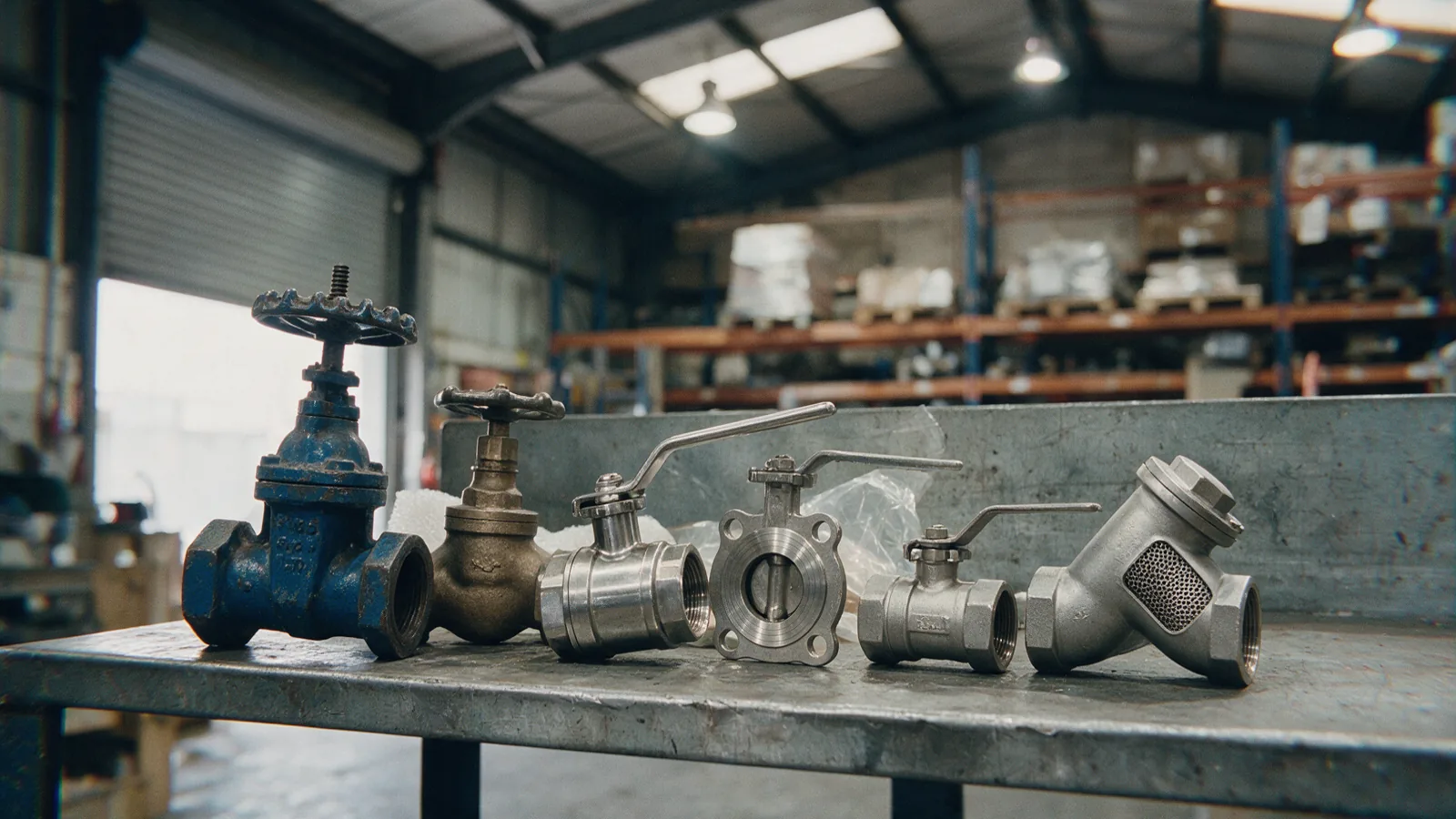
01Which industrial valves we supply, and what each is for
Ball, gate, globe, check, butterfly and knife-gate cover almost every isolation, throttling and check duty. We supply all six, in the materials and pressure classes the duty calls for. We also supply the pressure-reducing, safety and steam equipment around them and the actuators and fittings that connect them.
Each type does one job well. A ball valve gives a tight, fast, quarter-turn shut-off. A gate valve gives a full bore with almost no pressure loss. A globe valve holds a repeatable throttling position. A check valve closes itself against reverse flow. A butterfly valve is the lightest and cheapest closure on a large water line. A knife-gate cuts through solids. The duty decides, not preference.
02Match the valve type to the duty
The first question is what the valve is for, not the medium or the pressure. Isolation means fully open or fully shut, nothing between. Ball, gate, butterfly and knife-gate valves are built for it. Most are damaged by being left part-open. Throttling means holding an intermediate position. A globe valve does it by design. A characterised ball or offset butterfly can, within limits. A gate valve never should.
Backflow prevention is a check valve's job alone. An isolation valve left open will not stop reverse flow when a pump trips. One valve rarely does two jobs well. Where the line needs isolation and throttling, specify two valves. Where it needs isolation and check, put an isolation valve each side of the check so it can be serviced. The gate versus ball versus butterfly comparison covers the three isolation types.
03Ball, gate, globe, check, butterfly and knife-gate compared
Each cell names the duty a type suits, the duty it fails at, and the design standard. Read the failure line first: most field problems are a valve doing the wrong job.
Ball valve
- Suits
- Quarter-turn isolation of clean liquids and gases; frequent cycling; tight soft-seat shut-off; simple to actuate.
- Fails
- Throttling: a part-open ball erodes its seats. Soft seats above about 200 °C. Fibrous slurries that pack the cavity.
Gate valve
- Suits
- Full-bore, low-loss isolation of large lines left open or shut for long periods; steam and hydrocarbon mains.
- Fails
- Throttling: the disc chatters and wire-draws. Scaling media that jam the seat pocket. Any duty needing a fast close.
Globe valve
- Suits
- Throttling where a rising stem and plug give a repeatable position; steam, feedwater, bypass lines.
- Fails
- Large sizes, where pressure drop and seating torque become expensive; slurries that erode the plug.
Check valve
- Suits
- Stopping reverse flow on pump discharges, boiler feed and headers; no operator needed.
- Fails
- Pulsating flow that slams the disc; low velocity that leaves it fluttering; anywhere positive isolation is expected.
Butterfly valve
- Suits
- Large-diameter water, chilled water and seawater where weight, face-to-face and cost dominate.
- Fails
- High classes without an offset design; steam on resilient seats; dead-end service unless lugged and rated for it.
Knife-gate valve
- Suits
- Slurries, pulp, ash and waste water where a blade must cut through solids.
- Fails
- Clean high-pressure gas or steam; any duty that needs a tight seat-leakage class.
04Selecting by medium: water, steam, hydrocarbons, slurries, seawater
The medium decides body and trim material first. Chilled and heating water is undemanding: cast iron, ductile iron, bronze or carbon steel, stainless or bronze trim, resilient seat to Rate A. Potable water turns on wetted-material approval, not pressure: dezincification-resistant brass or an approved lining, every elastomer certified separately.
Saturated steam fixes its own temperature, so the body is rated against the relief setting. Carbon steel (ASTM A216 WCB) runs to about 425 °C. Chrome-molybdenum (A217 WC6, WC9) goes above it, with metal seats. Hydrocarbons add three qualifications the pressure rating ignores. Fire type-test (API 607 or 6FA). Fugitive-emission class (ISO 15848-1). In wet H₂S, the hardness limits of NACE MR0175. Slurries want a knife-gate or a full-bore ball with a hard-faced seat. Seawater is decided by chloride pitting. The alloy's pitting resistance equivalent number, proven under ASTM G48, puts super duplex in and 316L out. The service-condition article takes each medium in turn.
05Reading the ASME B16.34 class with the material group
A class number is not a pressure. Class 150, 300, 600, 900, 1500 and 2500 are rating groups in ASME B16.34. Each is a curve of allowable pressure against temperature for one material group. Carbon steel is group 1.1; stainless 316 is group 2.2; chrome-moly sits in group 1.9 and 1.10. The curve falls as temperature rises, at a different rate for each group. So the class on the nameplate means nothing until the material group is read beside it.
The method is mechanical. Take the design temperature, not the operating temperature. Read the allowable pressure for that class and material group at that temperature. Compare it with the design pressure, usually the relief setting. If design pressure exceeds allowable, step up a class or change the material group. A class 150 carbon-steel body holds a little under 20 bar g cold and loses most of it by 400 °C. Class 300 holds close to its cold rating to about 200 °C, then falls away. The B16.34 ratings article tabulates the curves.
Reference values: confirm against the current edition of the standard and the manufacturer's rating table.
06Size and actuation: where quarter-turn stops making sense
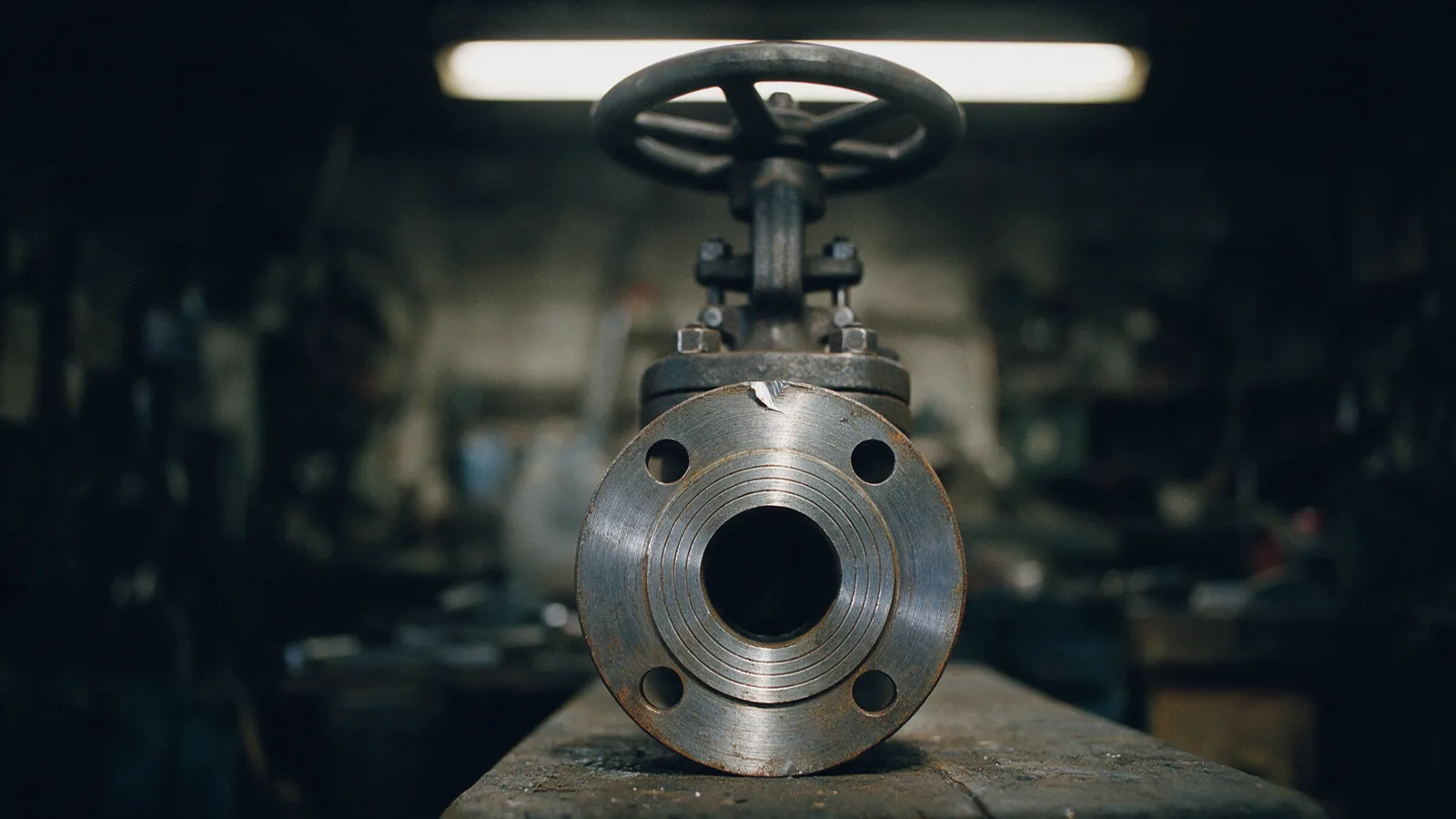
Below about DN 50 (NPS 2) a ball valve is hard to beat: compact, cheap, quick and tight. Between DN 50 and DN 300 the choice opens up. Ball valves grow heavy, and torque grows with the square of the bore. Gate valves suit lines that rarely operate. Butterfly valves take over on water, where weight and face-to-face matter. Above DN 300 the butterfly valve wins most water duties. Gate and trunnion-mounted ball valves hold the high-pressure and hydrocarbon lines.
Actuation follows the same logic. A quarter-turn valve takes a compact pneumatic or electric actuator on an ISO 5211 pad, and strokes in seconds. A rising-stem gate or globe valve needs a multi-turn actuator, a longer stroke and a larger budget. Above DN 200 it needs a gearbox for manual operation. Cycling frequency decides the seat: hourly cycling needs seats and stem seals chosen for wear, yearly cycling needs seats that will not stick. Where the valve must fail safe on loss of power, size the spring return against torque at full differential pressure. See actuators, dampers and fittings.
07End connections: flanged, threaded, welded and wafer
Flanged ends to ASME B16.5 (NPS ½ to 24) or EN 1092-1 (PN 10 to PN 40) are the default above DN 50. The valve comes out without cutting pipe, and the flange rating matches the valve class. Raised face is usual; ring-type joint for class 900 and above. Threaded ends serve small-bore lines to about DN 50 where pressure is modest. Use NPT to ASME B1.20.1 or BSP to ISO 7.
Socket-weld and butt-weld ends (ASME B16.11 and B16.25) remove the flange joint for high-pressure, high-temperature or lethal service. The valve becomes part of the pipe and is serviced in place. Wafer and lug patterns clamp between two pipe flanges, and suit butterfly and some check valves. A wafer valve cannot hold a dead-end line alone; a lug valve with threaded lugs and a suitable rating can. ASME B16.10 or EN 558 fixes face-to-face, so a replacement drops into the existing spool. Always state the series on the enquiry: the same DN and class exists in more than one length.
08Governing standards (confirm the current edition)
Four kinds of document govern a valve: the rating standard, the design standard for the type, the test standard for shell and seat, and the qualification documents the duty adds. A specification names one of each. The glossary defines every designation.
| Designation | What it fixes | Kind |
|---|---|---|
| ASME B16.34 | Pressure and temperature ratings, wall thickness, shell test and marking for flanged, threaded and welding-end valves. | Ratings |
| ASME B16.5 | Pipe flanges NPS ½ to 24: dimensions, facing, bolting and ratings. The mating geometry of a flanged end. | Ends |
| ASME B16.10 | Face-to-face and end-to-end dimensions of valves, so a replacement drops into the same spool. | Ends |
| API 600 | Bolted-bonnet steel gate valves: design, materials and trim numbers. | Design |
| API 608 / 609 / 623 / 594 | Metal ball · butterfly · steel globe · check valves: the type-specific design documents. | Design |
| API 6D | Pipeline valves: design, testing and marking for ball, gate, check and plug valves on transmission duty. | Design |
| API 598 | Inspection and testing: shell, backseat and closure tests, durations and allowable leakage by size and seat type. | Test |
| ISO 5208 | Pressure testing of metallic valves: the seat-leakage rate classes (A through G) that a specification calls up. | Test |
| API 607 / API 6FA | Fire type-testing of soft-seated quarter-turn valves and of API 6D / 6A valves. | Qualification |
| ISO 15848-1 | Fugitive-emission classification of stem sealing by tightness class and endurance. | Qualification |
| NACE MR0175 / ISO 15156 | Material and hardness limits for sour service in the presence of wet H₂S. | Material |
| EN 10204 | Inspection document types: 2.2 non-specific, 3.1 mill-certified, 3.2 third-party witnessed. | Document |
09Documentation to request with every valve
A valve without its documents is a casting of unknown origin. Ask for the six items below on the enquiry, not after delivery. A certificate never raised at the mill cannot be raised later. The sourcing and documentation guide explains each one. The MTC and test-certificate article shows a compliant example.
Material test certificate
EN 10204 3.1 for body and bonnet castings or forgings, tied to the heat number on the valve. Ask for 3.2 where a third party must witness.
Pressure test report
Shell and closure tests to API 598 or ISO 5208, stating the test pressure, medium, duration and leakage rate observed, not simply "passed".
Fire-safe type-test certificate
API 607 or API 6FA, covering the exact size range, class and seat material ordered. A certificate for another size family does not transfer.
Fugitive-emission classification
ISO 15848-1 tightness and endurance class where the specification calls for it, with the packing arrangement named.
Sour-service declaration
NACE MR0175 / ISO 15156 compliance for every wetted pressure-retaining part, with hardness results, where wet H₂S is present.
Drawing and data sheet
General-arrangement drawing with face-to-face, flange facing, trim designation and the actuator pad (ISO 5211) if the valve is automated.
10Product lines relevant to isolation and check duty
We supply from several established manufacturers' lines, because no one maker covers every type, material and class well. The three lines below do most isolation and check duty. The full set is on the product-lines page. Appointment status with any principal is To confirm and is never implied by a listing here.
 KITZIndustrial valves
 DFTCheck valves
 EtelecElectrical connection protection
 KVC UK LtdIndustrial valves
 VogtIndustrial valves
11Where to go next
If the service condition is not fixed, start with the valve selection by standard guide. It runs from medium to class to material group to document list. For a narrower question, the gate vs ball vs butterfly comparison covers the three isolation types. Chilled-water terminals have their own guide, district cooling and HVAC, because balancing and control valves follow different rules. All guides are indexed under Insights. Technical support and testing describes how we check a valve on site.
Enquiry Dubai
Send the service condition, not a part number.
State the medium, design pressure and temperature, line size and end connection. Say whether the duty is isolation, throttling or check. We reply with the valve type, class, material group and the documents to expect.
Send an enquiry