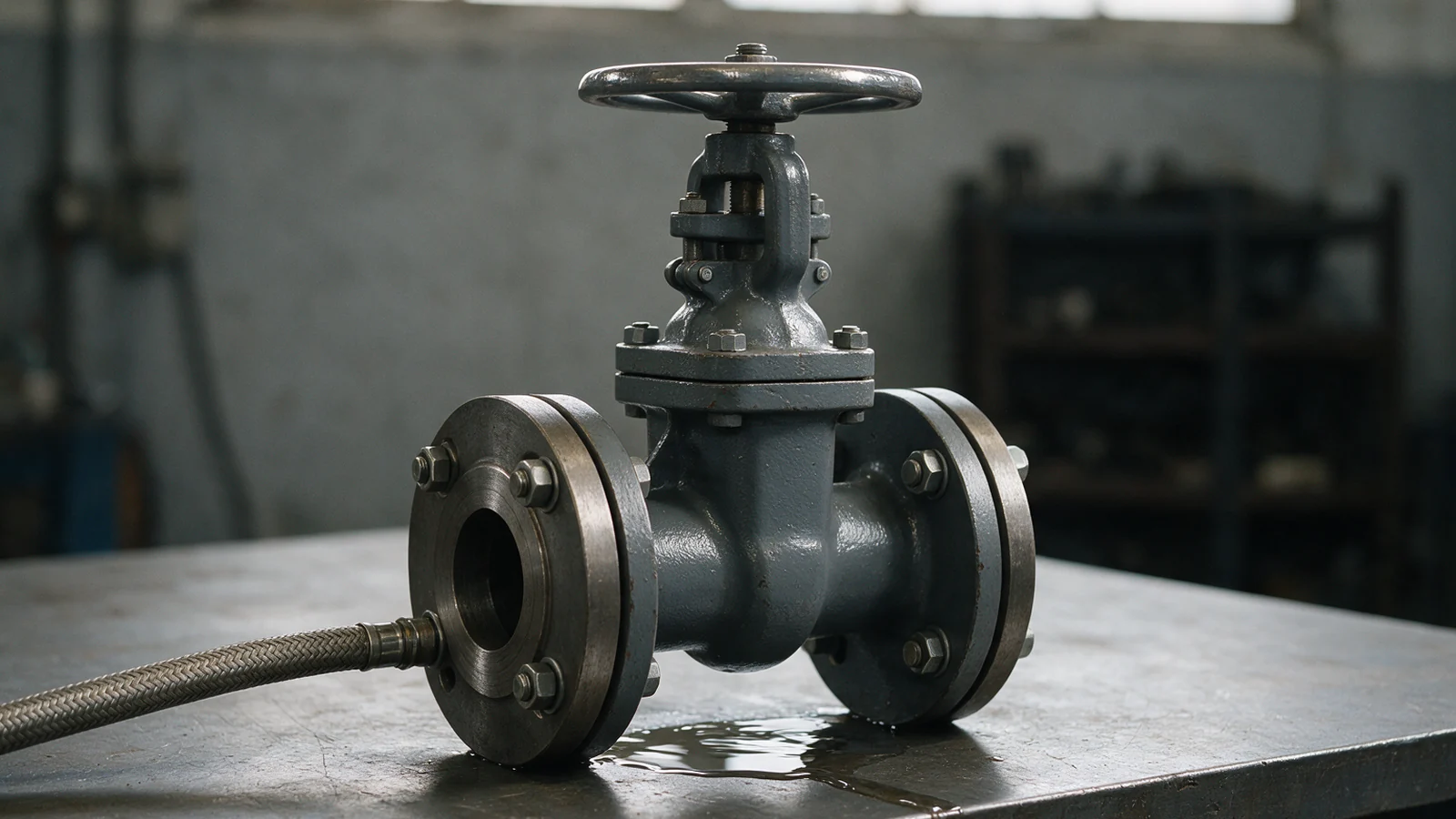
What does EN 12266-1 cover?
EN 12266-1 covers how a metallic industrial valve is pressure tested and whether the result passes. BSI's published record of BS EN 12266-1:2012 sets the document's reach at three things for production testing: which tests are run, how each one is carried out, and what counts as a pass. Safety devices and thermoplastic valves are outside it.
Those three things travel together. The standard settles the test, the method and the criterion the result is judged against. A test report that names the standard but not the acceptance criterion the result was judged on has quoted a procedure without its verdict, and that is the line worth checking on any certificate that arrives with a valve.
The German adoption describes the same intent. DIN EN 12266-1, the German version of EN 12266-1:2012, is summarised on DIN's record as setting out a floor of requirements for production pressure testing so that tests and procedures come out the same.
Is it a production test or a type test?
EN 12266-1 is written around production testing, and that is the distinction to read for on a certificate. Both the BSI and the DIN records note that the tests it specifies may also be used for type tests or acceptance tests. The same procedure can therefore appear on two documents that prove different things, so the report has to say which was performed.
That is a separate question from the inspection documents covering the material the valve is made of. Which certificate type applies to the body and bonnet, and what each one is, is set out in valve documentation and test certificates.
Why is a safety valve not covered by it?
Because the standard excludes that class of product. Both published records put safety devices outside what EN 12266-1 covers, and in both the exclusion is unconditional: it is that class of device that is excluded, not one material or one size of it. The tests that prove an isolation valve therefore do not describe what a safety device has to do.
In practice this trips up mixed enquiries. A specification that says "pressure test to EN 12266-1" across a package of isolation valves, control valves, steam traps and relief valves has asked for something the standard does not provide on part of that package. The relief valve's test evidence comes from the document its own product standard names, and the enquiry should say so rather than leaving the supplier to decide.
What a relief or safety valve is actually doing in a steam or pressurised system, and why it is specified on different grounds, is covered in steam pressure protection.
Which document wins if the valve standard says something different?
The valve product or performance standard wins. Both records set out the same two-part relationship: when EN 12266-1 is called up as a normative reference inside a valve product or performance standard, the two are read together with that standard's own specific requirements; and where the product or performance standard's requirements differ, its requirements are the ones that apply.
DIN's record adds the other half. Requirements that belong to one product or one performance standard alone are deliberately left out of EN 12266-1. The general test method lives in one document and the product-specific requirements live in the product standard that calls it up.
So the standard name alone does not define the test. A valve supplied to a product standard that modifies the test is still correctly described as tested to EN 12266-1, with the product standard's requirement applied on top. An enquiry that names both, and says which governs, leaves nothing for a supplier to interpret.
Does it apply to plastic valves?
EN 12266-1 does not apply to plastic valves. Its reach is limited to valves made of metallic materials, and that limit sits in the title as well as in the scope. BSI's record carries a note sending the testing of thermoplastic industrial valves to ISO 9393-1 and ISO 9393-2 instead, which are separate documents a specification has to name in their own right.
This matters on hydronic and water packages where metal and plastic bodies sit in the same system. A line on a schedule reading "test to EN 12266-1" cannot be satisfied by a thermoplastic valve, and the schedule needs a second test reference for those items. How the isolation and balancing items in those systems differ is set out in PICV versus balancing valve.
Which edition applies?
The edition of EN 12266-1 that applies is the one the purchase order names. BSI lists BS EN 12266-1:2012 as published on 30 April 2012, identical to EN 12266-1:2012, with the status Current, Under Review, filed under ICS code 23.060.01 for valves in general. DIN lists its German version at edition 2012-06. A standard under review is still the current standard.
BSI gives the committee PSE/18/1. DIN gives the national committee NA 003-01-01 AA and the European CEN/TC 69/WG 1, and files both of those under basic standards. BSI's record also carries the ISBN 978 0 580 67642 0 for its 2012 edition.
Name the year. A drawing or a framework agreement that has sat in a project file for several years may still cite a withdrawn edition of any standard, and a test report quoting only a number cannot be checked against the revision the order intended.
What should a pressure test line on an enquiry say?
A pressure test line should state five things: the standard and its edition, whether the test is a production or a type test, the acceptance criterion and any governing product standard, what the report must record, and a separate line for anything the standard excludes. Those five keep the requirement from arriving as an argument at inspection.
- The standard and its edition, written out, rather than the number alone.
- Whether the test is a production test on the supplied valve or a type test, since the records say the same procedures can serve either.
- The acceptance criterion the result is judged against, and the product or performance standard that governs if one applies.
- What the report must state: the valve's identity, the test performed, the medium, the pressure, the duration and the measured result, not simply that it passed.
- A separate line for any item the standard excludes, meaning safety devices and any thermoplastic-bodied valve in the same package.
Flowsynergy Solutions Limited supplies industrial valves, pipeline fittings and flow-control equipment into commercial, industrial, HVAC, water, power and oil and gas applications across Dubai and the wider Gulf, and offers valve selection and technical support alongside valve testing, maintenance and repair. Send the specification with those five items on it to enquiry@flowsynergy.ae or call +971 4 313 2786, use the contact page if that is easier, and see technical support and testing for how we work through documentation on an enquiry.
Questions buyers ask about EN 12266-1
Is BS EN 12266-1:2012 the same document as EN 12266-1:2012?
Yes. BSI's record of BS EN 12266-1:2012 states the international relationship as identical to EN 12266-1:2012, so the British designation is the European standard published in the United Kingdom rather than a modified version of it. DIN's entry is the German version of the same 2012 European standard, at edition 2012-06. A specification may name whichever designation its project uses.
Does it cover both the shell test and the seat test?
Its title covers pressure tests, test procedures and acceptance criteria as a set, and the published scope is in those general terms rather than a list. Which individual tests apply to your valve, at what values, comes from the purchased edition read with the product standard. Ask for the test report to name each test it performed rather than inferring the set from the standard number.
Is a seat leakage class the same thing as a pressure test result?
No. A pressure test to EN 12266-1 is a test with an acceptance criterion attached to it. A seat leakage class is a separate benchmark, set by its own document, and the two are often quoted side by side on the same data sheet. What a class does and does not promise is set out in seat leakage classes, which is the page to read before treating one as the other.
What makes a pressure test report checkable later?
Traceability to the valve and to the revision. The report needs the valve's identity, the standard and edition tested to, whether it was a production or type test, the acceptance criterion, the medium, the pressure, the duration and the measured result. A certificate recording only a standard number and the word passed cannot be audited against anything once the valve is installed.
More on specifying valves and the paperwork that comes with them is collected in our insights.
Sources, read 3 October 2026: BSI's own published record of BS EN 12266-1:2012, for the designation, the full title, the 30 April 2012 publication date, the Current, Under Review status, the identity with EN 12266-1:2012, the ICS code 23.060.01 for valves in general, the committee PSE/18/1, the ISBN 978 0 580 67642 0, the reach of the document, the point that the specified tests may also serve as type or acceptance tests, its exclusion of safety devices, the rule that a differing product or performance standard applies and that the two are read together when EN 12266-1 is a normative reference, and the note sending thermoplastic valve testing to ISO 9393-1 and ISO 9393-2; and DIN's published record of DIN EN 12266-1, the German version of EN 12266-1:2012 at edition 2012-06, for its statement of purpose, its statement that requirements specific to one product or performance standard alone are not included, and the committees NA 003-01-01 AA and CEN/TC 69/WG 1, both filed under basic standards. This page names those standards and summarises their publishers' catalogue records in our own words: beyond the standard's own designation and published title it reproduces no table, clause or other text from any standard, and it states no test pressure, duration or acceptance value. Buy the current edition from BSI, DIN or another appointed standards distributor for the requirements themselves, confirm every line against the valve maker's data sheet, and your purchase order governs.