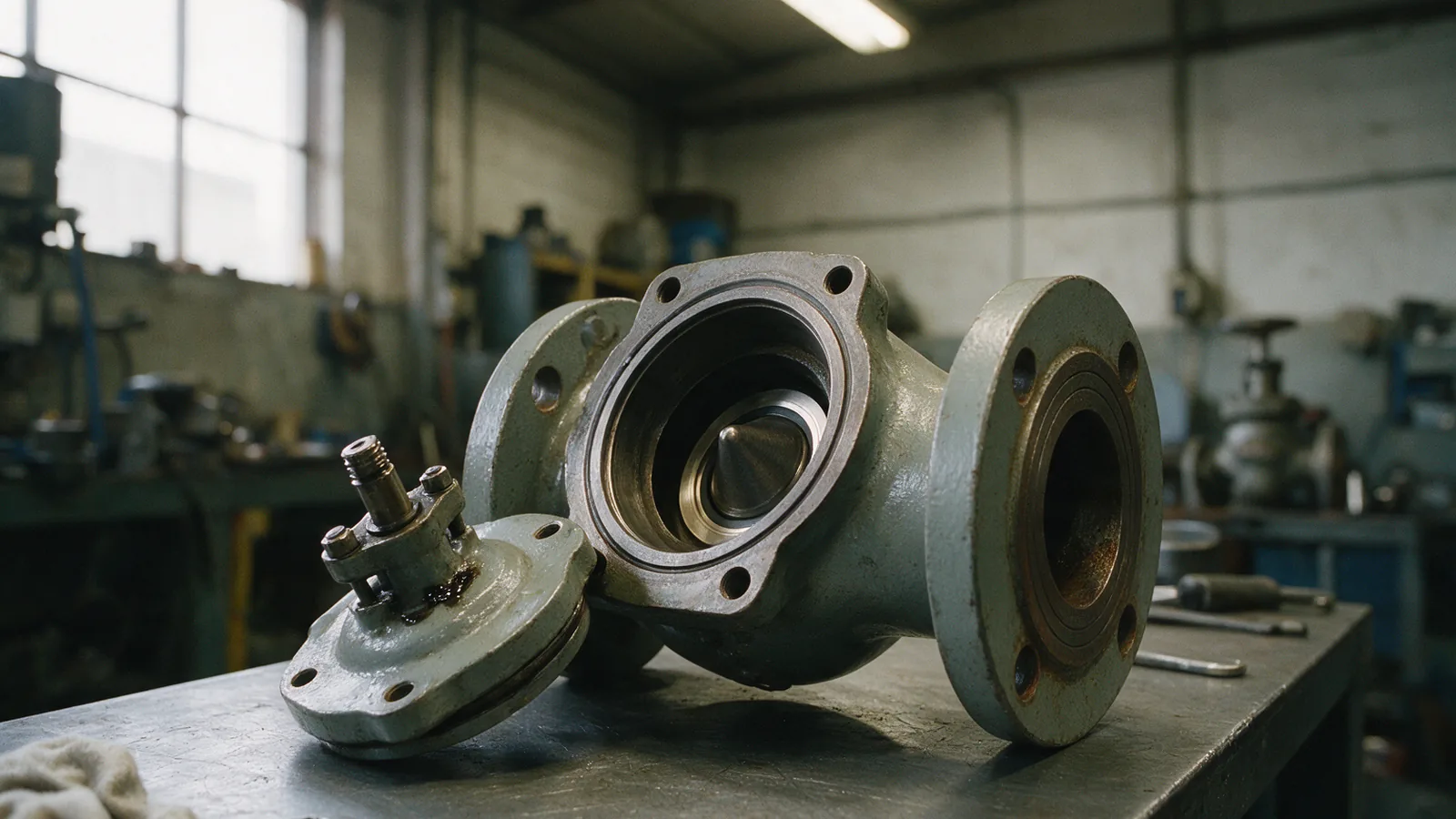
What is a control valve seat leakage class?
A control valve seat leakage class is a graded benchmark for how much fluid a closed control valve is allowed to pass, proved by a production test on the valve. Its classes and test are set out in ANSI/FCI 70-2, Standard for Control Valve Seat Leakage Testing, published by the Fluid Controls Institute. The class then travels with the valve as a published rating a buyer can hold the maker to.
The point of the classification is comparison. The Fluid Controls Institute explains that the standard "defines benchmark standards for seat tightness of control valves in the form of maximum allowable leakage under defined test conditions", and that these benchmarks let a specifier check the rated leakage of a valve suits a particular application. Because every manufacturer proves a class by the same defined procedure, the Institute notes that accurate comparisons can be made across a large range of valve offerings.
A published class is a demonstrated result rather than a claim. The Fluid Controls Institute states that to achieve a class rating and publish conformance, the manufacturer must prove the valve's design and assembly, which is what gives the user confidence in both the valve and the maker.
Why does a control valve leak when it is shut?
A control valve is built to modulate flow rather than seal a line, and its trim is shaped for that job. The Fluid Controls Institute puts it without hedging: "Control valves are not isolation valves, they will leak." The Institute adds: "The extent to which control valves leak can vary quite a bit from one valve to another, particularly when different seal types are involved."
That variation is what the classification exists to manage. A seat leakage class turns an unavoidable characteristic into a figure a specification can name, so a process that tolerates some passing flow is not sold an expensive tight shutoff design, and a process that cannot tolerate it is not sold a loose one.
The Fluid Controls Institute sets out what excessive leakage can cost, on a valve that was never tested to the standard. Depending on the service fluid, it lists energy loss where the fluid is a heat transfer medium such as steam; increased trim wear, because a seated trim that is still leaking significantly drives the velocity across the seating ring and the control element upward; and erratic system control where the valve cycles excessively. For combustible or flammable fluids it records that unexpected leakage could result in significant safety concerns, and it notes that control valves, although not designed for isolation, are often still expected to hold enough to stop pressure accumulating downstream and lifting a safety valve unexpectedly.
Which standards define control valve seat leakage testing?
Two documents carry this subject. ANSI/FCI 70-2, Standard for Control Valve Seat Leakage Testing, is the American national standard from the Fluid Controls Institute, devoted to seat leakage and its classification. IEC 60534-4 is the international standard on inspection and routine testing of control valves, and a seat leakage test sits in its clause 4 alongside hydrostatic, packing, rated travel and dead band tests.
IEC 60534-4 reached edition 4.0 in December 2021. It applies to control valves built to the rest of the IEC 60534 series, up to a pressure-rating ceiling of Class 2500, which a note allows a purchaser and a manufacturer to lift by agreement for a higher-rated valve. Where actuators are concerned, only pneumatic ones are in scope.
The standard also puts certain duties outside itself. Radioactive service, fire-safety testing and other hazardous conditions are excluded, and where a hazardous-service standard conflicts with it, IEC says that standard should take precedence. A hazardous-service line item therefore needs its own test document named, not this one alone.
Leakage to atmosphere through the stem seal is a separate qualification, covered in ISO 15848-1 fugitive emission classes, and the isolation-valve families themselves are compared in gate, ball or butterfly for isolation.
Neither standard's tables appear on this page. The class limits, test pressures and test durations belong in the purchased edition or on the valve maker's data sheet. What is set out here is what each document is for and how to cite it.
Does a leakage class predict how much a valve will leak in service?
No. A class is proved by a production test at conditions the standard fixes. It is a benchmark for comparing valves before purchase and for accepting one on delivery. It is not a forecast of the leak rate a line will show at its own differential pressure, temperature and medium.
A leakage class earns its keep after commissioning as well as before it. The Fluid Controls Institute notes that a control valve's leakage steadily increases as the valve is cycled, and that this is not necessarily a problem: "If observed leakage remains within an acceptable leakage class, it is likely that no maintenance is required yet." The Institute records that reading the class this way can reduce costs associated with outages and repairs.
A class named on a purchase order therefore buys a proven condition at delivery. Holding the valve near that condition is a maintenance question, so the figure worth writing into a maintenance plan is the class still acceptable in service, not only the class the valve was bought at.
Is a seat leakage class the right thing to specify for an isolation valve?
Usually not. A gate, ball or butterfly valve bought to isolate a line is not a control valve, and ANSI/FCI 70-2 addresses control valve seat leakage. Asking for "Class VI shut-off" on an isolation line item cites a control valve standard for a valve it was not written for, and the supplier is then left to guess what evidence the buyer actually wants.
What an isolation line item needs instead is the valve's own inspection and test document named. API 598 is a valve inspection and testing standard published by API, and a test report against whichever document the specification names is the paperwork to ask for. What each certificate carries is set out in valve documentation and test certificates.
Which documents state seat tightness for an isolation valve, and in what units, is set out in our glossary entry on seat leakage rate and in technical support and testing.
The distinction matters most where the two families overlap. A tight shutoff control valve and an isolation valve can sit next to each other on a line list and read as interchangeable. Which family a duty belongs to is the first question in valve selection, and it is worth settling before any leakage class is written down.
What should a seat leakage line on an enquiry say?
A seat leakage line should state four things: which valve family the item is, which document and edition the tightness is to be proved against, which class or result will be accepted, and whether the service is a hazardous one. Each closes a question a supplier would otherwise have to assume an answer to.
- Which valve family the line item is. Control, tight shutoff control, or isolation. Everything below follows from it.
- Which document the tightness is to be proved against, named with its edition: a leakage class under ANSI/FCI 70-2, routine tests under IEC 60534-4, or a pressure test to a valve inspection and testing standard.
- Which class or result will be accepted, and whether the test report is to come with the valve or only a certificate of conformity.
- Whether the service is a hazardous one, because that can put the work outside IEC 60534-4's scope and bring a different standard forward.
Flowsynergy Solutions Limited supplies industrial valves, pipeline fittings and flow-control equipment from Level 41, Emirates Towers, Sheikh Zayed Road, Dubai, with valve selection and technical support. Send a line list with the four items above to enquiry@flowsynergy.ae or call +971 4 313 2786, Monday to Friday, 8:30 am to 5:00 pm, Dubai time. More on what we do is on technical support and testing.
Questions buyers ask about seat leakage classes
Does Class VI mean a valve is bubble tight?
No. Class VI is a seat leakage class designation, and a class is an allowance rather than zero: the standard sets a maximum permitted leakage for it, proved on a defined test. The Fluid Controls Institute is explicit that control valves leak. Where a line genuinely needs nothing to pass, that is an isolation requirement and it needs isolation evidence.
Is IEC 60534-4 the same as ANSI/FCI 70-2?
They are different documents with overlapping subject matter. IEC 60534-4 is the international standard on inspection and routine testing of control valves, and seat leakage is one of its clause 4 tests alongside hydrostatic, packing, rated travel and dead band tests. ANSI/FCI 70-2 is the American national standard devoted to control valve seat leakage testing. A specification can cite either, and should say which.
Which edition should a specification name?
The one the valve is intended to be tested against, written out in full. For IEC 60534-4 the current edition is 4.0 of December 2021, and a drawing that has sat in a project file for a few years may still name the edition before it. A class number on its own does not tell a supplier which revision of either standard is meant.
What should a seat leakage test report show?
Enough to tie the result to the valve in front of the inspector: the valve's identity, the standard and edition it was tested to, the class or acceptance criterion, and the measured result. A certificate naming a class without the test conditions cannot be checked against anything later.
More on specifying valves and the paperwork that comes with them is collected in our insights.
Sources, read 30 September 2026: the Fluid Controls Institute's own information sheet on why ANSI/FCI 70-2 matters, which also records that the standard is bought through TechStreet or IHS; and the standards distributor VDE Verlag, whose redline-version preview of IEC 60534-4:2021, edition 4.0, published by IEC, for that standard's designation, date, scope and contents. API 598 is named as a valve inspection and testing standard published by API. This page cites these standards and summarises them in our own words; it reproduces no table or clause text, and the quotations from the Fluid Controls Institute are marked and attributed. Buy the current edition from its publisher or an appointed standards distributor for limits and test conditions, and confirm every line item against the valve maker's data sheet. Your purchase order governs.