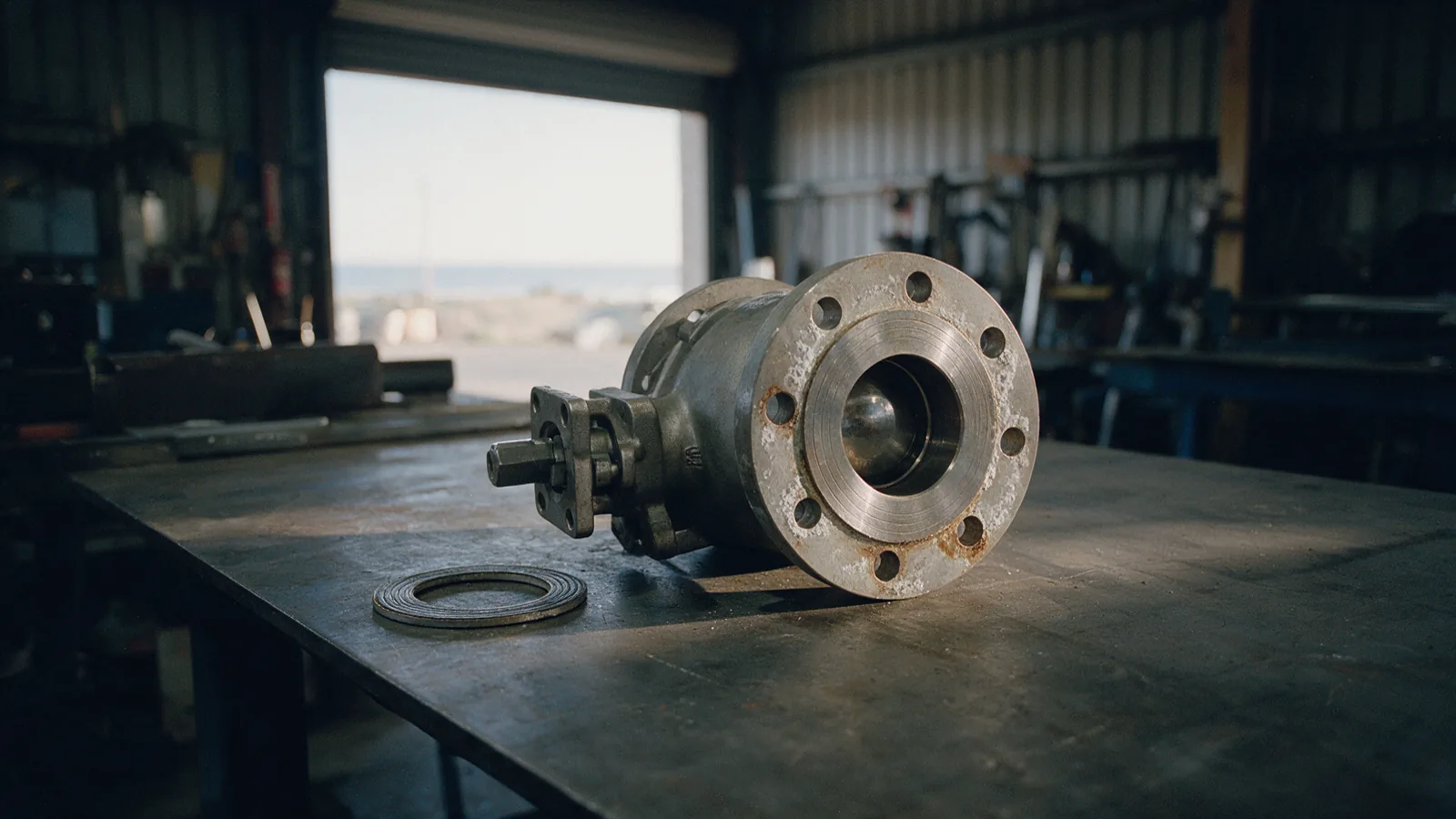
Why do crevices matter so much on a seawater valve?
Seawater attacks a valve in ways a general corrosion rating does not describe. Pitting breaks the passive film at one spot and drives a small, deep cavity. Crevice corrosion starts in tight gaps, under gaskets, at seat rings and behind packing. Chloride stress corrosion cracking needs tensile stress as well as chloride. A valve is full of the gaps where crevice corrosion starts.
Langley Alloys' page for Alloy 32760 makes the point directly: “Crevice corrosion starts well below the pitting temperature - allow a margin at gaskets, deposits and flange faces.” On a valve, that means the body-to-bonnet gasket and the flange faces. The seat pocket is another tight gap where deposits can sit. Langley lists valves and seawater systems among the grade's applications. Smiths Metal Centres lists pumps, valves and chokes. The wider framework sits in valve selection by service condition.
What does PREN tell a buyer, and what does it leave out?
The pitting resistance equivalent number, or PREN, is worked out from an alloy's composition. It ranks alloys for chloride pitting. Langley's PREN calculator gives the formula as PREN = %Cr + 3.3 x (%Mo + 0.5 x %W) + 16 x %N. For UNS S32760, Langley publishes a PREN exceeding 40. It credits the grade's higher chromium, molybdenum and nitrogen.
Smiths Metal Centres states that the alloy is supplied with a PREN of at least 40. Even so, a PREN is a screening figure, not a qualification. Langley's calculator says PREN compares grades on a single scale. It does not predict absolute performance in a specific service condition. PREN also says nothing about strength, welding or sour service.
What is the critical pitting temperature of UNS S32760, and why does the valve temperature matter?
The critical pitting temperature is the temperature at which pitting starts in a defined laboratory test. Langley Alloys publishes it for UNS S32760 as above 50 degrees Celsius. It gives a seawater corrosion rate below 0.01 mm per year. Langley also states that the grade has excellent resistance to chloride stress corrosion cracking.
Langley's pitting screen compares a grade's indicative pitting temperature with the service temperature. That comparison shows whether a grade has margin against pitting. Langley calls the screen indicative, not a certified result. Real pitting and crevice temperatures depend on test method, product form, surface finish and service chemistry. Langley's own instruction is to use certified data for design. So read the temperature at the valve itself, not the intake temperature.
Langley states that ASTM G48A pitting corrosion testing and ferrite content certification are available on its Alloy 32760 bar. Ask for either by name if the duty needs it.
Which designations belong on a super duplex valve line item?
One super duplex alloy arrives under several designations. An order naming only one of them has not said enough. Langley Alloys lists the designations below for Alloy 32760, alongside the trade name Zeron 100. Each governs something different: the alloy itself, a product form, an added data sheet or a service listing. The table uses Langley's own labels.
| Designation | Langley's label | What it governs on the order |
|---|---|---|
| UNS S32760 | Unified Numbering System | The alloy itself. The designation to name on every line |
| EN 1.4501 | European harmonised standard | The same alloy on a European document set. Langley also cites EN 10088-3 1.4501 |
| ASTM A182 F55 | Forgings and fittings | Forged parts and fittings in this grade |
| ASTM A479 | Bar and shapes | Bar product in this grade |
| ASTM A276 | Bar and shapes | Bar product, listed alongside A479 |
| NORSOK MDS D57 | Material data sheet | Requirements added to the base standard, where a project calls it up |
| NACE MR0175 / ISO 15156 | Sour service | Sour service listing. Langley gives a hardness limit of 28 HRC. Not a seawater requirement in itself |
| API 6A | Wellhead and tree equipment | Wellhead and tree equipment in this grade |
Reference values. Confirm against the current edition of each standard and the manufacturer's data sheet.
A line that names UNS S32760 is not asking for UNS S32750. Langley Alloys lists that alloy separately, as EN 1.4410 and ASTM A182 F53. Langley lists SAF 2507, an Alleima trade name, as an equivalent. It also gives a PREN exceeding 40. Langley describes Alloy 32760 as carrying tungsten and copper additions. Its composition for Alloy 32750 lists no tungsten. A substitution between the two should be agreed in writing, not assumed.
Castings are a separate question. Langley labels ASTM A182 F55 “Forgings and fittings”, and its designation list names no casting specification. A cast valve body needs its own casting grade and specification named on the order.
How strong is UNS S32760 super duplex?
Super duplex is also a strength choice. Smiths Metal Centres gives UNS S32760 a yield strength of typically up to 600 MPa. It describes notch ductility as good at ambient and sub-zero temperatures, down to minus 50 degrees Celsius. Langley Alloys lists typical minimums of 550 N/mm² proof stress and 750 N/mm² tensile strength. Its hardness figure is at or below 270 HB.
Langley Alloys also describes UNS S32760 as having higher strength than austenitic and 22%Cr duplex stainless steels. Langley lists the grade in NACE MR0175 for sour service, with hardness controlled to a maximum of 28 HRC. It also records ASME approval for pressure vessel applications. Where the pressure and temperature envelope is the question, ASME B16.34 pressure and temperature ratings is the companion piece.
When does super duplex replace another valve material, and when is it not needed?
Smiths Metal Centres names three steel families the alloy can replace and two costlier materials. In its words, it “can be used successfully as an alternative to 300 series stainless steel (such as type 316), standard 22% Cr duplex steel and precipitation hardening stainless steels.” Smiths adds: “Where appropriate the alloy can be considered in lieu of more costly Grade 5 titanium or nickel-based alloys.” Neither statement gives a switching threshold.
Standard duplex is the nearest step down. Langley describes Alloy 2205 (UNS S32205 / S31803, EN 1.4462) as a 22% chromium duplex. It gives the grade a PREN of 34. Its forgings are ASTM A182 F60 or F51. For UNS S32760, the published PREN exceeds 40.
The choice of UNS S32760 belongs to the service condition. That means the fluid, its chloride content and the temperature at the valve. A chilled water or clean utility duty is rarely where these seawater figures decide the choice. A warm seawater duty is where they matter. No published figure here sets that threshold; the project's material specification sets it.
Super duplex is not the only seawater answer. Our guide to valve selection by service condition also names 6Mo grades and lined bodies. The valve FAQ on seawater service adds nickel-aluminium bronze, with ASTM G48 testing to separate the candidates.
What should a buyer ask for on a welded super duplex valve assembly?
Smiths Metal Centres describes the alloy's microstructure as 50:50 austenite and ferrite. It says machining and welding present no particular problems. On a fabricated super duplex valve assembly, that balance is still worth evidencing rather than assuming. Langley offers ferrite content certification on its bar. That certificate covers the material as supplied, not the finished weld. Smiths puts its fabrication view this way:
The machining and welding of this grade of super duplex stainless steel presents no particular problems. Guidance notes are available upon request.
Smiths Metal Centres, UNS S32760
Smiths still offers guidance notes on request. For the weld itself, ask for the welding procedure and its qualification records. Name them on the order beside the material designation.
What goes on a super duplex purchase order, and what should a buyer ask back?
A super duplex valve line item is less likely to be queried when it states four things. List them in the order below. Each one closes a question a supplier would otherwise ask back. The first three map to the designations table above. Which certificate type to require, and what each type evidences, is covered in valve documentation and material test certificates.
- Grade: UNS S32760, with EN 1.4501 where the document set is European.
- Product form standard: for example ASTM A182 F55 for forgings and fittings.
- Additional data sheet: NORSOK MDS D57, if the project calls it up.
- Certificate and tests: the certificate type, plus ASTM G48A or ferrite content results if the duty needs them.
Questions worth asking back before the order is placed:
- Is each pressure-retaining part forged or cast, and which specification covers each?
- What is the temperature at the valve, rather than at the intake?
- Is the line also in sour service, so that the hardness limit applies?
- Does the offer name UNS S32760, or a different super duplex grade such as UNS S32750?
For the broader selection sequence, start at valve selection. The product families are listed under valves, and every guide sits in the guides library. Have a seawater or desalination duty to review? Talk it through with us before the order is placed.
Questions buyers ask about super duplex valve material
Is Zeron 100 the same as UNS S32760?
Yes. Langley Alloys lists Zeron 100 as an alternate designation for Alloy 32760. Langley covers that alloy under UNS S32760 and EN 1.4501. On a purchase order, name UNS S32760 and the product form standard rather than the trade name alone.
Is F55 the same as F53?
No. Langley Alloys lists ASTM A182 F55 against UNS S32760. It lists ASTM A182 F53 against UNS S32750, a separate super duplex grade. Both carry a published PREN exceeding 40, but they are different alloys. Do not substitute one for the other without written agreement.
What is the difference between duplex and super duplex?
The published PREN is the clearest difference. Langley Alloys gives Alloy 2205, a 22% chromium duplex, a PREN of 34. It gives UNS S32760 super duplex a PREN exceeding 40. Langley also describes UNS S32760 as stronger than 22%Cr duplex. The forging designations differ too: F60 or F51 for 2205, F55 for S32760.
Is UNS S32760 magnetic?
Yes. Langley Alloys describes Alloy 32760, which is UNS S32760, as ferromagnetic, because its structure is part ferritic. A magnet on a super duplex valve body is therefore not evidence of the wrong material. Equally, a magnet test does not confirm the grade; the material certificate does.
Does a PREN above 40 mean the valve will not pit?
No. Langley's PREN calculator says PREN does not predict absolute performance in a specific service condition. It compares grades on a single scale. Langley also notes that crevice corrosion starts well below the pitting temperature. Gaskets, deposits and flange faces on a seawater valve need that margin.
Sources, read 17 September 2026: Langley Alloys, Alloy 32760; Langley Alloys, Alloy 32750; Langley Alloys, Alloy 2205; Langley Alloys, PREN calculator; Smiths Metal Centres, UNS S32760. Supplier data, presented for reference. Confirm against the current edition of each standard and the manufacturer's data sheet.