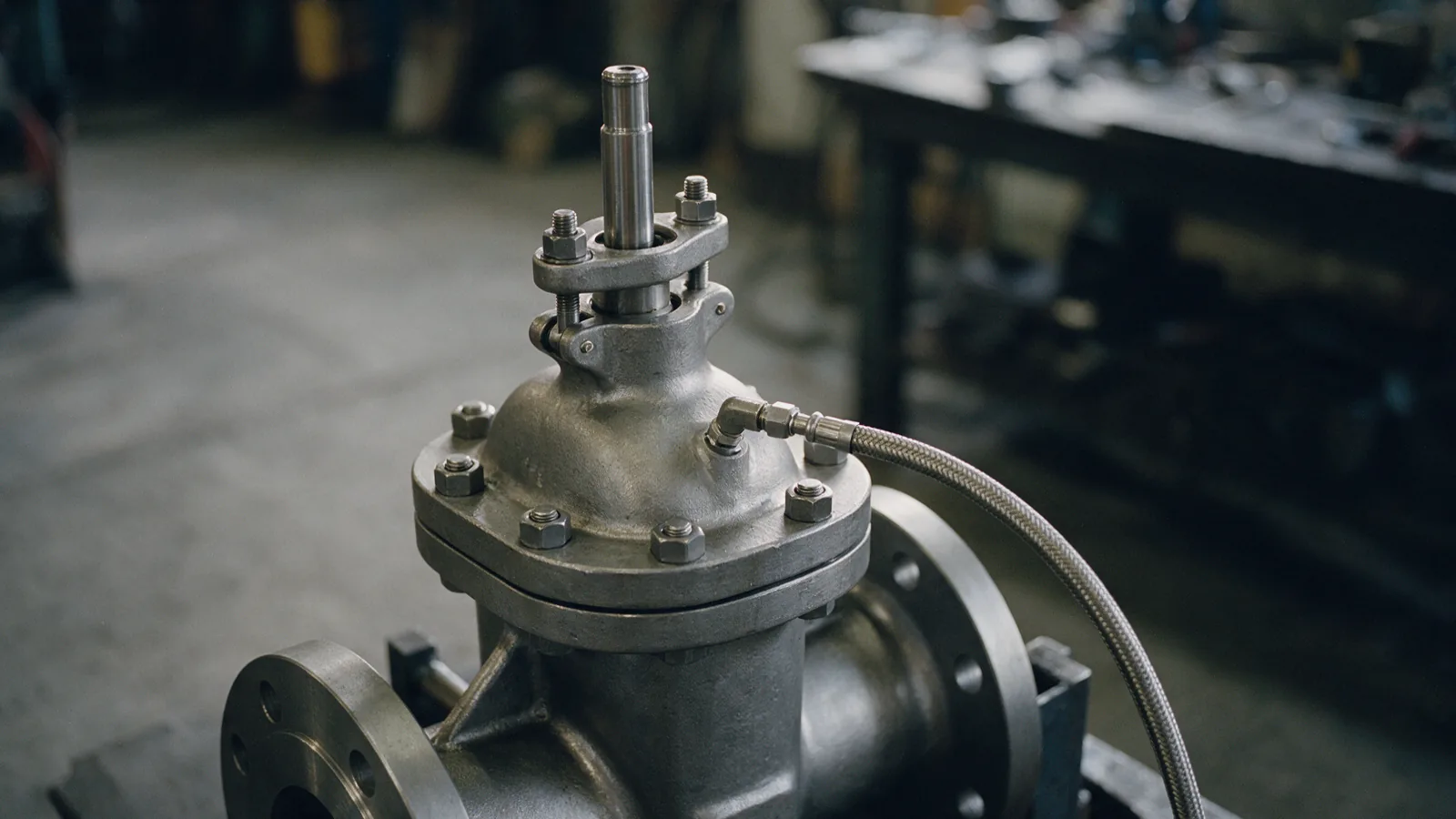
What does ISO 15848-1 test on a valve?
ISO 15848-1 tests how much a valve leaks to the atmosphere, not how well it shuts off. Its scope covers external leakage of valve stem (or shaft) seals and body joints, on isolating valves and control valves, for fugitive emissions of volatile air pollutants and hazardous fluids. ISO 15848-1:2015 excludes end connection joints, vacuum application, corrosion and radiation.
ISO states the purpose in its introduction:
“The objective of this part of ISO 15848 is to enable classification of performance of different designs and constructions of valves to reduce fugitive emissions.”
Fugitive-emission performance is separate from seat tightness and from fire safety. Seat leakage belongs to other standards, for example ISO 5208 or API 598. Fire type testing is set out in fire-safe valves: API 607 vs API 6FA. A valve can carry any one of these qualifications without the others, and valve selection by standard shows where each one sits on a line item.
What do tightness classes AH to CH and AM to CM mean for stem leak rate?
A tightness class is the leak-rate limit the stem seal stayed within throughout the type test. Classes A, B and C run from tightest to loosest. The second letter names the test gas: H for helium, M for methane. The ISO 15848-1:2015 foreword sets class AH at 10-5 mg·s-1·m-1, which the 2015 edition also expresses as 1.78 × 10⁻⁷ mbar·l·s-1 per millimetre of stem diameter.
| Class | Helium limit | Methane class and limit |
|---|---|---|
| A (tightest) | AH: at most 10-5 mg·s-1·m-1 | AM: at most 50 ppmv |
| B | BH: at most 10-4 mg·s-1·m-1 | BM: at most 100 ppmv |
| C | CH: at most 10-2 mg·s-1·m-1 | CM: at most 500 ppmv |
A helium class and a methane class are not interchangeable. The ISO foreword puts it directly:
“there is no correlation intended between the tightness classes when the test fluid is helium (Classes AH, BH, CH) and when the test fluid is methane (Classes AM, BM, CM)”
Body seals are judged separately. In Valve World Americas, Simon Weiler, head of valve testing at amtec North America, writes that “leakage from body seals is measured with the sniffing method and the concentration shall be ≤ 50 ppmv in every case.”
How is the leak measured?
ISO 15848-1:2015 measures stem leakage with the valve at rest in the partly open position, by one of two routes. The global method uses vacuum or bagging, set out in its Annex A. The local method is sniffing, set out in Annex B. Body seal leakage is always measured locally, by sniffing, and the end connections should be evaluated so that they do not affect that result.
What do endurance classes CO1 to CO3 and CC1 to CC3 mean?
An endurance class is the number of mechanical and thermal cycles the valve completed while holding its tightness class. Isolating valves use CO classes; control valves use CC classes. Valve Magazine gives CO1, CO2 and CO3 as 205, 1,500 and 2,500 cycles. It gives CC1, CC2 and CC3 as 20,000, 60,000 and 100,000 cycles.
In Valve World Americas, Simon Weiler describes how the classes build. CO1 requires 205 full-stroke mechanical cycles and two thermal cycles. CO2 adds 1,295 cycles and one more thermal cycle. CO3 adds 1,000 cycles and another thermal cycle. For control valves, CC1 requires 20,000 stem cycles and two thermal cycles, CC2 adds 40,000 cycles and one thermal cycle, and CC3 repeats the CC2 requirements. In his account each higher class extends the test of the one below.
ISO 15848-1 also records how often the stem seal was retightened. ISO 15848-1:2015 gives, as its example, a maximum of one adjustment for CO1 or CC1, two for CO2 or CC2, and three for CO3 or CC3. The total is recorded in the test report and shown in the designation as SSA-1, SSA-2 or SSA-3.
What does the temperature class add?
The temperature class states the temperature range the valve was qualified at. Valve Magazine lists the temperature classes as -196 °C, -46 °C, -29 °C, room temperature, 200 °C and 400 °C. It adds that the test pressure follows the pressure-temperature rating of the valve material.
Valve World Americas notes that the manufacturer defines the temperature at which the valve is tested, and the target temperature class follows from it. An ISO 15848-1 classification at room temperature does not cover a valve operating at 200 °C. A steam or hot-oil valve should carry a temperature class that covers its service temperature. The rating side of that question is covered in ASME B16.34 pressure-temperature ratings.
How is an ISO 15848-1 type test different from a production test?
An ISO 15848-1 type test qualifies a design, while ISO 15848-2 covers the production acceptance test of valves. ISO 15848-1:2015 sets the conditions for the type test itself. The test valve is selected from standard production at random. It must already have passed ISO 5208 or another applicable standard, with no protective coating applied afterwards. Helium or methane of at least 97 percent purity is the test fluid.
Valve World Americas notes that production valves qualified by type testing may be marked "ISO FE", for ISO fugitive emission.
ISO 15848-1:2015 also carries a clause on extending a qualification to untested valves, so ask which valves a certificate covers. Valve documentation a buyer should demand sets out how a type-test certificate sits beside the material certificate.
What changed in the 2015 edition?
The 2015 edition cancels and replaces ISO 15848-1:2006, which ISO says it technically revised. Its foreword lists the main changes. The stem-seal leak rate is expressed per millimetre of stem diameter, and class AH was revised. Methane leakage is expressed in ppmv and measured by sniffing, with a new methane table. The mechanical cycle counts for isolating valves were modified.
Valve World Americas adds the -29 °C temperature class to those changes, and notes two updates since the 2006 first edition; the latest version dates from 2017. The figures on this page are from the 2015 text, so a purchase order should name the edition, and any amendment, that the certificate must meet.
How does ISO 15848-1 compare with API 624 and API 641?
API 624 and API 641 are the American Petroleum Institute's fugitive-emission type tests. API 624 covers rising-stem valves with graphite packing, and API 641 covers quarter-turn valves. Valve Magazine describes both as methane tests that allow no stem seal adjustment and set a 100 ppm leakage limit under EPA Method 21. ISO 15848-1 instead offers a choice of gas and graded classes.
| Point | ISO 15848-1 | API 624 | API 641 |
|---|---|---|---|
| Valves covered | Isolating and control valves | Rising-stem valves with graphite packing | Quarter-turn valves |
| Test gas | Helium or methane | Methane | Methane |
| Mechanical cycles | By class: 205 to 2,500 (CO), 20,000 to 100,000 (CC) | 310 | 610 |
| Temperature cycles | Two for CO1 or CC1, one more for each higher class | Three at 500 °F, optional one at -20 °F | Three, up to 500 °F |
| Stem seal adjustment | Limited, recorded as SSA | None allowed | None allowed |
| Leakage limit | Graded: AH to CH, AM to CM | 100 ppm | 100 ppm |
Valve Magazine adds that a valve qualifies for API 624 testing only once its packing has qualified to API 622. The three tests are not substitutes for each other on a specification. If the line item names one, ask for a certificate to that one.
Where does TA Luft fit?
TA Luft is the German air-quality regulation, and Valve Magazine reports that since its 2021 update it uses the ISO 15848-1 (2015) test for valves. TA Luft keeps its own leakage classes: LA at 10-5, LB at 10-4 and LC at 10-2 mg·s-1·m-1, for helium and methane alike. Its tightness criteria are also pressure dependent. A TA Luft requirement is therefore a separate line from an ISO class.
What should a purchase order state for a low-emission valve?
A purchase order for a low-emission valve should state the whole classification, not one class. An ISO 15848-1 classification combines the tightness class with its test gas, the endurance class, the stem seal adjustment count and the temperature class, and the standard gives worked examples of class designation in its clause 6.5. Each part answers a different question, so each belongs on the order.
- Tightness class and test gas: for example BH, not just "class B".
- Endurance class: CO for an isolating valve, CC for a control valve.
- Stem seal adjustments allowed during the test, written SSA-1, SSA-2 or SSA-3.
- Temperature class covering the service temperature.
- The pressure class or PN of the valve being ordered, and the edition of the standard.
- A copy of the type-test certificate, and which valves it covers.
Flowsynergy Solutions Limited supplies valves from Level 41, Emirates Towers, Dubai, with valve selection and technical support. Send the line item with the classification it names, and read technical support and testing for how we work. Or call +971 4 313 2786, Monday to Friday, 8:30 am to 5:00 pm Dubai time.
Questions buyers ask about ISO 15848-1
Is ISO 15848-1 the same as a seat leakage test?
No. ISO 15848-1 measures leakage to the atmosphere through a valve's stem seal and body joints, which is the fugitive-emission path. Seat leakage across a closed valve is a different test, covered by ISO 5208 or API 598. A valve can hold one qualification without the other, so a specification that names both needs evidence for both.
Does a BM certificate meet a BH requirement?
No. The ISO 15848-1:2015 foreword states that no correlation is intended between the helium tightness classes (AH, BH, CH) and the methane classes (AM, BM, CM). A methane result therefore cannot stand in for a helium class. Ask for the class and the test gas the specification names, as set out in the tightness section above.
Does every valve in a delivery get an ISO 15848-1 test?
No. ISO 15848-1 is a type test on a valve selected at random from standard production, and it qualifies the design. Production acceptance of valves is covered by ISO 15848-2, a separate document. The certificate offered with a delivery is evidence about the tested design, so check which valves it covers.
Is a fire-safe valve also a low fugitive emission valve?
Not automatically. A fire type test to API 607 or API 6FA and an ISO 15848-1 fugitive-emission classification are separate qualifications, tested to different standards. A valve needs a certificate for each one the specification names. The fire-safe valves guide covers the fire tests themselves.
Sources, read 19 September 2026: ISO 15848-1:2015 preview (iTeh Standards); Valve Magazine, Fugitive emissions standards for valves; Valve World Americas, Valve testing according to ISO 15848-1. Published reference data. Confirm against the current edition of each standard and the manufacturer's certificate.