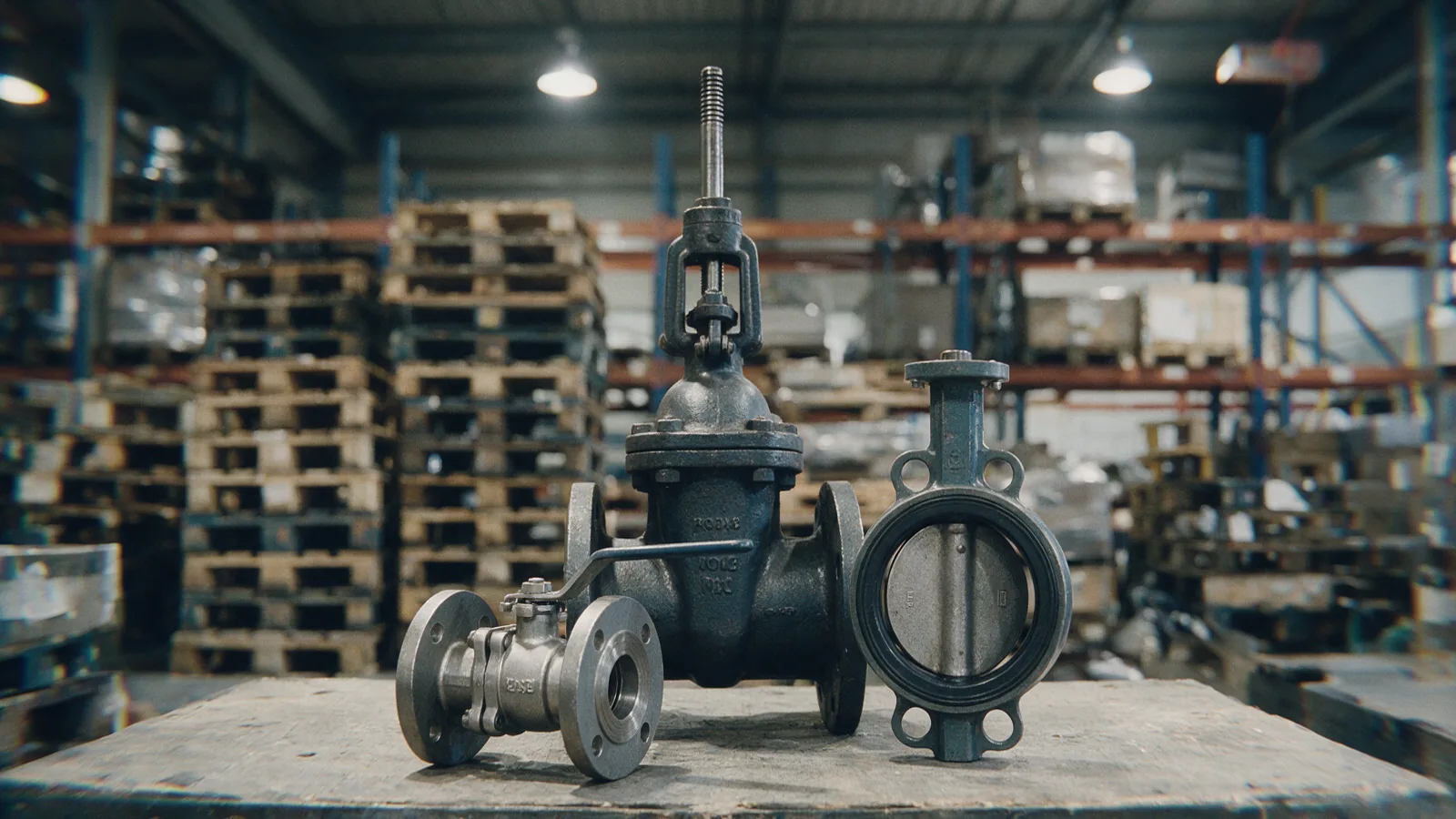
The three isolation families in one sentence each
A gate valve lifts a flat or wedge-shaped gate clear of a straight, full bore, so when it is open the fluid barely knows it is there. A ball valve rotates a bored sphere a quarter turn between full flow and a soft-seated shut-off that is tight from the first cycle. A butterfly valve rotates a disc that stays in the stream at every position, trading a permanent pressure drop for a body that is short, light and inexpensive at large bore. All three isolate. The valve selection guide places the choice in the wider sequence, and the comparison page covers bore, tightness, speed and cost side by side; this article goes after the criteria that decide real projects and rarely make the summary table.
Size: where the cost curves cross
Price, weight and torque behave differently with diameter for each family, and the crossovers are the practical answer to most isolation questions. Below about DN 100 a full-bore ball valve is the cheapest tight shut-off available and the lever fits in one hand. Through the mid range the ball's sphere, stem and body mass grow faster than the duty justifies, and gate valves take over wherever the bore must stay straight or the class is high. Above roughly DN 300 on water duty, a wafer butterfly valve is a fraction of the price and mass of either, and short enough to fit a header where a gate valve would not. Those crossovers shift with class, medium and whether the valve is actuated.
Exhibit: nine criteria that decide the choice, compared across the three families
| Criterion | Gate | Ball | Butterfly |
|---|---|---|---|
| Economic size band | Mid to large, and high class | Small to mid bore | Large bore, low to moderate class |
| Motion and turns | Multi-turn, slow, many rotations | Quarter-turn, seconds | Quarter-turn, geared at size |
| Operating torque | Low torque, long travel | High breakaway, rises with bore and class | Moderate, but dynamic torque varies with position |
| Body cavity and trapped fluid | Bonnet cavity above the gate | Cavity around the ball; needs venting on volatile media | Effectively none: no cavity to trap |
| Pressure drop when open | Lowest of the three | Near zero full-port; small loss reduced-port | Permanent: the disc never leaves the stream |
| Closure speed and surge | Slow closure limits water hammer | Fast closure can generate surge on long lines | Fast unless geared or actuator-timed |
| Fire type-test route | Metal-seated; tested with the pipeline families | Soft-seated quarter-turn: the classic API 607 case | Resilient liners rarely qualify; high-performance designs do |
| Actuation fit | Multi-turn electric or gearbox | Quarter-turn pneumatic or electric, simple mounting | Quarter-turn, lightest actuator for the bore |
| Face-to-face and weight | Longest and heaviest | Compact at small bore, bulky at large | Shortest and lightest by a wide margin |
Reference values. Confirm against the current edition of the standard and the manufacturer's rating table.
Duty: how often it moves, how tight it must shut, whether the bore must stay clear
Frequency is the first duty question. A valve cycled several times a shift wants a quarter turn and a seat that tolerates it; a valve that moves twice a year wants a design that will still move after two years of sitting. Tightness is the second: shut-off is specified as a leakage rate under ISO 5208, not as the word "tight", and a soft-seated ball sits at the strict end of that scale while a worn metal-seated gate sits far from it. Full bore is the third: pigging, scraping, drainable lines and slurry all rule out a disc standing in the stream, and rule out reduced-port balls with it.
Medium and temperature: soft seats, metal seats and where each family stops
Seat material sets the temperature ceiling more often than the body does. PTFE and filled PTFE ball seats are excellent on water, air and hydrocarbons at moderate temperature and retire well before steam conditions. Resilient butterfly liners in EPDM or NBR are ideal for chilled and condenser water, chosen against the glycol, and are not steam components at all. Metal-seated gate and globe valves remain the steam-main answer because there is no elastomer to fail. Body ratings across all three families come from the same tables, set out in ASME B16.34 pressure and temperature ratings explained, but a body rated for 400 °C with a seat rated for 200 °C is a 200 °C valve.
Ratings are decided by the body, and projects are decided by the seat, the torque and the length. Two valves with the same class on the nameplate can be entirely different purchases.
Isolation selection
Face-to-face, weight and installation cost on a large header
On paper a large gate valve and a large butterfly valve both isolate. On site they are different projects. The butterfly is a fraction of the mass, which changes the lift, the supports and sometimes the structural steel; it is far shorter, which changes the spool lengths either side; and a wafer pattern clamps between existing flanges rather than adding a pair. Face-to-face dimensions are standardised, so a replacement of the same pattern drops into the existing spool. A family swap almost never does. Where a plant room is congested and the duty is moderate-pressure water, that geometry decides the answer before price is discussed.
Actuation: quarter-turn versus multi-turn, and what it costs to automate
Automating a quarter-turn valve is straightforward: the actuator swings ninety degrees, the mounting is a standard pattern, and a spring-return unit gives a defined fail position. Automating a multi-turn gate valve means a multi-turn electric actuator or a gearbox, more travel, more time per stroke and a larger unit. Against that, ball valves demand the highest breakaway torque of the three, so a large actuated ball can need a bigger actuator than a butterfly of the same bore. Butterfly discs also see dynamic torque that varies with position and flow. Actuator sizing therefore belongs in the valve decision, not after it. That is why it is worth naming the duty on the enquiry alongside the size.
Worked example: a chilled-water riser, a steam main and a fuel line at DN 150
Three lines, one nominal size, three answers. The chilled-water riser at 16 bar g and 6 °C is isolated a handful of times a year, needs no full bore, and sits in a shaft where length and weight matter: a resilient-seated butterfly valve, with the liner chosen against the glycol. The steam main at 10 bar g and roughly 184 °C rules out every elastomer and wants slow closure to avoid hammering the line: a metal-seated gate valve, class read at the design temperature. The fuel line is a hydrocarbon with a fire case and needs fast, tight, positive shut-off from an actuator: a soft-seated ball valve carrying a fire type-test certificate, as set out in fire-safe valves: API 607 vs API 6FA.
Governing standards and the confirm-against-the-current-edition rule
Each family has its own design standard and they share the rating and test documents. API 600 and API 6D cover steel gate valves and pipeline valves; API 608 covers metal ball valves and API 609 covers butterfly patterns. ASME B16.34 rates all three by class and material group. API 598 and ISO 5208 define the tests and leakage classes, ISO 15848-1 the fugitive-emission classification. The glossary sets out what each document fixes and where it stops.
Reference values. Confirm against the current edition of the standard and the manufacturer's rating table.
Buyer mistakes: too cheap buys downtime, over-engineered buys cost
The recurring failures are family errors, not brand errors. A resilient-seated butterfly valve bought for a steam line because the pressure looked low. The liner is gone within weeks. A cheap ball valve left half open as a throttle, wire-drawing its own seat until it will no longer shut. A heavy gate valve specified on a large chilled-water header out of habit, paid for in price, in crane time and in the supports that carry it for the next twenty years. Selection by service condition, described in which valve does this service actually need, avoids all three, because it forces the medium and the duty onto the page before the family is chosen.
Documentation to request once the family is fixed
The family decision changes what the paperwork has to prove:
- Shell and seat test report to API 598 or ISO 5208, with the leakage class stated, not implied.
- Seat and liner material with its temperature limit, which is usually lower than the body's.
- Face-to-face or end-to-end dimension standard, so the valve drops into the existing spool.
- Torque figures for actuated valves: breakaway and running, at the design differential pressure.
- Fire type-test and fugitive-emission certificates where the specification calls for them, with the qualified range.
How to read those documents is covered in sourcing and documentation.
Related product lines and the category pages this guide resolves to
Specify the duty first. Send the medium, pressure, temperature, size and quantity. View our trading brands or ask our Dubai team to confirm a suitable product.
Next step: send an enquiry with the service condition pre-framed
The family question is answerable in one exchange when the enquiry carries the inputs. State the medium and what travels in it, the operating and design pressure in bar g, the operating and design temperature in °C, the size and end connection, how often the valve will be operated and whether it is actuated. Send that to us and the reply can name the family, the class, the seat material and the test scope before anything is priced.