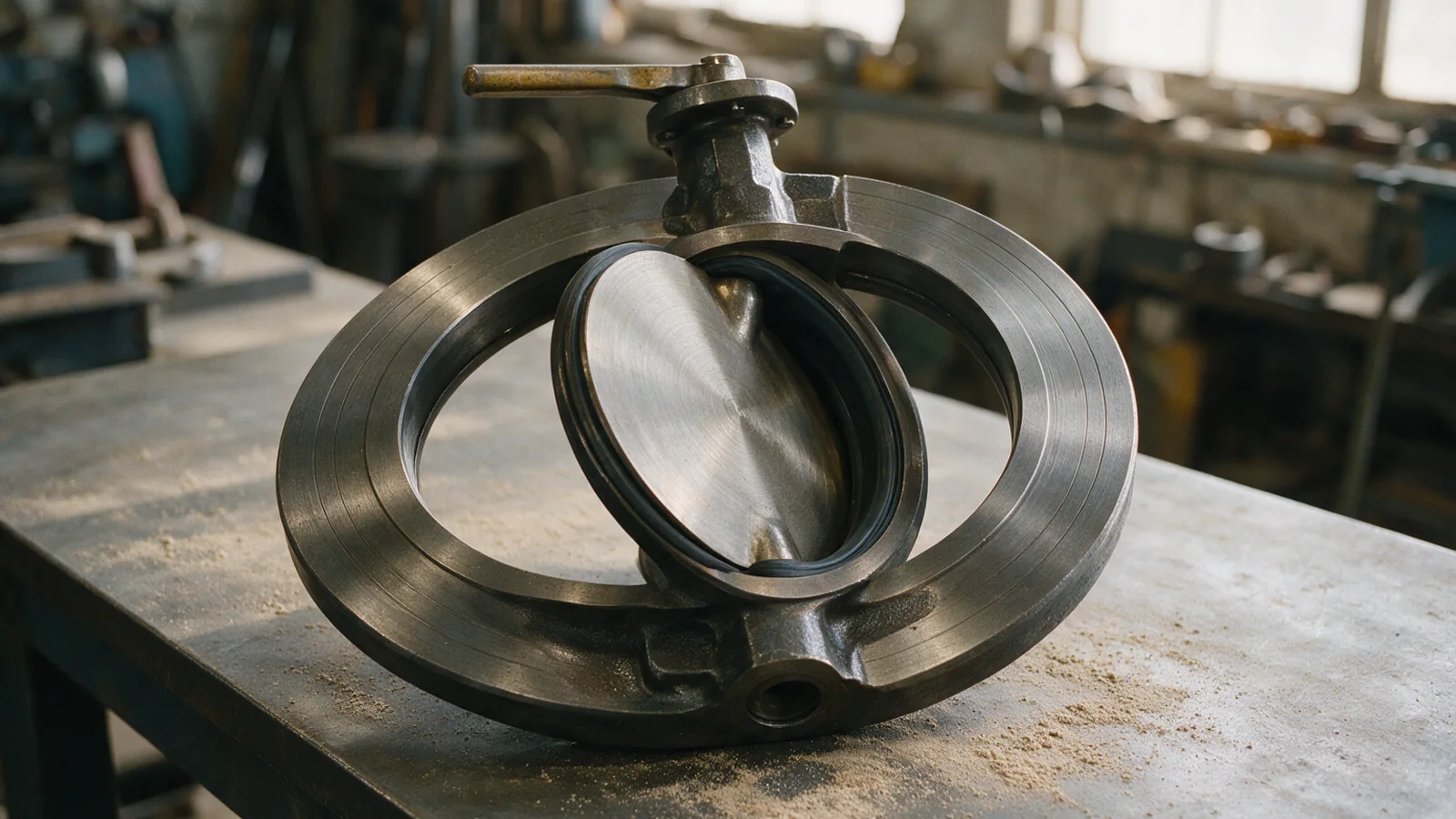
What is the difference between API 609 Category A and Category B?
The difference is how the valve is rated and how its seat is arranged. The American Petroleum Institute's published record of API Standard 609 describes Category A as "Manufacturer's rated cold working pressure (CWP) butterfly valves, usually with a concentric disc and seat configuration". It describes Category B as "ASME Class and pressure-temperature rated butterfly valves that have an offset seat and either an eccentric or a concentric disc configuration".
Category A's number comes from the manufacturer, and Category B's comes from a class and a temperature. That is the commercial point. One of those two tells a buyer what the valve does on a hot line, and it is not the first.
API Standard 609 covers, in the wording of the ninth edition's catalogue record, "design, materials, face-to-face dimensions, pressure-temperature ratings, and examination, inspection, and test requirements for gray iron, ductile iron, bronze, steel, nickel-based alloy, or special alloy butterfly valves". The two categories sit inside that one scope. They are not two standards.
Resilient seated, double offset, triple offset and high performance are trade descriptions, not designations API 609 defines: the standard defines Category A and Category B and no others. So a quotation that uses them has not yet told you which category it is offering. Ask for the category by name, with the edition. Choosing the valve type itself comes earlier, in valve selection.
| Point | Category A | Category B |
|---|---|---|
| How it is rated | A cold working pressure set by the manufacturer | An ASME class, with a pressure-temperature rating |
| Seat arrangement | Usually a concentric disc and seat | An offset seat |
| Disc | Usually concentric with the seat | Eccentric or concentric |
| Seat rating against body rating | Not addressed by the category description | May be lower than the body rating, in the eighth edition's record |
What does API 609's eighth edition say about seat rating against body rating?
It says the two can differ. API's own published record of the eighth edition states of Category B valves: "These valves may have a seat rating less than the body rating." A valve body may be a Class 300 casting while the seat holds less, and the seat is what stops the flow.
A valve bought as Class 300 because the body is Class 300 may not shut off at Class 300. An isolation duty depends on the seat, so the seat figure is a separate line on the datasheet, asked for at the service temperature rather than at ambient.
That sentence belongs to a particular edition, and the point is worth making on a page about editions. The ninth edition's catalogue record words Category B differently and does not repeat it. So treat it as a question to put to the maker rather than as a property every Category B valve carries, and confirm the two figures against the data sheet and the edition the project names.
Seat performance has a second dimension beyond pressure, which is how much leakage is accepted when the valve is shut. On an isolation duty that is proved by the valve's own inspection and test document, named on the line item, rather than by a control valve leakage class: why a seat leakage class is the wrong thing to quote on an isolation valve sets out the difference, and EN 12266-1 pressure testing covers how a shell and seat test is run. Stem and seat emissions are a third dimension, covered in ISO 15848-1 fugitive emission classes.
What does cold working pressure mean on a butterfly valve?
It is the manufacturer's own pressure rating, and API's record uses the term that way. Category A is defined as the manufacturer's rated cold working pressure, and that description does not tie the figure to an ASME class. The site's own glossary says the same of WOG, the marking that carries this kind of figure: a single cold working pressure, with no temperature curve behind it, and not an ASME class.
A cold working pressure figure and an ASME class figure are not interchangeable, even when the numbers look similar. API's record notes that Category A covers valves "having ASME Class 125 or Class 150 flange bolting patterns". A bolting pattern is a drilling, not a rating. A valve can match a Class 150 drilling and carry a manufacturer's own pressure figure instead of a class rating.
Most valve bodies a buyer meets are class rated, and that is the ordinary case. ASME B16.34 is the standard behind it, covering "pressure-temperature ratings, dimensions, tolerances, materials, nondestructive examination requirements, testing, and marking" for the valves in its scope, read per material group. API 609 Category A is the exception to watch for, because its number does not come from that route.
Which classes and end configurations does each API 609 category cover?
Each category covers its own set, and the sets have moved between editions. The ninth edition's catalogue record lists Category A as covering valves with ASME class 125 or class 150 flange bolting patterns. Category B spans a wider range of classes, tabulated in the standard itself.
The size and class tables are edition-specific, so this page publishes none of them. Reading a range from the wrong edition is how a specification asks for something the current standard does not cover. Take the figures from the edition the project names, and confirm them against the maker's data sheet.
The body styles are worth knowing by name, because they decide how the valve installs. The ninth edition's record puts it this way: "Valve configurations include double-flanged, lug- and wafer-type with facings that permit installation between ASME and MSS flanges and butt-welding ends." A wafer valve is clamped between two flanges; a lug valve has tapped lugs so one side of the line can be dismantled with the valve in place; a double-flanged valve bolts to a flange on each side. That is also a duty question, not only a convenience one. A plain wafer valve cannot hold a dead-end line on its own, and a lug valve has to be rated for dead-end service before it is used that way.
The title change between the two editions reflects that list. Butt-welding ends appear in the ninth edition's title and not in the eighth's.
What does API 609 expect the buyer to specify?
More than a size and a class. The ninth edition's catalogue record states that "Information to be specified by the purchaser is shown in Annex B". The standard carries its own list of what the buyer is expected to state, so an enquiry giving only a size and a class is incomplete by the standard's design.
An enquiry that names API 609 without naming the category has not yet asked for anything specific. The category decides how the valve is rated. Naming it, with the edition, is the shortest way to make two quotations comparable.
Actuation is the second thing a butterfly valve enquiry usually leaves open. Where the valve is actuated, the mounting interface is its own published standard, covered in ISO 5211 actuator mounting pads. Documentation is the third: which test and material certificates an order should ask for is set out in valve documentation a buyer should demand.
Is API 609 the only butterfly valve standard?
No. The Manufacturers Standardization Society publishes two of its own. The standards distributor Nimonik's catalogue record for MSS SP-67, titled Butterfly Valves, states that the standard practice "covers dimensions, design, testing, and marking requirements for butterfly valves" and that "Further reference should be made to the MSS SP-68".
MSS SP-68 is narrower and sits close to API 609's Category B. Its record, titled High Pressure Butterfly Valves with Offset Design, states that the standard practice "covers design requirements, test performance, marking requirements, and nomenclature for butterfly valves designed for high pressure performance, having a seat plane offset from the plane of the stem centerline". The offset seat is the feature MSS SP-68 and API 609 Category B share.
EN 593 is the fourth designation a specifier may write, and this site already names it alongside API 609 on its valves and HVAC and district cooling pages. A specification that names one of these documents has made a choice, whether or not the writer meant to, so read which one it names before quoting against it.
Where the question is which valve type to use at all, rather than which butterfly valve standard applies, the comparison is in gate, ball or butterfly isolation valves. Butterfly valves earn their place on large bore lines where cost and space decide, which is the crossover district cooling valve selection sets out.
Which edition of API 609 should an enquiry name?
Name the number and the year, and confirm the edition against API's own current record before the order. The ninth edition, dated 1 April 2021, is retitled to include butt-welding ends. API's own published record covers the eighth edition, of February 2016.
Editions move, and the size and class tables move with them. Naming a year alongside the number is what makes two quotations comparable, and the purchase order governs either way.
What should a butterfly valve enquiry say?
A butterfly valve enquiry to API 609 needs five lines in it before two quotations can be compared: the category, the standard and its edition year, the body and seat ratings at the service temperature, the body style and end connection, and the actuation interface. Each one closes a variable the phrase "to API 609" leaves open on its own.
- The category, A or B, because the category decides how the valve is rated.
- The standard and the edition year, since the tables differ between editions.
- The body rating and the seat rating, both at the service temperature rather than at ambient.
- The body style and end connection: wafer, lug, double-flanged or butt-welding ends.
- The actuation interface and the certificates wanted, stated as their own lines.
Flowsynergy Solutions Limited, at Level 41, Emirates Towers, Sheikh Zayed Road, Dubai, supplies industrial valves, pipeline fittings and flow-control equipment for commercial, industrial, HVAC, water, power and oil and gas applications. Butterfly valves are one of the categories offered, alongside ball, gate, globe, check and knife-gate valves. Send those five lines to enquiry@flowsynergy.ae, call +971 4 313 2786 between 8:30 am and 5:00 pm Dubai time, Monday to Friday, or use the contact page. Technical support and testing covers help settling a category, a rating and an actuation interface before the order.
Questions buyers ask about API 609 categories
How do I tell which API 609 category a quoted valve belongs to?
Ask how the valve is rated. A valve quoted with a cold working pressure figure and no class is being offered on the Category A description. A valve quoted with an ASME class and a pressure-temperature rating is being offered on the Category B description. API's record ties the categories to exactly that difference, so the rating line on the quotation answers the question.
Is a high performance or double offset butterfly valve the same as Category B?
Not necessarily, because those are trade descriptions rather than designations API 609 defines. The standard's own split is between a manufacturer-rated Category A valve and an ASME class rated Category B valve, and the Category B description is the one that fixes an offset seat. A datasheet using the trade words has not yet said which category it is quoting, so ask.
Does a Class 150 bolting pattern make a valve Class 150 rated?
No. API's record describes Category A as covering valves "having ASME Class 125 or Class 150 flange bolting patterns", while the rating itself is the manufacturer's cold working pressure. A bolting pattern settles how the valve bolts into the line. It does not settle what pressure the valve holds at temperature.
What is the difference between a wafer and a lug butterfly valve?
How each one is held in the line. A wafer valve is clamped between two mating flanges by through bolts, so removing it means opening both sides. A lug valve has tapped lugs, so one side of the line can be dismantled while the valve stays bolted to the other. API 609's configurations cover both, together with double-flanged bodies and butt-welding ends. A plain wafer valve cannot hold a dead-end line alone; a lug valve rated for dead-end service can.
If a datasheet names MSS SP-67, has it named API 609 as well?
No. They are separate documents from separate publishers. MSS SP-67 is a standard practice that sets out how butterfly valves are dimensioned, designed, tested and marked, and its own record points onward to MSS SP-68 for high pressure offset-design valves. API 609 is the document that defines the two categories. A specification that names one has not named the others.
More on specifying valves and the paperwork that comes with them is collected in our insights.
Sources, read 7 October 2026. The American Petroleum Institute's own published record of API Standard 609, eighth edition, February 2016, titled Butterfly Valves: Double-flanged, Lug-and Wafer-type (the hyphen placement is API's own), for the Category A and Category B descriptions, the sentence that Category B valves may have a seat rating less than the body rating, and the ASME Class 125 and Class 150 bolting pattern wording. The standards distributor NORMSERVIS's catalogue record of API STD 609, ninth edition, 1 April 2021, retitled Butterfly Valves: Double-flanged, Lug- and Wafer-type, and Butt-welding Ends, for the retitling, the scope sentence quoted above, the configuration list including butt-welding ends, and the statement that information to be specified by the purchaser is shown in Annex B. The two records differ by a comma in the scope sentence; the wording quoted here is the ninth edition's. Publisher records held by the standards distributor Nimonik for MSS SP-67, listing MSS SP-67-2022 issued July 2022, titled Butterfly Valves, and for MSS SP-68, listing MSS SP-68-2021 as the current revision, issued January 2021, titled High Pressure Butterfly Valves with Offset Design, for both scope sentences. And ASME's own catalogue record for ASME B16.34 for the scope wording quoted above. EN 593 is named here as a designation only, as it already appears on this site's own valves and HVAC pages. Saved copies of all five records are kept with this page's working papers. This page names those standards and summarises their publishers' catalogue records in our own words. Beyond each standard's own designation and published title it reproduces no table, clause or other text, and it states no size range, class table, test pressure, duration or acceptance value. The wafer, lug and double-flanged descriptions above are our own plain-English explanation of how each body style installs, not text from any standard. Buy the current editions from API, MSS and ASME for the requirements themselves, confirm every line against the valve maker's data sheet, and your purchase order governs.