Why the catalogue default was written for somewhere else
Most hydronic valve guidance was written for temperate Europe, where the cooling season is short, buildings are low, closed loops are flushed properly because the programme allows it, and the outdoor air is not carrying salt. Every one of those assumptions changes in the Gulf, and each change lands on a different part of the valve schedule. The pillar guide, district cooling and HVAC, sets out the network from substation to coil; the families themselves are on HVAC and district-cooling valves, and the sectors that buy them on industries. This article deals only with what the region does to the selection, and with what it does not change, because a Gulf project still obeys the same pressure-temperature ratings as any other.
What the region changes, condition by condition
Five conditions, and the consequence each has for the valve schedule.
| Gulf condition | What it does to the hydronics | Consequence for valve selection |
|---|---|---|
| Year-round cooling load | Terminals modulate continuously; there is no shoulder season in which to shut down and service | Cycle life and actuator duty rating decide the choice, not first cost; specify serviceable-in-line designs |
| High-rise differential pressure | Riser ΔP varies widely between full occupancy and night setback, and static head is large at the base | Body class chosen on static head plus surge, and terminal ΔP window wide enough to cover both extremes |
| Tariffs and metering tied to ΔT | A low return temperature raises the flow the network must carry for the same load | Flow-limiting terminal valves and measurable balance become commercial items, not just comfort items |
| High design ΔT, so low flow per kilowatt | Terminals run near the bottom of their flow range; small valves and small orifices | Turndown and authority matter more; the oversized control valve becomes an on-off valve |
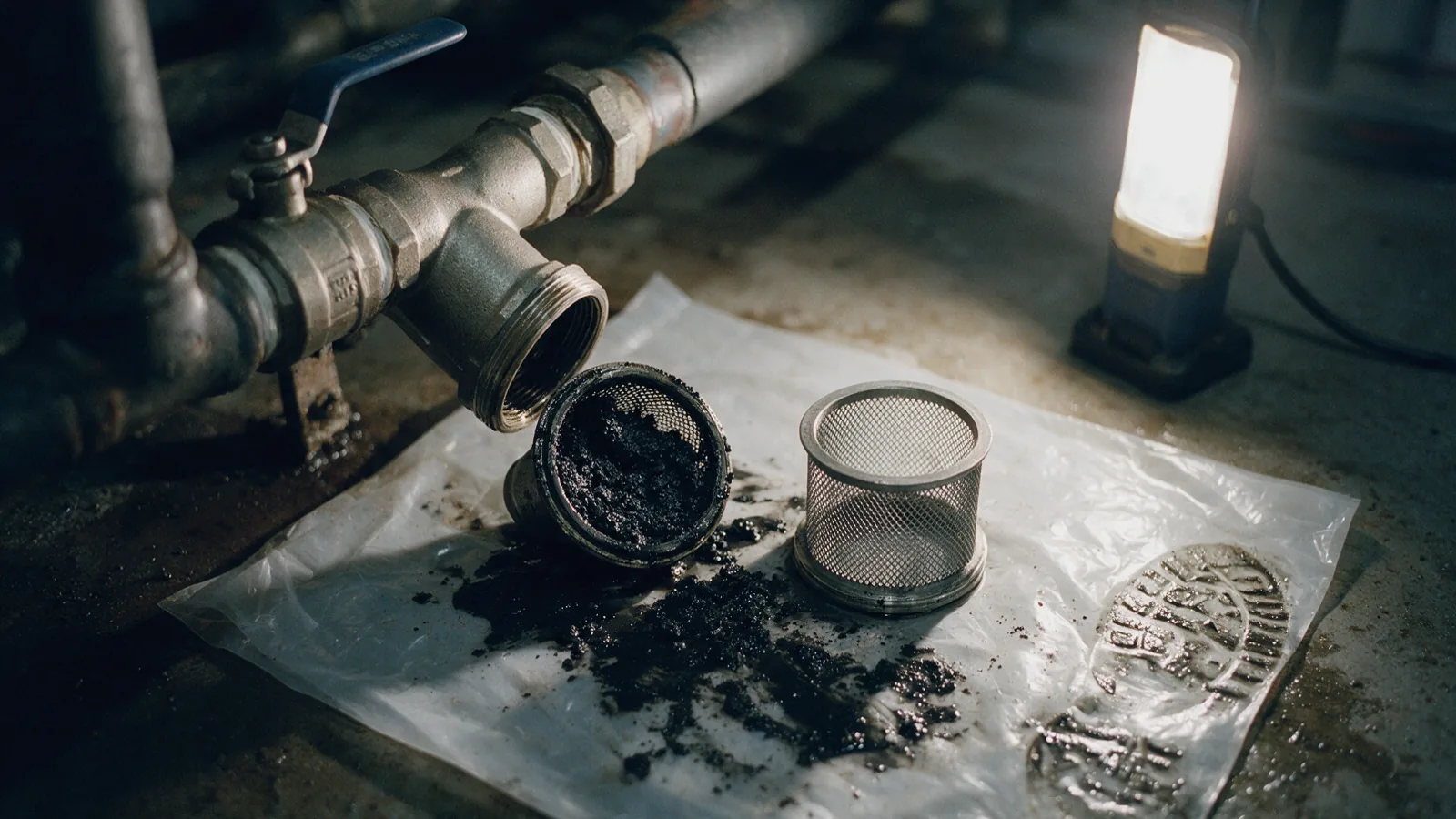
| Dirty closed loops in fast-track towers | Incomplete flushing leaves magnetite, scale and debris circulating for years | Strainer at every terminal, generous mesh area, and cartridges that can be withdrawn and cleaned |
| Chloride-laden, humid outdoor air | Attacks exposed stems, external fasteners and plant-room pipework, and condenses on cold surfaces | Stainless or coated external hardware, sealed actuators, and material choices proven against chloride pitting |
High design ΔT: less flow per kilowatt, and where that bites
District-cooling supply agreements push design ΔT up because a wider spread lets the network carry more load in the same pipe. The arithmetic is unforgiving in the other direction: raise the design temperature difference and the flow per kilowatt falls in proportion, so every terminal valve is asked to control a smaller flow. Two things follow. Conventional two-port valves lose authority, because the drop across a valve sized for the old flow becomes negligible against the branch resistance, and control degrades into hunting or on-off behaviour. And the practical minimum controllable flow of the valve (not the catalogue Kv) becomes the limiting number. Where the terminals cannot hold their flows, the return temperature collapses, the network runs low-ΔT syndrome at the plant, and the building pays for pumping it never needed. Guidance from ASHRAE treats that as a design-stage problem, not a commissioning one.
Continuous load: cycles, actuator duty and planned replacement
A valve in a European office might see a few thousand modulating cycles a year, concentrated in two seasons. A valve on a Gulf fan-coil sees them all year, and the same is true of the isolation valves on a header that never comes down. Seat elastomers harden, stem seals wear, and electric actuators reach their duty limit long before the body does. Specify accordingly: cycle-life data for the seat and actuator rather than a pressure rating alone; seats in materials rated for continuous chilled-water service; and a replacement plan that assumes the actuator is a consumable and the body is not. On plant that cannot be isolated, that plan also decides the arrangement. A double-isolation and bypass that lets a terminal valve be changed without draining a riser is worth more than a slightly better valve that cannot be reached.
Dirty loops: flushing reality in a fast-track tower
Programmes compress and flushing is what gets compressed. The result is a closed loop that circulates construction debris, weld scale and magnetite for its first several years. Fine-clearance devices are the casualties: pressure-independent cartridges lose their setting, control valve seats wire-draw, and small-bore terminal branches block. The countermeasures are dull and effective: a strainer at every terminal with enough open area that it does not become the restriction, sized mesh appropriate to the device it protects, side-stream filtration on the riser, and dosing with a corrosion inhibitor once the loop is clean. It also changes what a good valve looks like: one whose internals can be withdrawn and cleaned in place beats one that has to be cut out, whatever the datasheet says about accuracy.
Chilled-water chemistry: treated water, dezincification and materials that survive
Closed chilled water is not benign. Oxygen ingress at make-up, inhibitor that was dosed once and never checked, glycol that degrades and turns acidic, and stagnant legs in a partly occupied tower all attack the same components. Plain brass loses zinc and fails at the threads, which is why dezincification-resistant brass or bronze is the sensible default for small-bore terminal fittings. Elastomers must suit the treatment chemistry as well as the temperature. A seat compatible with plain water can swell in a glycol mix. Outside the loop, the humid, chloride-bearing air of a coastal Gulf plantroom is its own problem: exposed carbon-steel fasteners and unprotected stems corrode quickly, and stainless external hardware is cheap insurance.
Too cheap buys downtime; over-engineered buys cost. The valve that fails in a Gulf tower is rarely the one that was under-rated for pressure. It is the one that was correct on paper and unmaintainable in the ceiling void.
The position this guide takes: editorial, not a standard
Substation and plant-room isolation at size: butterfly valves on headers that never stop
At the energy transfer station and in the tower plantroom the duty is isolation on large bores, and butterfly valves do most of it. Three details decide whether they last. Seat type first: a resilient-seated wafer valve is the economical answer for chilled water at moderate pressure, while a double-offset design earns its cost where the header cannot be depressurised for service and tight shut-off is required at differential. Disc and shaft material next, chosen for the water treatment rather than the catalogue default. Then operation: a gearbox is right for a valve stroked twice a year, an actuator for one on a rotating duty, and the choice between them is a maintenance decision. Gate, ball or butterfly for isolation works through the families in detail.
Worked example: a tower on a district-cooling network
Follow the water through a residential tower connected to a network like those operated in Dubai by Empower. At the substation, the building side takes flanged isolation valves rated for the full static head at the lowest level plus surge, with a strainer ahead of the heat exchanger and a control valve on the primary side sized for the contracted ΔT. At each riser, isolation plus a differential-pressure control valve so that floors commissioned this year are not un-balanced by floors connected next year. At the terminal, one pressure-independent valve per coil with its own strainer, dial set to the design flow, sitting inside its stated ΔP window at both load extremes. Every one of those choices traces to a figure someone has to state: flow, differential, static head, temperature.
Reference values: confirm against the current edition of the standard and the manufacturer's rating table.
Governing documents and the confirm-the-edition rule
Nothing about the region changes the documents. Bodies and ends are rated under ASME B16.34 and ASME B16.5, shell and seat tests report to API 598 or ISO 5208, pressure-retaining parts carry EN 10204 inspection documents, and materials exposed to chloride are commonly assessed against ASTM G48 pitting tests, each unpacked in the glossary. Commissioning discipline follows the codes published by CIBSE. What the region changes is which duty point you check the rating at, and how much margin the maintenance regime deserves. Every figure quoted here is published reference data.
Reference values: confirm against the current edition of the standard and the manufacturer's rating table.
The two buyer mistakes
The first is the cheapest pressure-independent valve on every coil, bought on unit price for a loop that was never properly flushed and has no terminal strainers. It fouls, the flows drift, and the money reappears as re-commissioning and access works. The second is the mirror image: fully actuated, bus-connected valves on branches where a locked manual setting would have held for the life of the plant, bought because the specification was copied from a project with a controls team that this one does not have. Between them sits the schedule that was actually engineered: pressure independence where the load varies, measurable manual balance where it does not.
Documentation to request, and the next step
Ask for cycle-life data for seat and actuator; flow charts read at the project's design ΔT rather than a catalogue default; the ΔP window for every pressure-independent device; body pressure-temperature ratings against the static head at the lowest level served; material certificates to EN 10204 for pressure-retaining parts; and confirmation that elastomers suit the water treatment. The terminal decision itself is worked through in PICV or balancing valve for chilled-water terminals; more guides sit on Insights.
Specify the duty first. Send the medium, pressure, temperature, size and quantity. View our trading brands or ask our Dubai team to confirm a suitable product.