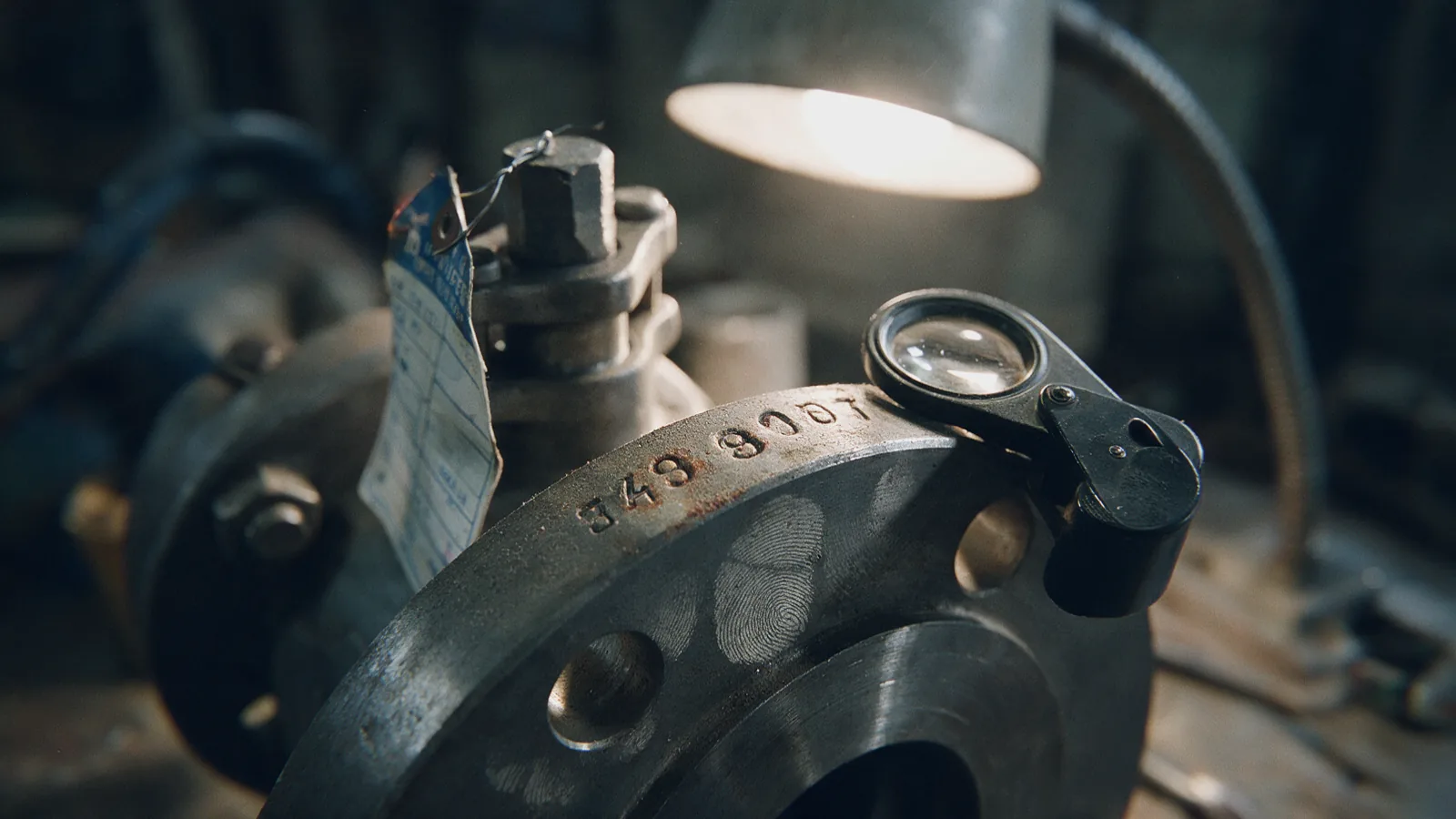
What EN 10204 is, and which document type your specification means
EN 10204 does not say how a valve is made or tested. It classifies the paperwork that comes with metallic products, and it defines four inspection document types. Type 2.1 is a declaration that the goods meet the order. Type 2.2 is a test report carrying results of non-specific inspection (tests on the production run, not necessarily on your item). Type 3.1 is an inspection certificate carrying results of specific inspection on the material actually supplied, validated by an inspection representative independent of the manufacturing department. Type 3.2 is the same certificate countersigned by the purchaser's representative or an independent inspection body. When a specification says "MTC" it almost always means 3.1, and when it says "witnessed" it means 3.2. Copies of the standard come from national standards bodies such as BSI. Each term used here is defined in our glossary of valves and standards, and this guide sits inside the sourcing and documentation cluster.
Document type, what it proves, what it does not prove
The right question about any certificate is not whether it exists but what it covers. The table separates the two.
| Document | What it proves | What it does not prove |
|---|---|---|
| EN 10204 2.1 | Goods meet the order, as declared by the maker | No test results, no heat traceability |
| EN 10204 2.2 | Test results from non-specific inspection of the run | Not necessarily your valve's own material |
| EN 10204 3.1 | Results for the material supplied, validated independently of production | Nothing about assembly, pressure test or fire behaviour |
| EN 10204 3.2 | The same results, countersigned by a second party | Not better material: a second signature only |
| API 598 test report | Shell and seat tests passed at the stated rates | Not a rating, and not evidence of service life |
| API 607 or 6FA certificate | A type test of that design survived a fire test | Not a test of your individual valve |
| ISO 15848-1 classification | Measured stem leakage class over an endurance cycle | Not the class after site handling and storage |
| NACE MR0175 compliance | Material and hardness limits met for sour service | Not a corrosion allowance or a life estimate |
| API monogram | A licence to mark products made to an API standard | Not per-order inspection or project approval |
| CE marking under PED | Conformity route for pressure equipment sold in the EU | Not a Gulf requirement in itself |
Reading a material test certificate
A 3.1 certificate is read in four passes. First the heat number: the cast or melt identity that ties the paper to the metal, and the number that must also appear on the body. Second the chemical analysis: element by element against the grade named in the order, ASTM A216 WCB or A105 or CF8M as the case may be, with attention to carbon, sulphur and any element the service restricts. Third the mechanical properties: tensile and yield strength, elongation, and impact energy at the test temperature where low-temperature service applies. Fourth the validating signature and stamp of the inspection representative, with the standard and edition cited. A certificate missing any of the four is not a 3.1, whatever the header says.
Pressure test reports: API 598 and ISO 5208
A material certificate says nothing about whether the finished valve holds pressure. That is the job of a pressure test report to API 598 or ISO 5208. Both define a shell test on the body, a backseat test where the design has one, and a seat or closure test, each at a pressure derived from the valve's rating and each with an allowable leakage rate for the seat type: soft seats normally sealing to a nil-visible-leakage criterion and metal seats to a stated rate per unit of bore. The report should name the standard, the edition, the test medium, the hold times and the acceptance criterion, and it should carry the same serial or heat identity as the valve.
A folder of certificates that nobody has matched to a body marking is not traceability. It is filing.
The one check that separates a document pack from a document pile
The API monogram: a licence, not a project approval
The API Monogram programme licenses a manufacturer to apply the API mark to products made at a registered facility to a specific API product standard, under an audited quality system. It tells a buyer that the maker's process has been assessed and that the product family is within the licence scope. It does not mean an inspector attended your order, it does not extend to items outside the licensed scope, and it is not a substitute for the material certificate or the pressure test report. Check the licence number and the scope, not just the presence of the mark, and check that the standard on the licence is the standard your specification names.
Fire-safe and fugitive-emission certificates
Where a specification calls for fire-safe performance it will name API 607 for quarter-turn valves with non-metallic seats, or API 6FA for valves under API 6D and 6A. Both are type tests: a representative valve of that design, size range and pressure class is burned under controlled conditions and the leakage measured during and after the fire. The certificate covers the design, not the specific unit shipped to you, and the size and class range on the certificate must bracket what you ordered. Fugitive-emission classification under ISO 15848-1 works the same way: a tested class, at a stated temperature and cycle count, for a defined design (low-emission valve classes explained). Our guide to fire-safe valves and when a specification needs them sets out which applies where.
Traceability: matching paper to pallet
Traceability fails on the receiving bay, not in the mill. On delivery, take the certificate pack and the goods together: read the heat number cast or stamped on each body and find it on a certificate; check the body markings for the material grade, pressure class and standard called for by ASME B16.34; check the tag or nameplate for the serial that appears on the test report; and check that end connections match the flange standard the line is built to. Where an item cannot be matched, quarantine it rather than accepting it into the store. The cost of resolving a heat number at the loading bay is an afternoon, and the cost of resolving it after installation is a shutdown.
A worked example: the document pack for a batch of steel gate valves
Ten cast-steel gate valves, Class 300, DN 100, flanged, for saturated steam. A complete pack is: an EN 10204 3.1 inspection certificate for each heat covering body, bonnet and stem material; a pressure test report to API 598 listing shell, backseat and seat tests with hold times and results; a dimensional and marking record against ASME B16.34 for the rating and ASME B16.5 for the flanges; the manufacturer's data sheet with the pressure-temperature rating for the material group; and a packing list tying serials to heats. If the specification adds sour service, NACE MR0175 hardness records join the pack. If it adds fire-safe, the API 607 or 6FA type-test certificate joins it too. Which class and material the service condition actually calls for is worked through in which valve does this service actually need and ASME B16.34 pressure and temperature ratings explained.
Reference values. Confirm against the current edition of the standard and the manufacturer's rating table.
Buyer mistakes, and a checklist to paste into the enquiry
Three mistakes recur. A certificate whose heat number matches nothing on the goods: common, and fatal to the audit trail. Paying for 3.2 witnessed inspection where the specification only asks for 3.1, which adds an inspector's fee and weeks of scheduling for no extra information about the metal. And accepting a fire-safe or emission certificate whose size and class range does not cover the item ordered. Too cheap buys downtime and over-engineered buys cost, and the document line of a quotation is where both are decided. So state the document requirement in the enquiry itself: inspection document type per EN 10204 and which components it must cover; pressure test standard, edition and acceptance criterion; fire-safe or fugitive-emission standard where the specification names one; NACE MR0175 where the service is sour; marking and traceability requirements; and the language and format of the pack. Our technical selection support, testing and maintenance page covers what we can test and verify after delivery.
Send the service condition with the document list
Documents are cheapest to get right before the order and most expensive after installation. Tell us the medium, the operating and design pressure and temperature, the size and end connection, and the document types your specification names. Send an enquiry and it comes back as a selection against the governing standard, with the document pack listed line by line so nothing is discovered on the receiving bay.