On this page8 sections
Sizing a butterfly valve for chiller isolation, in order:
- Take the line size: this is on-off duty.
- Fix the rating, PN or ASME Class, against the pipework and flanges.
- State the pressure the closed valve must hold, and the leakage allowed.
- Choose the body for how the chiller will be removed.
- Check the open-valve drop, then settle the operator.
Is a chiller isolation valve sized on flow?
No. A chiller isolation valve is specified at the size of the pipe it sits in, because its working positions are fully open and fully closed. A CPD module from the valve maker Crane Fluid Systems (CIBSE Journal, October 2021) calls ball and butterfly valves "the most common types of isolation valve employed in general HVAC applications", which "when closed, they offer a tight seal at their rated differential pressures".
The confusion is with control valves, which are sized on flow. In Pumps & Systems, Gilbert Welsford Jr., founder of the valve retailer ValveMan, holds butterfly valves to throttling "in low-pressure applications only, with the opening restricted to between 30 degrees and 80 degrees". One parked half open to trim a branch is doing the job of a PICV or balancing valve.
Flowsynergy supplies butterfly valves and the rest of the isolation range across the UAE and the Gulf from Level 41, Emirates Towers, Dubai, with valve selection and technical support. Pricing a chiller branch? Call +971 4 313 2786 or use the enquiry form.
What pressure rating must a chiller isolation valve hold?
Rate the valve against the highest pressure the pipework can reach, then check whether the project is written in PN or in ASME Class. Crane Fluid Systems states the rule: PN values "indicate the maximum working pressure in bar gauge (at a specific temperature) for the valve, and should be selected for at least the highest pressure that can be developed in the piping".
On a Gulf project, European and American specifications meet on one site. Crane Fluid Systems gives class 150 as what "would equate to PN20", and adds that "the flange hole configurations are not the same in the ANSI/ASME as in the BS EN standards". PN16 is not the same call-out as class 150: our guide to reading a flange call-out works the difference through.
Which document the valve was built to matters too. The American Petroleum Institute's record for API Standard 609 separates Category A, "Manufacturer's rated cold working pressure (CWP) butterfly valves", from Category B, "ASME Class and pressure-temperature rated butterfly valves that have an offset seat". Which of the two a quotation is offering is worth asking: our guide to API 609 Category A or Category B sets the definitions out in full.
What shutoff does isolating a live plant need?
State the pressure the closed valve has to hold and the leakage you will accept, because neither is settled by the class on the body. The American Petroleum Institute's record warns of Category B valves that "These valves may have a seat rating less than the body rating"; on a Category A valve the figure is the maker's own. Either way it is asked for, not assumed.
Leakage has its own vocabulary. The University of Michigan's valve guideline, section 15100 of April 1995, requires that "Butterfly, Ball and Eccentric Plug Valves shall be of bubble-tight construction". How tightness is proven on paper is in our guide to EN 12266-1 valve pressure testing.
Welsford, in Pumps & Systems, ties what a seat holds to disc offset: zero offset valves "provide sufficient sealing for low-pressure" duty, which he puts at up to 250 psi, while double offset valves "provide superior sealing for processes with pressure that reaches 1,440 psi". A chiller taken off line while the plant runs is isolated from a system still pressurised, so that differential is a project figure, not a catalogue one.
Does a chiller isolation valve need a lug body?
If the chiller will ever be unbolted, the valve must hold with the pipe on one side removed, which is what a lug body is for. The University of Michigan's valve guideline makes it a requirement: the body "shall be of full lug construction, and allow for disconnecting piping from either direction while maintaining shut-off service". The same guideline states that "For Chilled Water, Hot Water Heating and Condenser Water Systems, butterfly valves are preferred for isolation service".
Makers rate the bodies differently. Sure Flow, writing about its own range, says "Lug style bodies are full rated and suitable for ASME Class 125 and ASME Class 150 flanges" and lists "Dead-end service/removal of downstream piping" among typical applications. API Standard 609 is titled for all three patterns, "Butterfly Valves: Double-flanged, Lug-and Wafer-type", so naming the standard does not name the body.
What does the open disc cost in pressure drop?
A butterfly valve's disc stays in the flow when the valve is open, so it drops more pressure than a ball valve of the same size. Crane Fluid Systems quantifies it at one size, on a hot-water heating return at 30 degrees C rather than chilled water: what it calls "a full bore, butterfly valve" with a Kv of 98 from a manufacturer's data sheet, at 2 litres per second, drops 0.540kPa, where a similarly sized ball valve with a Kv of 338 gives 0.045kPa.
| At 50mm, 2 litres per second | Kv | Pressure drop |
|---|---|---|
| Butterfly valve | 98 | 0.540kPa |
| Ball valve (similarly sized) | 338 | 0.045kPa |
Kv and Cv are the two published names for that flow coefficient, both defined in our glossary. Crane Fluid Systems gives the working relationship as "Kv = 36Q /√Δp", rearranged to "Δp = (36Q/Kv)" squared, with flow in litres per second and the drop in kPa. Neither sizes this valve: they are the acceptance check. Take the figure for the series offered, work the drop at design flow, and hold it against what the project allows. Welsford warns that butterfly valves "are susceptible to cavitation and choked flow", because at the open position the valve "does not provide a full port". None of this rules the butterfly valve out: Crane Fluid Systems notes these valves "typically take up little more room than a pair of pipe flanges". Wider comparison: gate, ball or butterfly isolation valves.
What a Dubai chilled-water enquiry should state
Seven lines turn a valve enquiry into a quotation that can be compared. Chilled water is not a side service here: Empower, Emirates Central Cooling Systems Corporation PJSC, reported through the Dubai Media Office on 10 February 2026 a "total connected capacity" of "about 1.7 million refrigeration tons (RT)" in 2025, across 90 district cooling plants.
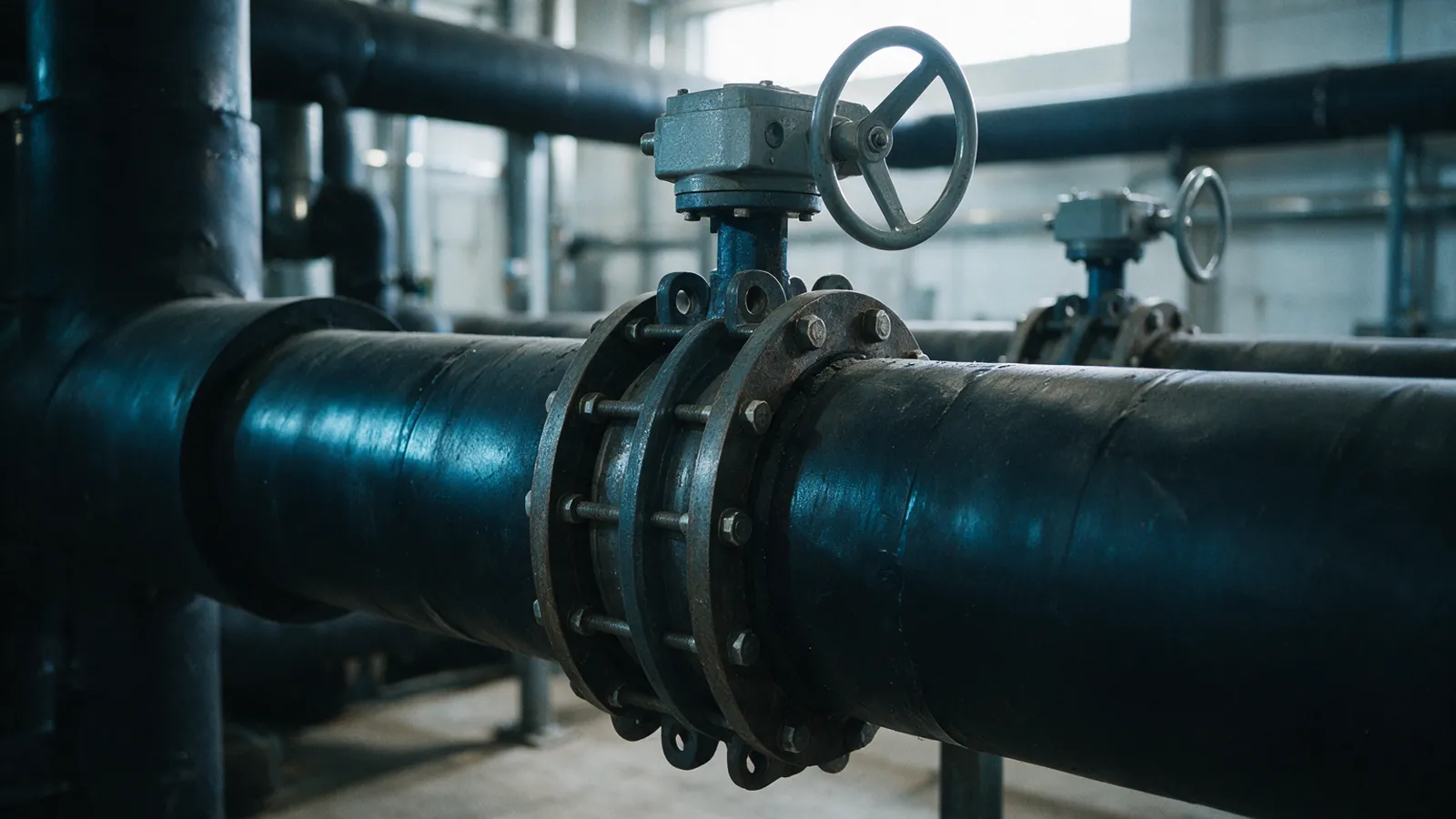
On the operator, Crane Fluid Systems notes these valves "shut off with a quarter turn, either using a direct, simple spindle or employing a gearbox for larger valves", and that they are "typically available with stem extensions to allow, for example, access to a handwheel beyond the thickness of insulation".
- Line size, in DN or NPS.
- Pressure rating as PN or ASME Class, with the flange standard it bolts to.
- Fluid and temperature range, including any glycol.
- The differential the valve must hold closed, and the leakage allowed.
- Body pattern, and whether the line will be broken on one side.
- Operator: lever, gearbox or an actuator on an ISO 5211 pad, plus any stem extension to clear the insulation.
- The documentation required at handover.
Send those and we can put a type and series in front of you. Wider picture: HVAC and district-cooling flow control for the Gulf and district-cooling valves in the Gulf. Call +971 4 313 2786 or write to enquiry@flowsynergy.ae, Monday to Friday, 8:30 am to 5:00 pm Dubai time.
Questions buyers ask about butterfly valves on chilled water
Three that come up on every chilled-water branch.
Does DN 200 mean the bore is 200mm?
No. The Crane Fluid Systems module is explicit that "the number following the letters DN does not represent a measurable value and should not be used for calculation purposes, except where specified in a relevant standard". It gives DN 50 as the 2 inch size, whose pipe has an outside diameter of 60.33mm.
Is a soft-seated butterfly valve suitable for chilled water?
Yes, with the liner and disc materials named. The Crane Fluid Systems module says that "with an appropriate combination of the elastomer (elastic polymer) liner and disc materials", butterfly valves "are suitable for use on CHW, LTHW, and domestic applications". Name both on the enquiry.
How far from a pump or elbow should the valve go?
Leave it room. Gilbert Welsford Jr. writes in Pumps & Systems that butterfly valves "should be installed at least four to six pipe diameters away from discharge nozzles, elbows or branches to minimize the impacts of turbulent flow". Settle that on the drawing, not on site.
Sources quoted on this page
- "Isolation Valves for HVAC Pipework Systems", a CPD module by the valve maker Crane Fluid Systems, CIBSE Journal, October 2021.
- The American Petroleum Institute's own record for API Standard 609, eighth edition, February 2016. The standard itself is not reproduced.
- University of Michigan design guideline 15100, Valves, April 1995: one owner's standard, quoted as a specifier's practice, not a code.
- Gilbert Welsford Jr. of the valve retailer ValveMan in Pumps & Systems, 2 March 2022, and Sure Flow product literature: both written by sellers of valves.
- Empower's 2025 results, Dubai Media Office, 10 February 2026.
Read 18 October 2026. Who we are: technical support and testing, about Flowsynergy. Reference only: nothing here says we stock a particular valve, are accredited to any of these standards, or test to them.