On this page12 sections
Already have a datasheet? Send it to enquiry@flowsynergy.ae for valve selection and technical support. The full checklist is further down.
Which parts make up a fail-close actuated LTCS ball valve?
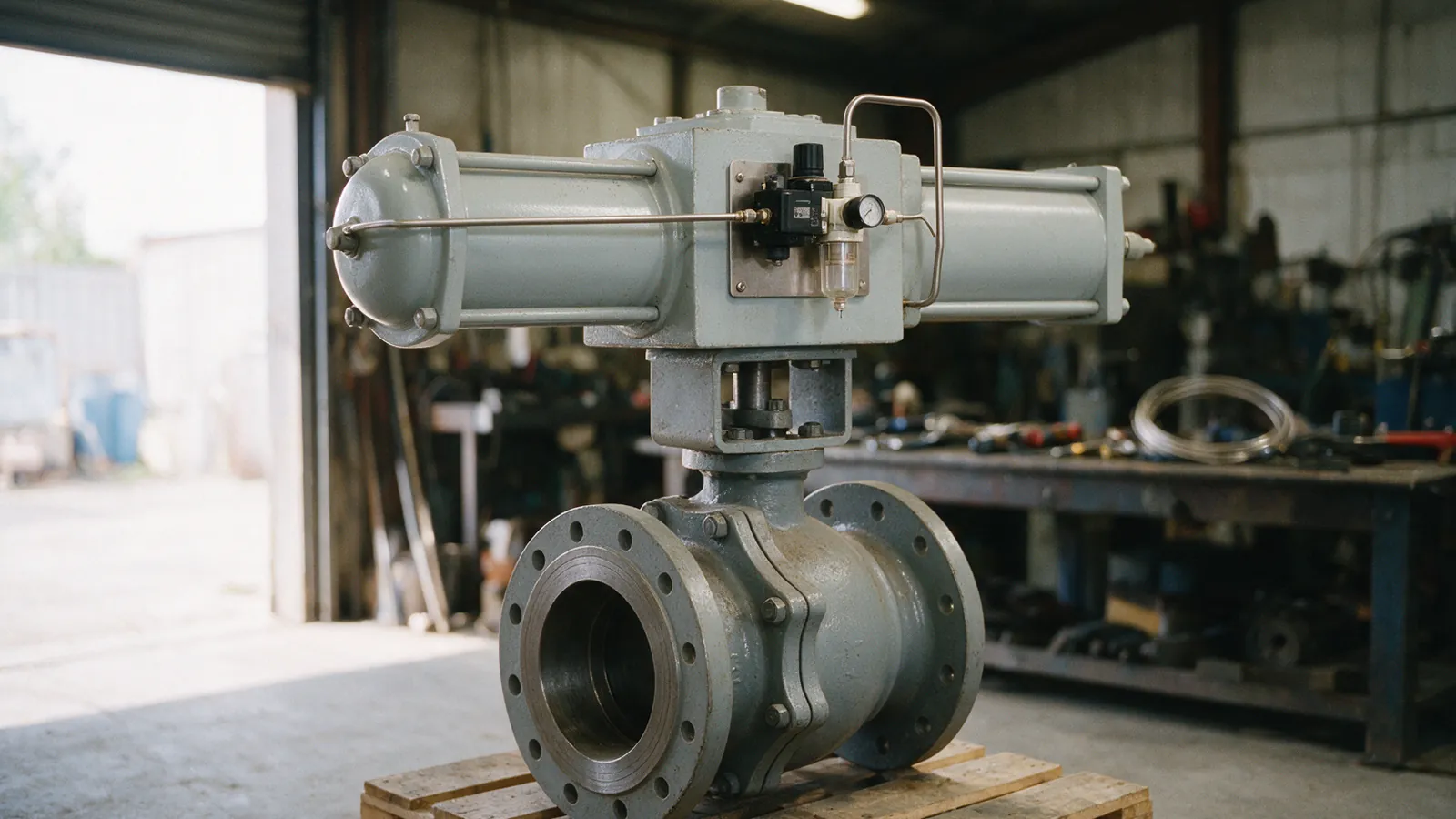
A fail-close actuated LTCS ball valve is three things bolted together: a ball valve with a low-temperature carbon steel (LTCS) body, cast for example to ASTM A352 grade LCC; a single-acting pneumatic actuator whose spring drives the ball shut; and a small panel of air accessories, typically a solenoid valve and a filter regulator, that decides when the air is let out.
Emerson's Control Valve Handbook defines fail-closed as "a condition wherein the valve closure member moves to a closed position when the actuating energy source fails". On a pneumatically actuated, spring-return valve that energy is instrument air. Air holds the ball open against the spring; when a trip vents the air, or the air supply fails, the spring swings the ball back through a quarter turn, shut, with no power needed.
In a floating ball valve the shut ball is then held tight by the line itself. KITZ, one of the valve brands Flowsynergy trades, explains that on closing, the ball is driven by the line pressure against its outlet-side seat, and that seat does the sealing. Its TDZ series is described as "flanged, full bore, split body, floating ball valves", compliant with ISO 17292 and API 608 and given an integral ISO 5211 mounting pad. This guide takes a cast LCC body as its example; the wider actuator and fittings range is on our actuators, dampers and fittings page.
Which datasheet lines decide the assembly?
Eight lines decide a fail-close actuated LTCS ball valve: the fail direction, the air and signal, the minimum design temperature, the sour service document, the class, bore and ends, the ball support, the closing time and seat leakage, and the documents to deliver. Emerson's handbook, written for control valves, puts the fail direction ("action desired on air failure"), with body material, end connections and rating, on its list of information for the valve maker.
| Datasheet line | What to write | Why it matters |
|---|---|---|
| Fail direction | Close, and how the solenoid behaves | Sets the spring direction and the panel logic |
| Air and signal | Minimum and maximum air pressure, solenoid coil voltage, trip signal | The actuator maker matches output to the air available |
| Temperatures | The coldest process temperature for the body and seats; the ambient range for the actuator and panel | LCC is tested to a set temperature; colder service normally needs another grade |
| Sour service | Document, part and edition, and the H2S conditions | The end user decides what is acceptable |
| Class, bore and ends | ASME class, full or reduced bore, flange face | Sets the pressure-temperature rating and the line fit |
| Ball support | Floating or trunnion mounted | A floating ball seals on line pressure; a trunnion ball turns on two opposed bearings |
| Closing time and seat leakage | The required values and the test that proves each | Emerson notes a proof test may verify safety time and valve leakage; name the test the project uses, for example EN 12266-1 |
| Documents | Material, impact, pressure test, fire test and sour service records | Each line above has to be shown, not stated |
The pressure class works the same way as on any steel valve: our guide to ASME B16.34 pressure-temperature ratings shows how the class and the body material set the allowed pressure at each temperature.
How cold can an LCC-bodied ball valve be specified?
ASTM A352 grade LCC is ordinarily proven to -46 °C. The standard gives each grade a "usual minimum testing temperature", the coldest point at which it normally has to pass the standard's impact test, and for LCC that point is -50 °F (-46 °C). Grade LCB carries the same figure. A line colder than that is outside LCC's usual range, and ASTM A352 lists colder grades.
ASTM A352 is the casting specification for pressure-containing parts, valves among them, "intended primarily for low-temperature service". It also covers colder ferritic grades, LC1 to LC4 and LC9, each with its own lower test temperature, and points to its Supplementary Requirement S51 for impact test temperatures. Its Note 1 adds that certain austenitic grades to ASTM A351 have been found suitable for low-temperature service, used with impact tests at energy levels and temperatures agreed between purchaser and manufacturer.
The body is not the only part with a limit. KITZ quotes -46 °C for the TDZ series in carbon steel on its low temperature page and fits extended bonnets "for assured stem seal and freezing prevention". Its standard HYPATITE PTFE seats on the SCTDZ series start at -29 °C; going colder takes an extended bonnet and special materials. Actuators have their own range: Rotork's GP comes in standard (-30 °C), low (-40 °C) and extreme low (-60 °C) temperature builds, all to +100 °C. Put the minimum process temperature on the body and seats, and the ambient range, coldest and hottest, on the actuator and panel.
What does a sour service line commit the materials to?
A sour service line, usually NACE MR0175 / ISO 15156, commits the materials to resisting the cracking that hydrogen sulfide (H2S) can cause in oil and gas production. It does not promise corrosion resistance: Parts 2 and 3 of ISO 15156 each state that the document "is concerned only with cracking". Acceptability for the actual line is the end user's decision.
For a cold, sour line the body carries two statements: its ASTM A352 impact test, and its qualification to ISO 15156-2, the part for carbon and low-alloy steels. The ball and stem need theirs too: a stainless trim falls under ISO 15156-3, the part for corrosion-resistant alloys. The document, part and edition belong on the datasheet; how each part reads is in our guide to NACE MR0175 / ISO 15156 for sour service valves.
Fail-close, fail-open or fail-in-place: what does the datasheet say?
The datasheet should name one of three outcomes, because a valve can be built to any of them. Emerson defines fail-safe as the valve going "fully closed, fully open, or remain in the last position, whichever position is defined as necessary to protect the process and equipment". A spring-to-close valve fails closed on loss of air by design; power and signal failures depend on the solenoid valve.
A solenoid valve may vent the actuator so the valve moves to its no-air fail state, or may trap air to hold it where it is; Emerson's handbook says three-way solenoids are generally used on spring-return actuators. Rotork notes its GP spring-return units "can be assembled to provide operation in either direction", so the direction is part of the order, not an assumption.
- Loss of instrument air: the spring closes the valve. Nothing else is needed.
- Loss of solenoid power: the valve closes only if the solenoid vents when de-energised. State whether it is normally energised and de-energised to trip.
- A trip from the shutdown system: the same solenoid action, so name the signal and who owns it.
How is the actuator sized and mounted?
The actuator is matched to the valve's torque and bolted to the valve's top flange. Emerson's handbook sizes a rotary valve actuator on two torques: breakout torque, which rises with the pressure drop at shutoff, and dynamic torque while the ball travels. On a spring-to-close unit, the spring stroke must still deliver enough torque to close and seat the valve at the end of its travel.
Scotch-yoke is one common design; Rotork's GP range is one published example. It offers a symmetric yoke, strongest at both ends of its travel, or a canted yoke strongest at one end, which "can often reduce actuator size, weight and cost" where the valve's torque demand suits. Ask the valve maker for torque figures at your shutoff pressure drop, and state the lowest air pressure the site can supply.
KITZ gives its TDZ series an ISO 5211 top mount with a CAPI stem. Our guide to ISO 5211 actuator mounting flanges explains what the flange and drive designations fix.
Why full bore for a fail-close ball valve, and why not throttle with it?
Full bore suits a fail-close ball valve on isolating or shutdown duty because the open valve barely restricts the line, and it is a poor choice for control. KITZ says its full port design gives minimal pressure loss. Emerson notes that a full-port ball, in the wide-open position, must rotate 15 to 20 degrees before it absorbs any significant energy from the system.
A fail-close LTCS ball valve with a solenoid trip is an open-or-shut device. For control duty, specify a valve made for it, as set out in our guide to valve selection by service condition.
Where is a fail-close LTCS ball valve used, and in which industries?
A fail-close LTCS ball valve is used where a line must shut without anyone touching it: emergency shutdown and isolation in oil and gas production, natural-gas sweetening and petrochemical plant, in cold or sour service. Emerson's handbook names ball valves as one of the final element types used for emergency shutdown (ESD) inside a safety instrumented system.
The industries follow from the documents. The ISO 15156-1 record scopes sour service to equipment in oil and gas production and natural-gas sweetening plants; sour refining has its own document, ISO 17945. KITZ builds its TDZ series to ISO 17292 and API 608 "to serve petroleum, petrochemical and allied industries". Our industries page sets out the sectors Flowsynergy supplies.
Emerson's handbook cites OREDA data that as many as 50% of failures within a safety instrumented function can be attributed to the final element, meaning the valve, actuator and their instrumentation together, which is why it calls for testing them periodically.
What should the delivery documents prove?
The delivery documents for a fail-close actuated LTCS ball valve should prove each datasheet line: the body and trim materials, the impact test at the stated temperature, the sour service statement against the named part and edition, the pressure test, and any fire test or fugitive emission qualification the specification calls for. A line without a document is a promise, not a property.
- Material and impact test records: see our guide to valve documentation, MTCs and test certificates.
- Fire test: KITZ offers API 607 / ISO 10497 fire test certification on the TDZ series. What those tests show is in fire-safe valves: API 607 vs API 6FA.
- Fugitive emissions: KITZ cites ISO 15848 for the TDZ gland design. See ISO 15848-1 fugitive emission classes.
- Safety rating: where the safety function needs one, the actuator maker's IEC 61508 certificate. It covers the device, not the loop.
What should an enquiry to Flowsynergy include?
An enquiry for a fail-close actuated LTCS ball valve should carry the datasheet lines above plus the line itself: fluid, pressures and temperatures, size, and the specification it must meet. With these, the valve, the actuator and the panel can be matched together rather than one at a time.
- Fluid, design pressure and the process temperature range, coldest first, and the ambient range at the actuator.
- H2S conditions, and the sour service document, part and edition.
- Size, ASME class, bore, ball support and flange face.
- Fail direction, air pressure range, solenoid voltage, trip logic, and open and closed limit switches.
- Hazardous area classification for the panel.
- Closing time, seat leakage, and the documents and tests required at delivery.
Specifying a shutdown valve? Flowsynergy, at Emirates Towers in Dubai, offers valve selection and technical support. Call +971 4 313 2786, email enquiry@flowsynergy.ae or use the enquiry form, Monday to Friday, 8:30 am to 5:00 pm, Dubai time. The wider selection route is in our valve selection guide.
What else do buyers ask about fail-close ball valves?
Is fail-close the same as fail-safe?
No: fail-close is one case of fail-safe. In Emerson's definition a fail-safe valve goes closed, open or stays in its last position, whichever protects the process. Fail-close is fail-safe with a shut safe position, so write "fail closed" on the datasheet rather than "fail-safe" alone.
At what temperature is an LCC casting impact tested?
At its usual minimum testing temperature, -46 °C (-50 °F). ASTM A352 gives that as the lowest temperature at which LCC ordinarily must meet the impact requirements, and points to its Supplementary Requirement S51 for impact test temperatures. Check that -46 °C is at or below the minimum design temperature, and check the impact records against it at delivery.
Can the same valve go into refinery sour service?
Not automatically. The ISO 15156-1 record says the standard is not necessarily applicable to refining; ISO 17945's record covers sour refining environments, and TWI names NACE MR0103 for refineries. So the materials need a statement against the refining document. Our guide to sour service valves sets out the difference.
Does a fail-close ball valve need partial stroke testing?
It depends on the safety function's test plan. Emerson's handbook describes partial stroke testing as exercising the valve a portion of its total travel to verify that it is not stuck, as a way to extend the interval between full proof tests. If the plan relies on it, the panel has to allow it, so state it on the datasheet.
Does a SIL-certified actuator make the valve SIL-rated?
No. Rotork's 2020 release says the GP is certified for use at SIL3 as a single device, but Emerson notes the final element is only part of the safety function, alongside the initiator and the logic solver. The SIL belongs to the whole safety function, so a certified actuator is one input to that assessment, not the result.
Sources quoted on this page
- Emerson, Control Valve Handbook, sixth edition, August 2023: definitions, solenoid valves, ordering information, actuator torque, full-port ball valves, partial stroke testing and safety instrumented systems.
- ASTM International, ASTM A352/A352M-21: scope, grade temperatures and Note 1.
- KITZ Corporation, Ball valves, Floating type ball valves (TDZ series), Ball seats and Ball valves for low temperature services.
- Rotork, GP/GH range flyer (PUB011-043-00, issue 05/26), and Rotork GP actuators selected for Asian LNG terminal, 6 November 2020.
- TWI, "What has happened to the MR0175 standard for sour service in exploration and production applications and what is ISO15156?"
- Standard Norge catalogue records for ISO 15156-1:2020, ISO 15156-2:2020, ISO 15156-3:2020 and ISO 17945:2015.
Read 27 October 2026. The ISO 15156 records show the 2020 editions, each with a revision in draft. Standards are cited and summarised; no clause or table is reproduced. Reference data only, not a claim that Flowsynergy stocks, tests or is accredited to any of these standards, or supplies any named actuator: confirm every line against the current edition and the maker's datasheet.