
On this page11 sections
Already have the specification? The enquiry checklist is in the last section; send the specification to enquiry@flowsynergy.ae for valve selection and technical support.
What does an explosion-proof rating on a valve actuator mean?
An explosion-proof (Ex) rating on a valve actuator means the actuator is built and certified for use where a flammable gas or dust may be present, and its marking states exactly which hazardous areas, gases and temperatures it is safe for. On a project specification it usually appears as a single line such as "Ex db IIB T4 Gb", plus the certificate the project accepts.
That line is a set of separate answers. The Wikipedia entry on electrical equipment in hazardous areas explains that explosion-protected equipment is marked with a protection marking identifying the equipment group, category, protection concept, gas or dust group, temperature class, and equipment protection level (EPL)
. Each part is read on its own below. The same entry adds that the marking also carries the maker's name, the apparatus type, its serial number, the year of manufacture and any special conditions of use
, which are worth reading before the actuator is installed.
What do Zone 0, Zone 1 and Zone 2 mean?
The zone says how often an explosive gas atmosphere is expected where the actuator will sit, and it decides how much protection the actuator needs. Wikipedia's entry gives the gas zones and a rough guide to how many hours a year each means:
| Zone | Flammable gas or vapour is | Guide | Protection level |
|---|---|---|---|
| Zone 0 | Present continuously or for long periods in normal operation | Over 1,000 hours a year | Ga |
| Zone 1 | Likely to exist in normal operation | 10 to 1,000 hours a year | Gb |
| Zone 2 | Not likely in normal operation; present only under abnormal conditions | 1 to 10 hours a year | Gc |
The entry's example of Zone 0 is the vapour space above the liquid in a tank. The zone for each place comes from the site's hazardous area classification, and the actuator is chosen to suit it, never the other way round.
Dust has its own scale. Zone 20 is where ignitable concentrations of dust, fibers, or flyings are present for long periods of time
, Zone 21 where they are likely under normal conditions and Zone 22 where they are unlikely, with protection levels Da, Db and Dc. Dust groups run from IIIA (fibres and flyings) through IIIB (non-conductive dusts such as flour, grain, wood and plastic) to IIIC (conductive dusts such as magnesium). Most valve actuator specifications deal with gas, but a dust area needs these instead.
How is an Ex marking on an actuator read?
An Ex marking is read left to right: equipment group and category, the type of protection, the gas group, the temperature class and the equipment protection level. Wikipedia gives a complete example and decodes it:
| Part | Meaning |
|---|---|
| II 2G | Group II equipment for surface industries, Category 2 gas protection |
| Ex ia | Intrinsically safe protection type "ia" |
| IIC | Suitable for IIC gases, including hydrogen and acetylene |
| T4 | Temperature class T4 |
| Gb | Equipment protection level Gb |
On a motorised actuator's nameplate the protection part is often flameproof, "Ex d", rather than "Ex ia", for the reason set out in the next section. A current nameplate often adds a level letter, as in "Ex db": since 2009 the IEC has used "a" for zone 0, "b" for zone 1 and "c" for zone 2
as the equipment's level of protection. So "Ex db IIB T4 Gb" reads as flameproof at level b, gas group IIB, temperature class T4, protection level Gb.
What is a flameproof (Ex d) actuator?
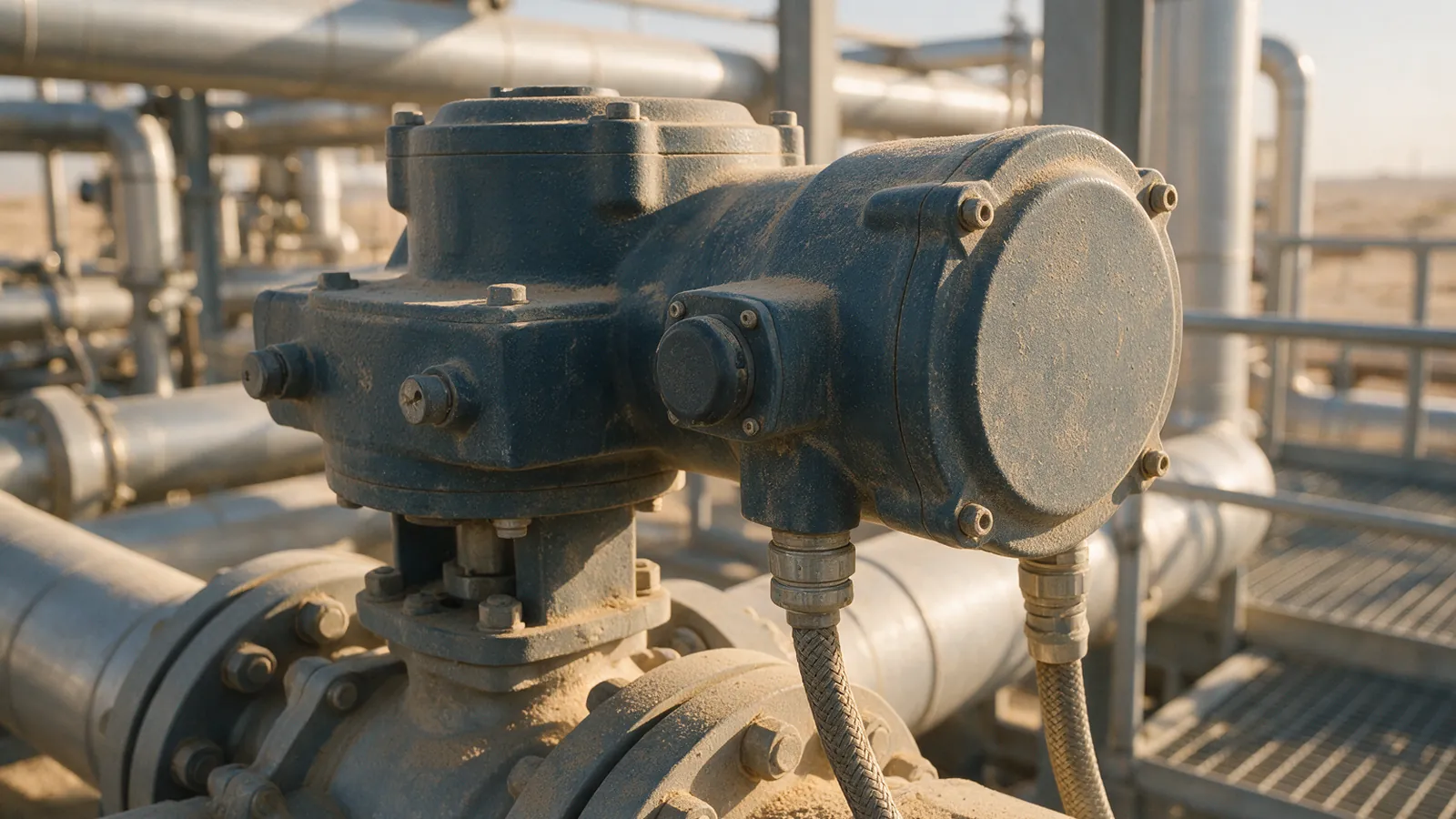
A flameproof actuator has an enclosure strong enough to contain an explosion inside it, with gaps so narrow that escaping gas cools before it reaches the area outside. Wikipedia describes the flameproof type of protection, code "d", as equipment that can withstand an internal explosion and provide relief of the external pressure via flamegap(s) such as the labyrinth created by threaded fittings or machined flanges
, with the escaping gases cooled so that they are not a source of ignition outside.
The same entry lists flameproof protection for Zone 1, if gas group & temp. class correct
, and names motors, lighting, junction boxes and electronics as its typical uses. An electric actuator is a motor and its controls in one housing, so flameproof protection fits it. Its list also includes increased safety ("e"), pressurised ("p"), encapsulated ("m") and intrinsically safe ("i"), in which any arcs or sparks in this equipment have insufficient energy (heat) to ignite a vapour
.
What do the gas groups IIA, IIB and IIC mean?
The gas group says which gases the actuator is safe in, from IIA (propane) to IIC (acetylene and hydrogen), and a higher group covers the lower ones. The hazardous areas entry lists the representative gases as IIA propane, IIB ethylene, IIB+H2 hydrogen, and IIC acetylene and hydrogen.
The rule that matters when ordering is the direction of cover. In its words, Equipment marked as suitable for IIB is also suitable for IIA but NOT for IIC.
So a specification for a hydrogen service needs IIC (or IIB+H2 where that is accepted); an IIB actuator does not meet it, however well it is built.
What does the temperature class T4 mean?
The temperature class is the highest surface temperature the actuator can reach, and T4 means the surface stays at or below 135 °C. Under the international (IEC) classes the hazardous areas entry lists, T1 is 450 °C, T2 300 °C, T3 200 °C, T4 135 °C, T5 100 °C and T6 85 °C.
The class is set against the gases present. The entry defines the autoignition temperature as the lowest temperature at which the substance will ignite without an additional heat or ignition source
, and explains that a T3 device will not rise above 200 °C
. A lower temperature means a higher class number, so a T4 actuator also meets a T3 requirement. The plant's area classification gives the class required for each area, and the specification governs.
ATEX or IECEx: which certificate does a specification mean?
ATEX is the European Union's legal framework for equipment in explosive atmospheres; IECEx is the IEC's international certification scheme for the same kind of equipment. A specification that names one is asking for that certificate, so check which one a project accepts before an actuator is selected.
The European Commission states that the ATEX Directive 2014/34/EU covers equipment and protective systems intended for use in potentially explosive atmospheres
; it has applied since 20 April 2016, replacing Directive 94/9/EC. Wikipedia's ATEX entry adds that equipment certified under ATEX is marked with the CE mark and the Ex symbol, and names a second directive, 1999/92/EC, on minimum requirements for improving the safety and health protection of workers potentially at risk from explosive atmospheres
: it is the site's side of ATEX, while 2014/34/EU covers the equipment.
IECEx is the IEC System for Certification to Standards Relating to Equipment for Use in Explosive Atmospheres
. Its certified equipment scheme is governed by the IEC and its international member bodies
and involves independent 3rd party testing and evaluation of products and equipment to confirm adherence to international standards
; equipment that passes is granted an IECEx Certificate of Conformity. IECEx says that since 1996 it has grown to more than 60 approved certification bodies (ExCBs) in more than 35 countries
.
| Point | ATEX | IECEx |
|---|---|---|
| What it is | EU law: Directive 2014/34/EU for equipment | The IEC's international certification scheme |
| What the equipment carries | The CE mark and the Ex symbol | An IECEx Certificate of Conformity |
| How it is assessed | Usually by a third-party notified body; Category 3 and Category 2 non-electrical equipment may be self-certified | Independent third-party testing by an approved certification body |
Whichever the project names, the certificate number on the nameplate is what it checks.
Does the rest of the valve assembly need an Ex rating?
Yes. Every item mounted on the valve is in the same hazardous area as the actuator, so each needs a rating that suits it, not only the actuator. On an automated valve that usually means the solenoid valve, the limit switch box, the positioner, the local control station and the cable glands.
A pneumatic actuator has no motor, but it is still equipment for a hazardous area, and its accessories are often electrical. Under ATEX, non-electrical equipment is covered too: Wikipedia's ATEX entry notes that manufacturers may self-certify Category 2 non-electrical equipment, though for Category 2 the technical dossier must be lodged with a notified body
. Our guide to the fail-close actuated LTCS ball valve shows a typical package of actuator, solenoid valve and filter regulator.
An Ex rating is also separate from the enclosure's dust and water rating. Our guide to actuator IP ratings covers that, and a specification for an outdoor hazardous area usually asks for both.
What should an Ex actuator enquiry state?
An enquiry for an actuator in a hazardous area should state the zone, the gas group, the temperature class and the certificate the project accepts, along with the valve and duty, because those decide which actuator can be offered at all. A complete line reads:
- The hazardous area: zone (or the equipment protection level, Gb or Gc; Db or Dc for dust), from the area classification.
- Gas group (IIA, IIB, IIB+H2 or IIC) and temperature class (for example T4).
- Certificate accepted: ATEX, IECEx or both, and any national approval the project names.
- Actuator type: electric or pneumatic, on/off or modulating, fail action if pneumatic.
- Valve: type, size, pressure class and the torque or the valve maker's data, and the mounting flange (ISO 5211 for part-turn actuators).
- Accessories on the valve (solenoid, limit switches, positioner) and the IP rating and ambient temperature range.
The quickest route is to copy the Ex line straight from the specification, with the valve data, and send both to enquiry@flowsynergy.ae; our valve selection page explains how we work through an enquiry. Mounting is covered in our guide to ISO 5211 actuator mounting flanges, and our actuators and fittings page lists what Flowsynergy supplies.
Frequently asked questions
Is "explosion-proof" the same as "flameproof"?
Not exactly. "Flameproof" (Ex d) names one type of protection: an enclosure that contains an internal explosion. "Explosion-proof" is used more loosely. On a specification, read the type of protection code rather than the word, because Ex d, Ex e and Ex i are different methods.
Can an IIB actuator be used where IIC is specified?
No. Equipment marked IIB is suitable for IIA and IIB gases but not for IIC, which includes hydrogen and acetylene. An IIC actuator can be used in an IIB area, but not the reverse.
Does a Zone 2 area need an Ex actuator?
Yes, but it can be rated lower than for Zone 1. The hazardous areas entry lists equipment protection level Gc for Zone 2 and notes that Category 3 equipment may only be used in Zone 2 areas, while Category 2 equipment may be used in Zone 1 or Zone 2. The project specification states what it accepts.
How do I know which certificate a project accepts?
Read the hazardous area section of the project specification: it names ATEX, IECEx, both, or a national approval. Quote the actuator against exactly what it lists, and check that the certificate number on the nameplate matches the certificate offered.
Sources quoted on this page
Read 7 November 2026. Confirm every detail against the current edition of any standard named and the project's own area classification and specification.
- Wikipedia, Electrical equipment in hazardous areas: gas and dust zones, gas and dust groups, temperature classes, types of protection, levels of protection, categories, marking contents and the example marking.
- Wikipedia, ATEX directive: certification, marking, Category 2 non-electrical equipment and the workplace Directive 1999/92/EC.
- European Commission, Equipment for potentially explosive atmospheres (ATEX): the scope and dates of Directive 2014/34/EU.
- IECEx, home page (the system's full name, certification bodies and countries) and Certified Equipment Scheme overview (how equipment is assessed and certified).
No clause, table or requirement text from IEC 60079 or Directive 2014/34/EU is reproduced here; the scheme is summarised from published secondary sources. The marking shown is a published example, not a rating of any product Flowsynergy supplies.