
On this page9 sections
Already have the specification? The enquiry checklist is in the last section; send the specification to enquiry@flowsynergy.ae for valve selection and technical support.
What does an IP rating on a valve actuator mean?
An IP (ingress protection) rating on a valve actuator states how well its enclosure keeps out solid particles and water, as two digits: the first for solids and dust, the second for water. A specification uses it to make sure the motor, switches and wiring inside an actuator survive where the valve is installed.
The IP code is defined by the International Electrotechnical Commission in IEC 60529, which classifies the degree of protection that mechanical casings and electrical enclosures give against intrusion, dust, accidental contact and water. It is published in the European Union by CENELEC as EN 60529. The code exists to give users more detailed information than vague marketing terms such as "waterproof".
The IP rating covers the enclosure only. The valve's own pressure rating, the mounting interface and any hazardous-area certification are separate lines on the specification.
What do the two digits of IP66, IP67 and IP68 stand for?
In IP66, IP67 and IP68 the first digit, 6, means the enclosure is dust-tight. The second digit sets the water protection: 6 for powerful water jets from any direction, 7 for temporary immersion up to 1 metre, and 8 for continuous immersion at 1 metre or more under conditions the manufacturer states.
| Digit | Position | What it means |
|---|---|---|
| 5 | First (solids) | Dust protected: dust is not entirely kept out, but not enough enters to stop safe operation |
| 6 | First (solids) | Dust-tight: no ingress of dust |
| 6 | Second (water) | Powerful water jets from any direction have no harmful effect |
| 7 | Second (water) | Immersion up to 1 metre: water may not enter in harmful quantity; tested for 30 minutes |
| 8 | Second (water) | Continuous immersion at 1 metre or more, under conditions the manufacturer specifies |
For outdoor sites with blowing sand and dust, the first digit matters as much as the second. A 6 in first place is the dust-tight level; a 5 lets some dust in, provided it does not interfere with safe operation.
Is an IP68 actuator also rated for water jets?
Not necessarily. Above IPX6 the water ratings are not cumulative: an enclosure tested for immersion (7 or 8) has not by that test been shown to resist powerful water jets (5 or 6). An actuator that has passed both is marked with both, such as IP66/IP68.
The IP code summary states that a device compliant with IPX7 "is not necessarily compliant with IPX5 or IPX6", and a device that meets both tests lists both, separated by a slash. On a site where actuators are washed down with hoses and can also be flooded, such as a valve chamber or a pump station, the specification should ask for both ratings rather than the higher number alone.
How deep and how long does IP68 cover?
IP68 has no fixed depth or duration. The standard leaves the immersion conditions to the manufacturer, so the depth of water, the time and any operation while submerged come from the actuator maker's own rating, and the specification should state what the site needs.
As one published example, AUMA says its actuators are typically supplied in IP68 to EN 60529, and that for AUMA, "IP68 means protection against continuous immersion up to 8 m head of water for max. 96 hours", with up to 10 operations permitted during continuous immersion. AUMA also offers versions for continuous underwater use: its SA-UW actuators are qualified for up to 15 m head of water as standard, with the actuator controls installed outside the flooded area.
An IP68 rating from another actuator maker can state a different depth and time, so the maker's data sheet governs. Where a valve sits in a chamber that can flood, write the expected depth of water, how long it may stay flooded and whether the valve must be operated while under water.
Does an IP rating protect against seawater, oil or chemicals?
No. IP tests are carried out with fresh water. Protection against salt water, oils or solvents is not covered by the rating and needs its own chemical resistance testing, so a coastal, marine or chemical site needs the enclosure's corrosion protection and materials specified separately.
For an actuator near the sea, on a desalination plant or in salt-laden air, ask the maker for its corrosion protection class and coating system as well as the IP rating. Seawater valve materials themselves are covered in our super duplex valve materials guide.
Which IP rating should a specification ask for?
Ask for the rating that matches where the actuator will sit: dust-tight for outdoor sites with sand and dust, jet protection where it is hosed down, and an immersion rating, with the maker's depth and duration, where it can be flooded. State both water ratings when the site needs both.
- Indoor plant room, dry: an immersion digit adds nothing where the actuator cannot be flooded; the dust digit still matters if the room is not sealed against dust.
- Outdoors, with dust and sand: a first digit of 6 (dust-tight).
- Washed down with hoses: a second digit of 6 (powerful jets), or both ratings where it can also be flooded.
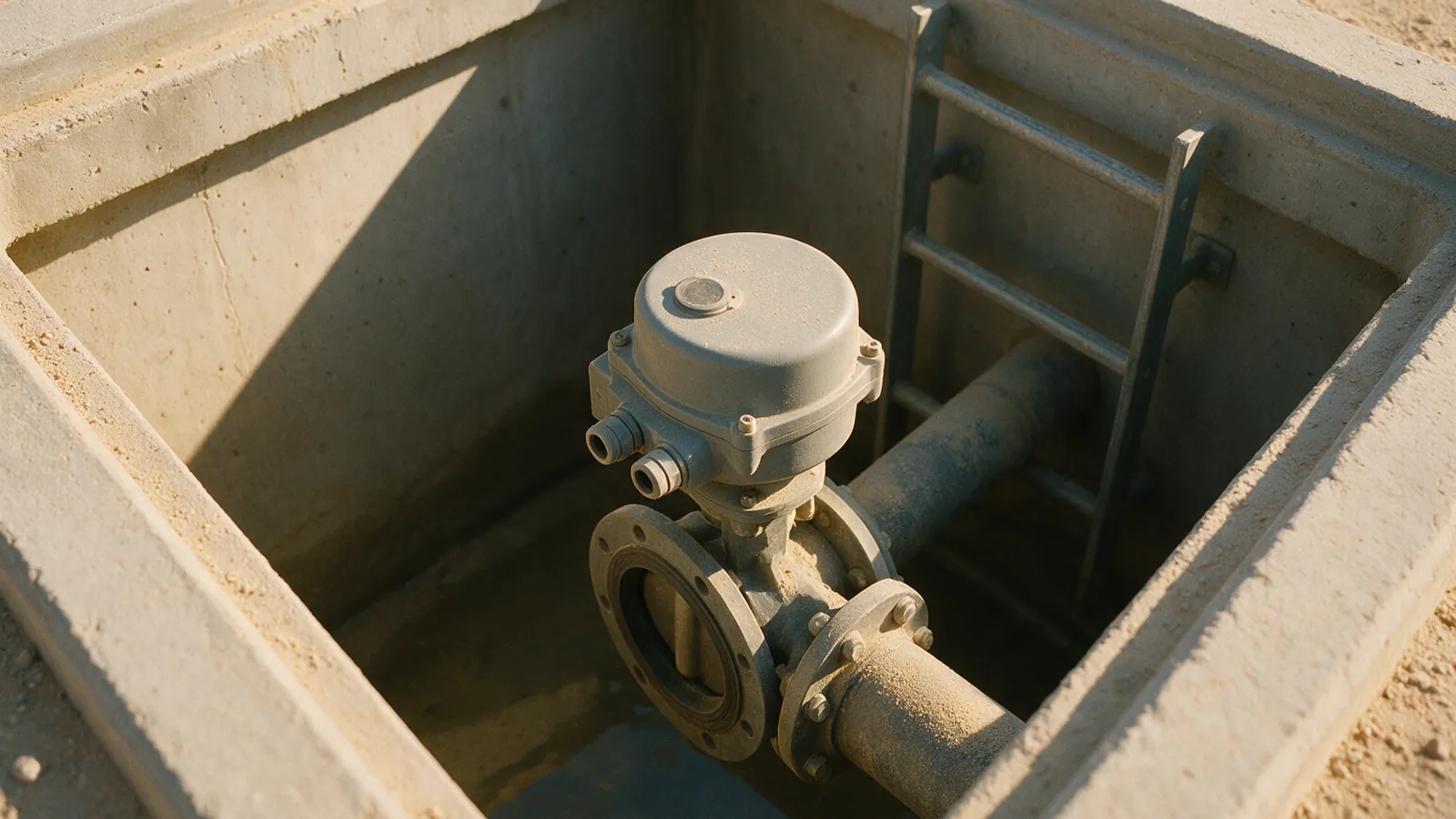
- Valve chambers and pits that can flood: IP68, with the depth, the time and any operation under water written on the line, checked against the maker's IP68 conditions. Valve selection for district cooling is in our district cooling valve guide.
- Coastal or chemical sites: the IP rating plus a separate corrosion protection requirement.
| Rating | Dust | Powerful water jets | Immersion | Where it fits |
|---|---|---|---|---|
| IP66 | Dust-tight | Yes | Not rated | Outdoors, dust and sand, hose washdown |
| IP67 | Dust-tight | Not shown by this rating | Temporary, up to 1 metre | Short, shallow flooding |
| IP68 | Dust-tight | Not shown by this rating | Continuous, 1 metre or more, as the maker states | Chambers and pits that can flood |
| IP66/IP68 | Dust-tight | Yes | Continuous, as the maker states | Washed down and floodable |
Two neighbouring ratings also appear on data sheets. IP65 is one step below IP66 on water: a second digit of 5 means water jets from a nozzle, where 6 means powerful jets. IP69K is not in IEC 60529: it comes from DIN 40050-9, now ISO 20653, for high-pressure, high-temperature wash-down.
What should an actuator enquiry state?
An actuator enquiry should state the valve it drives, the IP rating or ratings needed with any immersion depth and time, the site conditions, the power supply and the control signal, because those decide the enclosure, the motor and the controls. A complete line reads:
- The valve: type, size, pressure class and the torque or thrust if known, and whether the duty is on/off or modulating.
- The IP rating needed, both water ratings where both apply (for example IP66/IP68), and for IP68 the depth of water, the time and any operation while submerged.
- The site: indoor or outdoor, dust and sand, hose washdown, flooding, coastal or chemical exposure.
- Any hazardous-area requirement.
- Power supply and control signal.
- The mounting interface, such as the ISO 5211 flange for a part-turn valve.
Send the line to enquiry@flowsynergy.ae or call +971 4 313 2786, Monday to Friday, 8:30 am to 5:00 pm Dubai time, for valve selection and technical support. The full family of valve standards is in our valve selection guide.
Frequently asked questions
Is IP68 always better than IP67?
Not always. IP68 is expected to cover longer or deeper immersion than IP67, under conditions the manufacturer states, so it is the better choice only where the actuator can be flooded. Neither number says the enclosure resists water jets, so where jets matter ask for IP66 as well, written as IP66/IP67 or IP66/IP68.
What does an X mean in a rating such as IPX7?
An X stands in for a digit that has not been rated. IPX7 states the water protection only and gives no dust rating. For an outdoor actuator, ask for a full two-digit rating so the dust protection is stated too.
Is EN 60529 different from IEC 60529?
No. EN 60529 is the European publication of IEC 60529, issued by CENELEC, so an IP code means the same under either designation. Confirm which edition the project specification names, and ask for the rating in the same terms.
Is IP66 enough for an outdoor valve actuator?
For an outdoor valve actuator that sees dust, sand, rain and hose washdown but cannot be flooded, IP66 covers both: dust-tight and powerful water jets. Where the valve sits in a chamber or pit that can flood, IP66 is not enough on its own; ask for IP66/IP68 with the depth and time.
Sources quoted on this page
Read 4 November 2026. Product ratings are the maker's own published statements; confirm every detail against the current datasheet and the current edition of any standard named.
- Wikipedia, IP code: the code's definition, its digits, non-cumulative water ratings and fresh-water testing.
- AUMA, Enclosure protection: IP68 conditions for AUMA actuators and its underwater versions.
No clause, table or requirement text from IEC 60529, EN 60529 or ISO 20653 is reproduced here; the code is summarised from published secondary sources. AUMA is named only as a published example of an actuator maker's IP68 rating, not as a brand Flowsynergy supplies.