On this page9 sections
Why does a check valve slam?
A check valve slams when the liquid column has already turned around before the disc reaches the seat, so the disc stops a moving mass instead of a still one. DFT, one of the brands we trade, names the most common cause of hydraulic shock as "either a valve closing too quickly or a pump shutting down suddenly". When a pump trips, flow decays, reverses, and runs back at the closing valve.
The noise is a symptom of pressure, not of contact. AVK International puts it plainly: "the cause of the sound is not the physical closing but a sound wave arising from a pressure spike stretching the pipe wall". There is a scale for how bad it is. In Water Technology, John V. Ballun reports that "water hammers in the range of 50 to 100 ft (or reverse velocities of 0.5 to 1.0 ft/sec) represent a mild slam and can be tolerated", while "water hammers over 100 ft (or reverse velocities over 1.0 ft/sec) are extremely loud and should be avoided".
Flowsynergy supplies check valves across the UAE and the wider Gulf from Emirates Towers, Dubai, with valve selection and technical support. Have a noisy line? Call +971 4 313 2786 or use the enquiry form.
Why does a swing check valve slam hardest?
A swing check valve is the most slam-prone of the three, because nothing closes it except gravity and the returning flow. DFT's own description is that this design "relies on either gravity and/or fluid flow in order to close, and therefore the flow reversal must occur before closure begins". The reversal is the trigger, so the disc is still moving while liquid runs backwards.
Ballun ranks the result: the valves "with long strokes and no spring assist, the ball check and swing check, have the greatest potential for slamming". Read that with its provenance: the article reports valve maker Val-Matic's own tests and ranks Val-Matic products, so it is not neutral. Its author is a registered P.E. who "serves on six of the AWWA Standards Committees and also serves on five committees for the Manufacturers Standardization Society".
The API 594 call-out for a swing check is a dimensional split, not an end-connection one, and it is easy to get backwards. The NORMSERVIS record says Type "A" valves "have short face-to-face dimensions per this standard", with a body that "may be wafer, wafer with lugs, or double flanged"; Type "B" valves are "long pattern or short pattern with face-to-face/end-to-end dimensions per ASME B16.10", with a body "flanged or butt-welding ends". A swing disc is admitted under both.
When is a dual plate check valve the right choice?
A dual plate check valve splits the disc in two and springs both halves, which cuts the distance each travels and the time it takes. It is also the compact option: a short face-to-face body that bolts between flanges instead of adding a cast valve length to the line.
This is squarely API 594 territory. The catalogue record for API STD 594, ninth edition, February 2022, held by the standards distributor NORMSERVIS, describes Type "A" valves as short face-to-face, with a body pattern that "may be wafer, wafer with lugs, or double flanged" and an obturator that "may be single or dual plate, swing disc, or pivoting disc", over a size scope of DN 50 to DN 1200.
Do not read dual plate as second best on slam. Ballun's top non-slam tier is defined by spring-assisted closure and holds a dual disc valve alongside a silent check. The spring matters more than the plate count.
Do axial and nozzle check valves really stop water hammer?
A spring-loaded in-line check valve is the design built to beat the reversal, and the field evidence for it is the strongest on this page. Trade usage runs several names together here: axial, in-line, silent and nozzle. DFT says of its own axial flow silent check valve that internal springs "help close the valve before the flow reverses", so that "by the time the forward velocity had decreased to zero, the valve disc has reached the seat and the valve is already closed".
A measured case backs the type, not just the brand, and it was measured on nozzle checks specifically. A Hydraulic Institute case study of December 2024 reports the Tibidabo pumping station in Barcelona, on "a municipal water network over 125 years old and serving over three million users", where "comparing swing and nozzle check valves, the nozzle valves reduce the surge pressure spike after valve slam by over 80%". The station's swing check "was replaced with a nozzle check valve in order to reduce surge pressures". How far that figure carries to another geometry or duty, the study does not say.
The names are not interchangeable, and the standards show it. API 594 excludes "axial disc or body/stem guided disc (center spring type) valves, nozzle-type check valves, or lift-type check valves", listing axial-disc and nozzle-type separately. Only the centre-guided spring-loaded type has its own document: DIN Media's record for MSS SP-126:2025, current at 24 pages, titles it In-Line, Spring-Loaded, Center-Guided Check Valves and states these valves "are intended for use with clean fluids (i.e., fluids that contain no solids)". So a line reading "check valves to API 594" has not asked for a silent check valve: name MSS SP-126 too, and say which geometry you mean. The same discipline applies to a gate valve call-out, covered in our guide to API 600 against API 602.
Which type suits which duty?
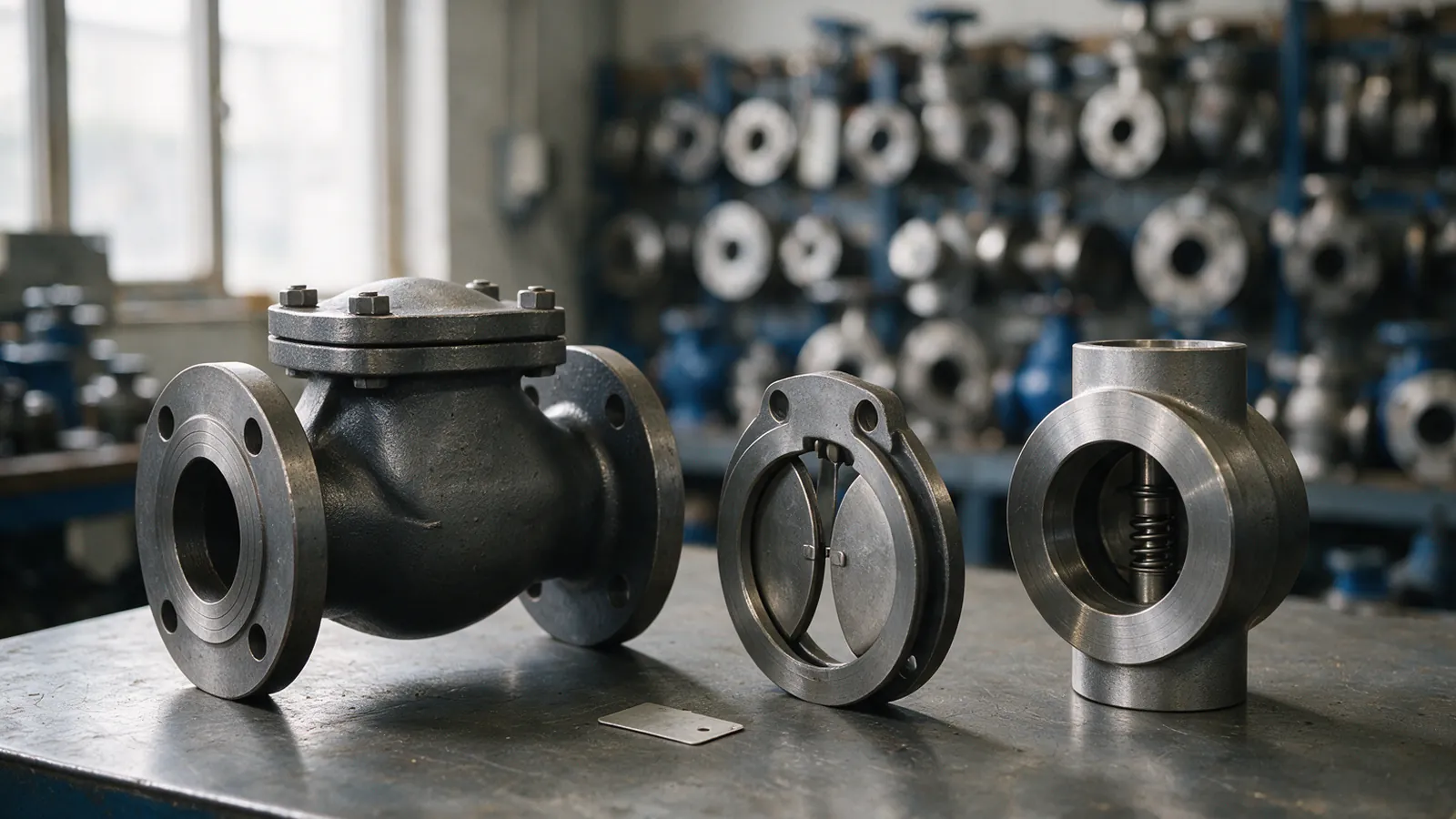
Match the check valve to how fast the liquid column turns around and to what the line carries. A pump discharge whose flow decays fast wants a spring-loaded in-line valve to MSS SP-126, on clean fluid. Limited face-to-face or budget points to a dual plate valve under API 594 Type "A". A slowly decaying line, or one carrying solids, keeps the swing check.
| Point | Swing check | Dual plate | Spring-loaded in-line |
|---|---|---|---|
| What closes it | Gravity and returning flow | Springs on two plates | A spring on a centre-guided disc |
| Stroke | Longest | Short | Shortest |
| Ballun's non-slam tier | Lowest: long stroke, no spring | Top tier when spring-assisted | Top tier |
| Standard | API 594, Type "A" or Type "B" by face-to-face basis | API 594 Type "A", short face-to-face | Outside API 594; MSS SP-126 |
| Fluid | Weigh waterway design for solids | Check the series | Clean fluids, per MSS SP-126 |
How do you size a check valve so it does not chatter?
Size a check valve on the flow it will actually see, not on the pipe it bolts into, because a valve that never opens fully can chatter. Writing in Valve Magazine in July 2025, Noah Miller of Check-All Valve explains that a swing or double-door check valve has "a minimum flow velocity requirement for whichever manufacturer, series and size" it is, and that below it "your check valve is partially open".
From there it follows: "any partially open check valve has the potential to chatter", and "any check valve that chatters will likely wear prematurely (sometimes severely)". For piston, poppet and ball types the same threshold appears as a pressure drop: it "can vary by manufacturer, series and size", and "for most manufacturers" it is "around 2 to 5 times the spring cracking pressure". Ballun puts the burden for the closing figures on the maker: "it is the responsibility of the valve manufacturer to provide the dynamic characteristics of their valves so that the engineer can predict the maximum reverse velocity that may occur."
So send us the duty, not just the size. Five things let our technical support put a type and a series in front of you:
- Line size and pressure rating, and the face-to-face gap between flanges.
- Normal, minimum and maximum flow, to check it against its minimum velocity.
- The medium, its temperature, and whether it carries solids.
- How the pump stops: a controlled ramp, or a trip.
- Orientation, which Ballun says the manufacturer should be consulted on.
Can a check valve alone stop water hammer?
Not always: a check valve is one input to a water-hammer calculation, not a cure on its own. Ballun is explicit that dynamic characteristic data "only offers the designer the tools necessary to evaluate the non-slam characteristics of various check valves", and has to be combined with "headloss, laying length, waterway design for fluids containing solids, and cost". Head loss is on that list for a reason: a spring is something the pump pushes against every hour it runs.
Diane Meyer, in WaterWorld, applies the same test: "it is essential to match the closing characteristic of the valve with the dynamics of the pumping system". In the Hydraulic Institute case the field measurements ran alongside a surge model, and "the surge model shows good agreement with field data". On a long line, a tall static lift, or a Gulf district-cooling plant whose pumps stop and start around the clock, that modelling is what says whether a different check valve is enough. Chilled-water duties have their own quirks, covered in district cooling valves in the Gulf; the wider picture is in valve selection by standard and service condition.
Questions buyers ask about check valves and water hammer
Where should a check valve be installed relative to the pump?
There is no universal figure, and anyone quoting one is guessing on your behalf: what matters is the position the flow holds the disc in, which is particular to the valve. Ballun's guidance in Water Technology is that "the manufacturer should be consulted for the potential impact of orientation and size on the performance of the selected valve": settle series and size first.
Does a bigger check valve close more gently?
The opposite, on the evidence. Ballun reports in Water Technology that "larger valves have heavier discs and longer strokes and will likely produce somewhat higher reverse velocities". Upsizing to be safe tends to make both problems worse at once: a heavier slam, and a disc that may not reach full lift at normal flow.
Is water hammer only a pump problem?
No. DFT names two common causes of hydraulic shock, "either a valve closing too quickly or a pump shutting down suddenly". A fast-acting isolation or control valve can produce the same surge with no pump trip at all, so closing time belongs in the specification for those valves too.
Does Flowsynergy supply check valves in Dubai?
Yes. Check valves are one of our valve categories, alongside ball, gate, globe, butterfly and knife-gate valves, with valve selection and technical support, supply, and valve testing, maintenance and repair from our Dubai office at Level 41, Emirates Towers, Sheikh Zayed Road. Call +971 4 313 2786 or write to enquiry@flowsynergy.ae, Monday to Friday, 8:30 am to 5:00 pm Dubai time.
Sources: the records and articles quoted on this page
Read 18 October 2026. The two standards are quoted from catalogue records held by standards distributors, never from the standards themselves, and no table, dimension or test value is reproduced.
- NORMSERVIS for API STD 594, ninth edition, February 2022; DIN Media for MSS SP-126:2025.
- John V. Ballun, "Company examines slam characteristics of check valves", Water Technology, 1 September 2003, reporting valve maker Val-Matic's own test programme; Noah Miller of Check-All Valve, "What's the chatter about check valves?", Valve Magazine, 28 July 2025.
- Hydraulic Institute, 12 December 2024, from a paper by David Lozano Sole, Roger Bosch Segarra (Aquatec, SUEZ Group) and Trey Walters (Applied Flow Technology); AVK International; DFT, a brand we trade; Diane Meyer, WaterWorld, 15 May 2020.
Reference information only. Nothing on this page is a claim that Flowsynergy stocks a particular valve, is accredited to any of these standards, or performs testing to them.