On this page10 sections
Already have the specification? The enquiry checklist is in the last section; send the specification to enquiry@flowsynergy.ae for valve selection and technical support.
What is a knife gate valve, and when does a specification call for one?
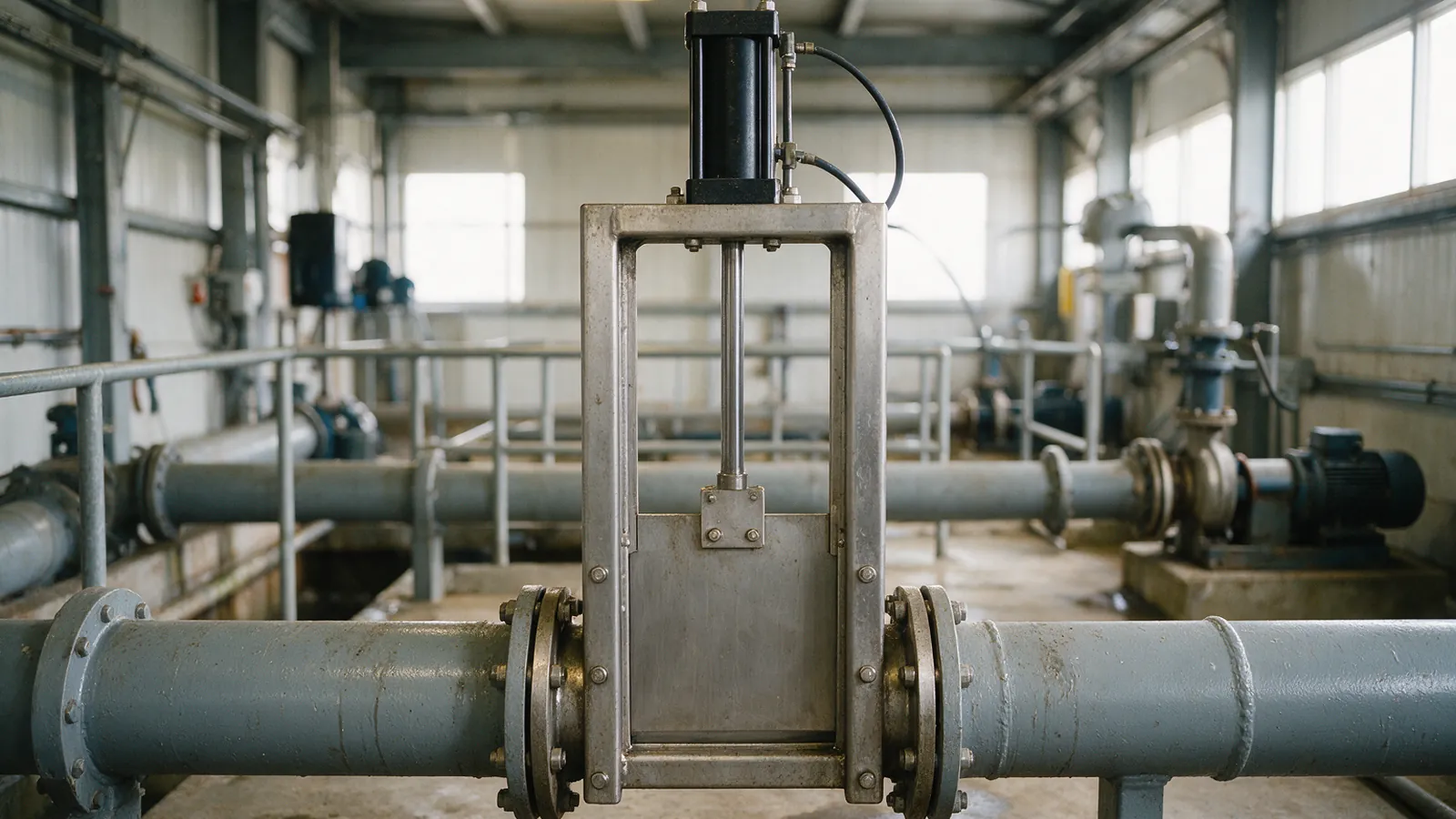
A knife gate valve is an isolating valve with a thin gate that slides across the bore. A specification calls for one where the line carries slurry, solids or dry material, because a full-port knife gate valve leaves no cavity for grit to collect in and stop the gate closing.
DeZURIK's October 2024 knife gate valve selection white paper lists the services: slurry, corrosive chemicals, vacuum, dry material handling, sanitary duty and free discharge. For slurry it says the valves are designed with full porting, "ensuring the absence of cavities that can accumulate grit from the slurry and prevent gate closure".
Bray's 2024 knife gate and slurry valve product guide lists pulp and paper, power, wastewater, chemical and mining among its application areas. DeZURIK's paper names six styles; the table sets out what it says of each.
| Style | How DeZURIK describes it | What to write on the line |
|---|---|---|
| Conventional | Cost effective, simple design and maintenance, rated to 150 CWP (cold working pressure) | Style and the line's working pressure |
| Unidirectional | Seals with flow in one direction; metal seats for higher temperatures or resilient seats for tighter shutoff | Flow direction and seat type |
| Bidirectional | Seals in both directions; for dead end service and backflow | Bidirectional, and any dead end duty |
| Push through | No packing chamber; cleans media from the gate to atmosphere; mainly abrasive slurry | Slurry duty and where the discharge goes |
| High performance | Replaceable wear rings protect the seats; designed to ASME Class 150 and 300 flange ratings | The ASME class and the pressure |
| Specialty | O-port designs for solids and hoppers, and lined valves | The duty, for example hopper outlet or lined service |
Unidirectional or bidirectional: which does the line need?
A unidirectional knife gate valve seals with the flow in one direction, using system pressure to push the gate onto the seat; a bidirectional valve seals in both directions. Choose bidirectional where the line can see backflow, or where the valve may have to hold pressure with the downstream pipe removed.
DeZURIK says a unidirectional valve "achieves effective shutoff through gate jams and system pressure pushing the gate against the seat", so it must be installed the right way round: "Proper installation ensures flow assists in sealing." A unidirectional valve can have metal seats for higher temperatures or resilient seats for tighter shutoff, and a deflection cone can direct abrasive media away from the seat.
A bidirectional valve, in DeZURIK's words, offers "bidirectional shutoff capabilities crucial for dead end service and backflow requirements", and allows the downstream flange to be removed while pressure is held on the upstream side. Mueller's Pratt bidirectional knife gate valve is one example: its rubber seat gives a "bi-directional, drip-tight seal across the gate from 0 to 150psig/10barg".
What does MSS SP-81 mean on a knife gate valve line?
DeZURIK describes MSS SP-81 as the standard used to design stainless steel, bonnetless, flanged knife gate valves, with acceptable leakage rates and test procedures. Makers also cite it for face-to-face dimensions (Bray) and the gate's rated pressure (Mueller). The line still has to state the size, pressure and test the project requires.
The makers read for this guide each cite it in a different way:
- DeZURIK says MSS SP-81 is "the standard used to design stainless steel, bonnetless, flanged knife gate valves", and that standards such as MSS SP-81 "define the acceptable leakage rates and testing procedures".
- Bray's Series 941 recommended specification asks for a single-piece, fully lugged body with MSS SP-81 face-to-face, a 150 psi (about 10.3 bar) rating from 2" to 24", and a shell and seat test per MSS SP-151.
- Mueller says the Pratt gate "withstands full 150psig/10barg rated pressure as required by MSS SP-81".
Low pressure lines need a check. DeZURIK says unidirectional valve seats are tested at 40 psi (about 2.8 bar) in accordance with MSS SP-81, and that where the line pressure is below 40 psi the valve maker should be contacted so the testing matches the actual service. Bar figures in brackets are our conversions. This guide summarises what the makers publish; it does not reproduce the standard, so confirm the current edition and its requirements before ordering. How seat leakage classes are written on other valve types is in our guide to FCI 70-2 seat leakage classes.
Metal seat or resilient seat on a knife gate valve?
A metal seat suits higher temperatures; a resilient (rubber or elastomer) seat gives tighter shutoff, up to zero leakage, within the elastomer's temperature limit. The seat is therefore chosen from the fluid, the temperature and how tight the shutoff must be.
Bray's specification offers an "Integral metal seat or optional resilient, zero-leakage seat". Mueller gives a resilient seat's limits: the Pratt valve's standard replaceable Buna-N seat is rated to 225°F (107°C), and the seat is also offered in Neoprene, EPDM, Viton and other materials. Mueller adds that its rubber seat sits flush with the bottom of the port, eliminating pockets that would collect media.
DeZURIK puts the shutoff question plainly: "Zero-leakage is essential for valves that require absolute isolation." Write the required shutoff on the line.
What changes for abrasive slurry and higher pressure?
Abrasive slurry and higher pressure call for a heavier knife gate valve: abrasion-resistant materials, hardened gates and replaceable wear rings that protect the seat, packing chambers with scraping rings, and a body rated to an ASME flange class rather than the conventional valve's cold working pressure.
DeZURIK's white paper says high performance knife gate valves are designed to meet ASME Class 150 and 300 flange ratings: in carbon steel, Class 150 valves withstand up to 285 psi (about 19.7 bar) and Class 300 valves up to 740 psi (about 51 bar). For slurry it describes abrasion-resistant construction and "specialized packing chambers with scraping rings to clean debris from the gate". A push through valve, with no packing chamber, discharges media cleaned from the gate to atmosphere, mainly in abrasive slurry service.
For corrosive chemicals, DeZURIK says the valve needs liners or special body and gate materials. How flange classes and PN ratings are written on a line is in our guide to PN or Class flange call-outs.
Can a knife gate valve throttle flow?
Not every knife gate valve can throttle. DeZURIK says it is important to recognise that "not all knife gate valves are suitable for control applications", so the line must state whether the valve is for on/off isolation or for throttling, and a throttling duty needs a valve the maker offers for it.
DeZURIK gives one example of a throttling design: for low-head free discharge on a dam outlet, special bonneted throttling knife gate valves with fully supported square gates, to prevent vibration and cavitation. Our guide to valve selection by service condition covers the alternatives.
How should a knife gate valve be installed?
Install a unidirectional valve so the flow assists its seal, support the gate and actuator of a large valve mounted horizontally, fit gate guards to keep fingers clear, and shield the gate and stem from falling material and weather. These points decide whether the valve still seals and moves freely after commissioning.
- Orientation: DeZURIK says horizontal installations of large knife gate valves need extra support for both the gate and the actuator, such as roller gate supports and actuator supports, to prevent side loads that misalign the gate.
- Dry material: some dry material duties need dry packing and the valve installed seat side up, so media does not build up in the seat area.
- Indoors: gate guards prevent finger pinching, and dust covers shield the gate and stem from material that could cause packing failure.
- Outdoors: DeZURIK lists insulation blankets, heat tracing, suitable elastomers and alloys, and protective coatings against moisture and UV light.
- Emissions: where gases or vapours must be contained, DeZURIK says a bonnet is used, generally with ring-style packing rather than rope-style.
What should a knife gate valve enquiry state?
A knife gate valve enquiry should state the media and its solids, the flow direction, whether the valve isolates or throttles, the pressure and temperature, the required shutoff, and the size and flange or face-to-face standard, because those decide the style, seat and rating. DeZURIK's own summary names most of them: media type, flow direction, isolation or control, shutoff, industry standards, temperature and pressure. A complete line carries:
- The media: slurry, chemical, dry solids or clean fluid, and the solids content.
- Unidirectional or bidirectional, and whether the valve may see dead end service.
- On/off isolation or throttling.
- Operating and test pressure, and operating temperature.
- Metal or resilient seat, and the shutoff required.
- Size, body type (wafer or lugged) and the face-to-face and flange standard, such as MSS SP-81.
- Operator: handwheel, bevel gear, pneumatic, electric or hydraulic, and any gate guard, lockout or limit switch.
- Installation: horizontal or vertical stem, indoors or outdoors.
Send the line to enquiry@flowsynergy.ae or call +971 4 313 2786, Monday to Friday, 8:30 am to 5:00 pm Dubai time, for valve selection and technical support. The full family of valve standards is in our valve selection guide.
Frequently asked questions
Is a knife gate valve the same as a gate valve?
No. Both isolate by moving a gate across the bore, but a knife gate valve has a thin gate that closes through slurry and solids, and DeZURIK describes the MSS SP-81 type as bonnetless. A conventional wedge gate valve for refinery and petroleum service is built to other standards, such as API 600 or API 602.
What happens if a unidirectional valve is installed backwards?
A unidirectional knife gate valve installed backwards may not seal. DeZURIK says a unidirectional valve shuts off through the gate jamming and system pressure pushing the gate against the seat, and that proper installation ensures the flow assists in sealing.
Is a knife gate valve suitable for high pressure?
It depends on the style. DeZURIK's white paper puts conventional knife gate valves at 150 CWP, while high performance valves are designed to ASME Class 150 and 300 flange ratings, up to 285 psi and 740 psi in carbon steel. Write the pressure and the rating on the line.
Can a knife gate valve be used on vacuum service?
Yes, with the right seat. DeZURIK says one of the main risks in vacuum service is media being drawn up through the packing chamber, and that valves with bidirectional sealing seats are used to isolate the packing and stop air entering the system.
Sources quoted on this page
Read 31 October 2026. Product features and ratings are the makers' own published statements; confirm every detail against the current datasheet and the current edition of any standard named.
- DeZURIK, Knife gate valve styles, applications, operating conditions and installations, white paper, October 2024.
- Bray International, Series 941 unidirectional knife gate valve, recommended specification sheet (2022).
- Bray International, Knife gate and slurry valves product guide (2024), application areas.
- Mueller Co., Pratt DN50/2" to DN2400/96" bi-directional knife gate valve, product page.
No clause, table or requirement text from MSS SP-81, MSS SP-151 or any ASME standard is reproduced here; these designations are identifiers, summarised from the makers' published pages. No Flowsynergy stock, delivery or appointment claim attaches to any product named.